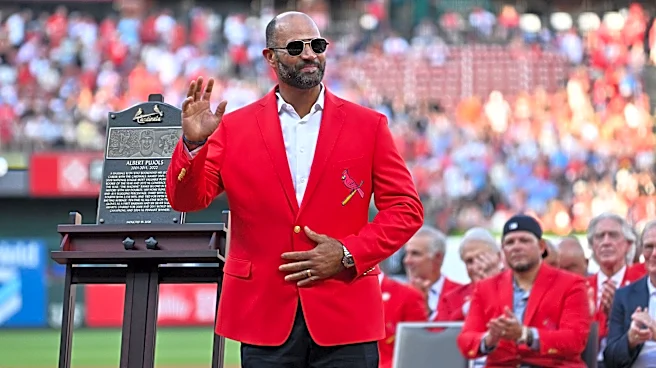


When Albert Pujols stepped into the batter’s box during his major league career, the game seemed to pause. Everybody wanted to watch, from his first season in 2001, when he hit 37 home runs, to his last, when he passed 700.
They wanted to watch AJ, his oldest son, too. AJ Pujols told his dad what that was like when he was around 13.
“Dad, I don't want to play baseball anymore,” he said.
“He didn't feel good having his friends and everybody else stopping the game and coming, watching him hit,” Pujols tells USA TODAY Sports. “And I felt that pressure. He was getting a lot of pressure, and I respect that. I wish he would have kept playing, because he was really good at it, but I was always a dad that didn't force sports on any of my kids. I support
them, whatever sport, they want to play.”
Pujols, 46, a father of five kids ranging from teenagers to their 20s, watched AJ become a college golfer, while his daughter, Sophia, is a gymnast for UC Davis.
“I'm just a big supporter,” he says of his kids’ sports. “Anytime I get an opportunity to be there and watch them play and not judge them at all, just try to help them out to be better.”

He has been retired since 2022. He splits time between New York and his native Santo Domingo, traveling with his wife, Nicole, and “doing the things that I wasn't able to do when I played for 23 years, because as you know, it's a busy schedule for nine months. And now I'm kind of my own boss, and I kind of make my own schedule.”
“I'm able to do a lot of things,” he says, “and as you see, that beautiful tan that I have, playing a lot of golf.”
Dressed in a sharp light aqua blue jacket and white collared shirt during our virtual interview, he spoke to us about his campaign with Cologuard to increase awareness about the importance of colorectal cancer screening and early detection.
He also spoke with us about his career and his mentors, where his desire stands to manage in the major leagues and how parents and their athletes can maintain a healthy lifestyle and relationship.
'Far from the truth': Pujols denies rumors of making big managerial demands
Pujols said he interviewed to be the manager of the Los Angeles Angels and San Diego Padres last offseason. The Angels went with Kurt Suzuki, the Padres with Craig Stammen, but Pujols says he came away feeling good about how both went.
“I think there's an opportunity that could happen at the end of the day,” he tells USA TODAY Sports. “It’s playoff time right now, so I think things are busy within the season, but I'm looking forward to seeing if I get any job out there. I think it was a learning experience for myself as well.”
The Seattle Mariners have a vacancy so far, while the Phillies have likely moved on from Don Mattingly, although Alex Cora appears to be his likely successor.
John Mozeliak, who was general manager and president of baseball operations, respectively, during Pujols’ two stints with the Cardinals, joined the Angels front office this year. According to The Athletic, Mozeliak hopes Suzuki will be back, but he said it’s not his decision with a new ownership group.
When Pujols fell short of the Angels job last season, news media reports surfaced that he made heavy contract demands of the team, and they resurfaced in September.
“I think both of the teams showed me really good interest,” he says, “and just, it wasn't my time. So the process went well. I enjoyed it. I know the rumors about what I was asking, which was far from the truth, (there) was never anything about that. If anything, it was really close and it was great interview. I mean, it happens.”
Pujols referenced his extended second interview with the Padres.
“I think the whole process with the interview went really, really well,” he says. “I'm a big believer that when your last interview, you interviewed for (hours) because they like what you brought to the table, and it just didn't happen, but I think what I took from there, it was just a great experience of preparing myself better.
“I think at the end of the day, just waiting to see when my name (is called), and if it comes, great, I mean, if it doesn't, I still want to be around being a voice for this great game that helped me out a lot.
“I took the big jump on managing. I did it in the Dominican Republic and it was really successful.”
During the winter of 2024, Pujols managed Leones del Escogido of the Dominican Republic to the Dominican League and Caribbean Series championship. He led the Dominican team to the semifinals of the World Baseball Classic.
We need to be able to lean on our family first, especially when we are kids
He has since taken a job as team president for the Estrellas Orientales, another Dominican winter league team. He says that as athletes, and as adults and parents, we are constantly learning.
“When I got into the country, I didn't know English that well, so it was hard going to school,” he says. “My cousin took a lot of the classes with me to help me out, but when I want something, I go hard at it, until I get the best out of it, and I learned the language, I mean, I’m still learning up to now (he laughs) but it's something that was tough at that time.”
Pujols came to the United States at 16 and settled in Missouri. He says the transition wasn’t easy, but it was eased by the presence of relatives who came with him, especially his father and grandmother.
“I was around my family, who gave me the education and supported me every single game that I played,” he says.
The support started with his father, Bienvenido, whom he has said was one of the best softball pitchers in the Dominican Republic. Pujols followed him around from the time he was six, and his father saved him a seat at games.
“As a young player, my dad was my hero,” he says. “That's that person that I also look up to. And he was a great example for myself, especially growing up. And the reason why I fell in love with the game of baseball. My dad was somebody that inspired me, and helped me out to... I would say, to learn the game.”
Pujols remembers his father patiently hitting him grounders during a 20-minute break in between games.
“I think, sometime, you get parents (who) go to some of these games, and their kids didn't perform to their level that their parents were expecting,” he says. “And they get frustrated with the parent, and that's a big mistakes that we make sometimes as a dad, or as a mother, to yell at our kids (and) put a lot of pressure on them.”
Think of yourself being outside with your son or daughter, getting frustrated because they’re not quite doing what you want. When they are young, maybe they are being pushed into travel teams.
They are impressionable and still developing and figuring out what they like.
“At the end of the day, they need to do it because they love it instead of I'm doing it because my dad's forcing me, because that's the last thing that we want as a parent, have that guilt, that my son didn't want to play baseball,” he says. “Well, Albert Pujols decided, yes, because I'm a baseball player, you need to play. No, I didn't want to have guilt. I want my son to choose what he wants to do and support him.”
Pujols remembers taking the time to understand why AJ didn’t want to play baseball anymore, and listening to AJ’s reasoning. Pujols, during a 2019 episode of Graham Bensinger’s interview show, says he always told his kids to just be themselves.
“He’s still a dad, still my dad,” AJ told Bensinger for the episode. “Every night when he comes home from playing a game, he’s still the same dad. Throughout the failures, throughout the awards, nothing changes in his heart and he’s awesome. … He tells me to keep going, no matter how much I fail, no matter how much trouble I’m going through, he always helps me push to the end.
“On the golf course when I’m playing, I’ll play my rounds and I’ll call him right after. I’m like, ‘Dad, I just got off the course, I just shot 87. I never play like this. This is terrible.’ And he’ll call me, he’s like, ‘Buddy, there’s days where I go 0-or-4, 0-for-5, 0-for-6 with three strikeouts and I don’t get a hit and I’ll go in a slump. But do you ever see me back down? I’m always standing there, I’m always fighting, I’m always pushing.’ He always tells me to stand up and I’ve got it.”
Bryce Harper went deep about his mistake in rightfield and how he came back from it and how kids can learn from that, especially his son
— John Clark (@JClarkNBCS) September 30, 2026
“I'll tell you what, I was thinking about Krew, my son, what I would say to him in that situation. I think it's a learning situation not for…
'Choose your friends': You can often tell which teammates you can trust
Even when we are extremely talented and move up levels, we can enter spaces where others have more experience than us. We find teammates and coaches we need to lean on for support.
Pujols saw them in manager Tony La Russa, who was like a father to him, and he listed a number of teammates who helped him get comfortable in the major leagues: Darryl Kile, Jim Edmonds, Woody Williams, Mark McGuire, Placido Polanco. Jim Edmonds, Scott Rolen, Mike Matheny, J.D. Drew.
When you join a team, you can see who the leaders are by the ones who talk to the new guys, and not just the rising stars but the ones who are struggling.
“Choose your friends, who you have hanging around you,” Pujols says. “You always want to have people around you that are gonna bring great things to you and know, take you away (to) the place that you want to reach. And I was lucky enough and blessed, I guess, to have that wisdom, to see that right away.”
And at the end, when he hit home run No. 700 at Dodger Stadium in 2022, he found himself surrounded by his wife and kids. It’s a reminder that when we achieve sports success, or even fame, our families can also be the ones we look to for support when they are over and we move on to something else.
Check in on physical and mental health, for yourself and your kids
According to Pujols’ campaign with Cologuard, many people don’t know that screening for colon cancer is recommended for anyone 45 and older, while 60 million people either remain unscreened or are outdated on their screening.
He says he learned from the campaign that colon cancer is the nation’s No. 2 cancer-related killer.
“You can be in the best shape ever, and feel great about it, and there's no red flag(s) and (you’re) not feeling anything, and then, all of a sudden something comes along,” he says.
The theme is similar to how we can be with our kids. Have open communications with them about their health and well-being, in and out of sports, even I you think things are going well.
“I always say that we only have such a short window with our kids before we (send) them into the world, they go to college, and we don't control them anymore, and I think the goal was as a dad is that is that when the kids run into temptation, we help them out.
He says. “The discipline, hard work, day in and day out, separate the bad things from the good things.”
Steve Borelli, aka Coach Steve, has been an editor and writer with USA TODAY since 1999. He played baseball in high school, rowed in college and spent 10 years coaching his two sons’ baseball and basketball teams. He and his wife, Colleen, are now sports parents to a college and high school baseball player.For his past columns, click here
This article originally appeared on USA TODAY: Pujols talks managerial pursuit, kids sports in wide-ranging interview