






The 2026 winner of the 3M Young Scientist Challenge has been announced, and the winning project could change the world.
This year, contestants aged 11 to 14 used science to solve everyday problems, from smart utensils that detect allergens to tools that are designed to help drought-prone areas find better ways to water their crops. The final presentation took place on Oct. 13, at 3M's Innovation Center in St. Paul, Minnesota, according to information provided to USA TODAY.
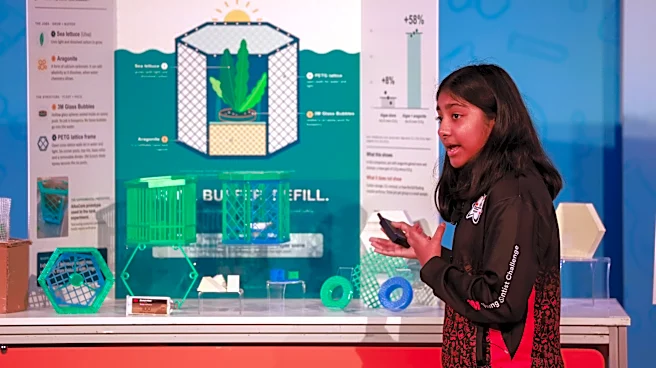
Raji Doshi, a 13-year-old eighth grader from Farmington, Connecticut, was announced as the winner during an award ceremony.
"The 3M Young Scientist Challenge brings together student curiosity, scientific thinking and 3M mentorship to turn promising ideas into real solutions,"
William Brown, 3M chairman and CEO, said in a statement. "3M is focused on helping these young innovators strengthen their ideas and apply science in ways that can make a meaningful impact."

What was the winning project?
Raji engineered a natural algae-and-aragonite system, an inventive solution to address ocean acidification by increasing alkalinity and removing carbon dioxide from seawater, 3M said in a statement.
3M's 'Young Scientist' finalists and their projects
The 10 "Young Scientist" finalists were a part of 3M's summer mentorship program. They earned a $1,000 cash prize for participating.
Here's a look at the full list of 3M's "Young Scientist" finalists:
- Ahmed Abdelsalam, Cambridge, Massachusetts
- Developed VERDA, a technology focused on harnessing energy from people walking, wind, and waves to find a more sustainable solution to powering our world.
- Aaisha Asif, Sarasota, Florida
- Worked on an eco-friendly adhesive inspired by mussels and made from natural proteins and iron-based cross-linkers, which "creates strong bonds while reducing pollution."
- Raji Doshi, Farmington, Connecticut
- Created a coastal solution that lowers ocean acidity and improves marine health using algae and calcium buffers.
- Aiden Jo, Houston
- Invented an origami-inspired solution to waste. His Squeeze-gami can completely flatten and reduce waste while improving sustainable packaging.
- Roy Kim, Beaverton, Oregon
- Created a device that turns the moisture in the air into water. The device's goal is to give farmers a sustainable source of water in drought-prone areas.
- Arika Kundu, Shorewood, Minnesota
- Designed a new approach to removing pesticides from produce by using agricultural waste like peanut shells.
- Sharvi Mahajan, San Diego
- Created an advanced system called NeuroDrive Alert, which can track fatigue to "enhance safety in driving and other high-risk fields."
- Millie Pradawong, Fairfax, Virginia
- Designed a tool that can predict how gene editing can "redirect microalgae metabolism to produce more biofuel while balancing growth and efficiency."
- Naboshree Santra, Oviedo, Florida
- Created a solution for drought-affected agriculture. The soilshade ball can reduce the amount of water that evaporates from soil and help it retain moisture.
- Abigail Stein, Nashville
- Created the Allergy Spoon, a smart device that can detect allergens in food. The utensil will change color if it detects an allergen and "help prevent life-threatening allergic reactions."
Finalists were enrolled in a summer mentorship program, where they developed a project prototype alongside a 3M scientist. After months of work, students presented their projects during their final presentations on Oct. 13.
What does the winner receive?
Raji will receive the grand prize of $25,000, a contest trophy, and the title of "America's Top Young Scientist 2026," according to 3M's website. But finalists will not go home empty-handed.
All 10 finalists, including the winner, received the following, according to 3M:
- $1,000.
- Enrolled in a summer mentorship with a 3M scientist.
- A trip to the final event for the student and one parent or guardian.
- A contest medal.
Finalists will also be invited to join the 3M Young Scientist Challenge Alumni Network. The network connects finalists and mentors with others who have participated in the challenge throughout its nearly two decades.
Additionally, 51 State Merit Winners are awarded, and one person per grade receives an honorable mention.
What is 3M's 'Young Scientist Challenge'?
The 3M Company, which creates products and systems used across multiple industries, including automotive, electronics, and more, hosts the annual competition in partnership with Discovery Education.
Middle school students from across the country enter for a chance to compete and later win 3M's "Young Scientist Challenge," the nation's top-tier middle school science competition. The competition began in 2008, and students have worked to solve issues they faced over the years.
According to a 3M news release, the challenge tasks the nation's best and brightest with developing an original, unique solution to an everyday problem. Students can submit proposals under any of the following categories: robotics, home improvement, automotive, safety, AR/VR, and climate technology.
"At 3M, we are all about finding amazing people who bring innovation and creativity to producing products that really change lives, tackling hard problems and changing and improving people's lives," Clarke said. "This competition is the epitome of it."
How can children enter the 2027 3M Young Scientist Challenge?
To enter next year's challenge, middle school students must submit a short presentation about an everyday problem and their proposed solution. Video entries should be one to two minutes long.
According to 3M, a panel of experts then judges the entry based on the following metrics:
- Creativity.
- Scientific knowledge.
- Persuasiveness and effective communication.
- Overall presentation.
Students interested in participating in the 2026 "Young Scientist Challenge" could submit video entries from Jan. 7 through April 30. The competition then selected 10 finalists and state merit winners.
Who won in 2025?
Kevin Tang, an eighth-grade student at Cedarlane Academy in Hacienda Heights, California, won the 2025 Young Scientist Challenge.
With help from mentor Mark Gilbertson, a 3M senior robotics and automation engineer, Tang created "FallGuard," a fall detection system that can "accelerate emergency responses to falls among older adults at home, even in the dark."
With an algorithm that analyzes video input, Tang's device identifies falls and alerts loved ones using a smartphone app. FallGuard can also detect irregular walking movements, which could be a symptom of a stroke.
Tang's "new solution advances current offerings on the market through the ability to capture imagery at night and provide around-the-clock monitoring," 3M said in a 2025 statement.
Julia Gomez is a Trending reporter for USA TODAY and covers space phenomena, scientific studies and natural disasters. Connect with her on LinkedIn, X, Instagram, and TikTok: @juliamariegz, or email her at jgomez@gannett.com
This article originally appeared on USA TODAY: Meet 'America's Top Young Scientist' for 2026 and her winning idea