


Arizona's incumbent Democratic Gov. Katie Hobbs was poised to defeat her Republican challenger, Rep. Andy Biggs, according to race calls and projections by Decision Desk HQ and CBS News.
The networks called the race about 8:30 p.m. local time, shortly after the first round of statewide election results were reported.
Hobbs' projected victory will give her a second term in the Governor’s Office after she ran on a pledge of pragmatism and appealed to voters who favor bipartisanship. Her commitment was exemplified in her choice of running mate: former Republican mayor of Mesa John Giles, who now is not affiliated with either major political party.
For the first time, Arizonans voted for a gubernatorial ticket and chose a lieutenant governor to be the state's
second-in-command. That running mate would step in if the governor cannot finish their four-year term that begins in January. Giles is projected to be that Arizona first.
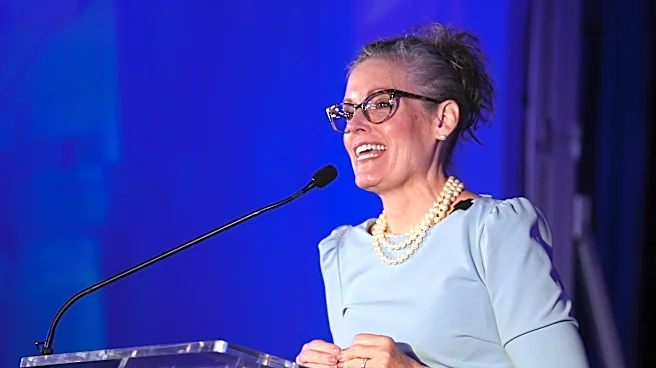
Hobbs and Giles briefly spoke to supporters at the Arizona Democratic Party’s election night event at a Phoenix resort before the first results were reported and the race was called.
“We might have to be a little bit patient,” Giles told the crowd, foreshadowing what could be a long night counting votes. “Every vote matters, every vote counts,” he said.
But within an hour, early results put Hobbs decisively out front of Biggs and positioned her to extend a 60-year streak in which no incumbent Arizona governor has lost reelection.
Democrats' mood grew jubilant as the hours passed, with the crowd erupting in cheers when results indicated Democrats could control the Arizona Capitol for the first time since the 1960s, with a Democrat in the Governor's Office. Hobbs and Giles did not return to the stage to address the results.
Arizona Democratic Party Chair Charlene Fernandez told The Arizona Republic that Hobbs' win was solid, and the result of shoe leather crisscrossing the state to speak to Arizonans about her record implementing policies like erasing medical debt. Fernandez, a former state lawmaker who has worked in local, state and federal politics in Arizona for decades, said she never thought a race would be called so quickly for a Democratic governor.
“But I had faith in our voters, and they knew when enough was enough," she said.
Across town, at his own event at a Chandler restaurant, Biggs addressed his supporters just before 9 p.m.
“We have been tracking early results as they come in — they are not good for us,” Biggs told a crowd of more than a hundred people.
“The reality is we’ve got a tough hill to climb,” he said. “We will never lie to you.”
The race included two other third-party candidates who have failed to gain the funding or traction of the major party nominees, but who could draw votes from either Hobbs or Biggs in a close race. In the earliest results, neither third-party candidate appeared headed for an upset victory.
The election results are unofficial until county and state officials have certified them. Certification must be done by Nov. 23.
How the Arizona governor's race was run
The race to Nov. 3 saw the state inundated with attack advertising as Hobbs defended her seat in the Governor's Office. She was considered Democrats' most vulnerable incumbent governor nationwide, leading outside political groups to pour tens of millions of dollars into the race.
Arizonans have not given a Democratic governor a second term since the 2006 election of Gov. Janet Napolitano, and the basic math of elections was not in Hobbs' favor. Republican voters outnumber Democrats by almost 300,000, though independents are the largest voting bloc in the state.
But the national environment and President Donald Trump's cratering approval ratings were factors Hobbs hoped would propel her to victory. Every Arizona pollster who surveyed the race in the weeks prior to Nov. 3 projected a Hobbs victory, largely due to Trump's drag on his own party.
Hobbs often reminded voters how closely Biggs aligned with Trump, highlighting his votes in favor of Trump's tariffs and against ending the war in Iran. Biggs secured the endorsement of his party's patriarch and bragged to the base about being able to get the president on the phone, assets that helped him win the GOP nomination for governor in July with more than 70% of the vote.
Both Biggs and Hobbs pledged to address voters' affordability woes if elected. Biggs, a libertarian-leaning conservative, wanted to eliminate the state's lowest-in-the-nation personal income tax and root out waste, fraud and abuse in government programs. Hobbs, who declined an interview request to discuss her plans in detail, instead ran on her record from her first term.
Voters elected her to the Governor's Office in 2022 by less than 1 percentage point. She defeated Republican former news anchor Kari Lake in a cycle when voters statewide rejected GOP candidates closely aligned with Trump's false claims he won the White House in 2020.
Hobbs and her Democratic allies sought to tether Biggs to Lake and highlighted Biggs' embrace of those false claims from six years ago, though Biggs tried to shift focus beyond what could be heavy electoral baggage.
Hobbs had been Arizona's secretary of state for four years before she was elected governor, and spent eight years as a state lawmaker before that. Several of her years in the Arizona Senate overlapped with Biggs, who was a lawmaker and Senate president until 2016 when he was elected to represent the 5th Congressional District in the southeast Valley suburbs.
Much of Biggs' time at the Arizona Capitol, where he opposed Medicaid expansion and proposed slashing enrollment to less than one-tenth of its size, was featured in attacks from Hobbs' campaign. Seemingly nonstop television commercials blasted Biggs for standing in the way of a bill to take over policing in Colorado City, home to a polygamous cult, and for flipflopping on whether to release government files related to disgraced financier Jeffrey Epstein.
While Hobbs has won statewide twice before, Biggs sought to translate easy wins in his reliably red congressional district into a message that would appeal across the state. He blasted Hobbs for a scandal that has plagued her administration involving a child welfare contractor that got a special pay increase worth millions after donating to her political groups in 2022 and 2023 and criticized her for refusing to debate.
He said he would sign many of the more than 500 bills Hobbs vetoed in four years while Republicans controlled the Legislature.
Biggs chose former state Sen. Sine Kerr, a farmer from Buckeye and Trump administration agriculture official, to be his choice for lieutenant governor and take up the mantle of appealing to rural Arizona.
Hobbs' campaign spent $17.8 million through the end of September, the most recent reporting date. The sum is likely to grow as reports for the final campaign push become publicly available. Biggs' campaign spent over $5 million at the end of September, a much smaller sum attributable to his lethargic fundraising compared to Hobbs' haul.
The massive fundraising machine powering Hobbs' campaign allowed her to run largely on the airwaves, leaving Biggs to try to earn attention through news interviews and events.
The race included two other longshot candidates who were polling in the low single digits.
They were Arizona Green Party nominee Risa Lombardo, whose bid was best known for allegations she was a sham candidate and an investigation over how she qualified for public campaign funding. No Labels candidate Teri Hourihan, a licensed professional counselor, spent just over $50,000 on her campaign — but still was able to beat a well-funded health care executive in the July primary.
Reporter Robert Anglen contributed to this story.
Stacey Barchenger covers state politics. Reach her at stacey.barchenger@arizonarepublic.com or 480-416-5669.
This article originally appeared on Arizona Republic: Katie Hobbs projected to win second term as Arizona governor