



Ready for a warmer, wetter winter?
The very strong El Niño is forecast to be the main driver of weather across the United States this winter, forecasters from the National Oceanic and Atmospheric Administration's Climate Prediction Center said Oct. 15 in their annual winter outlook.
So what does this mean for our weather?
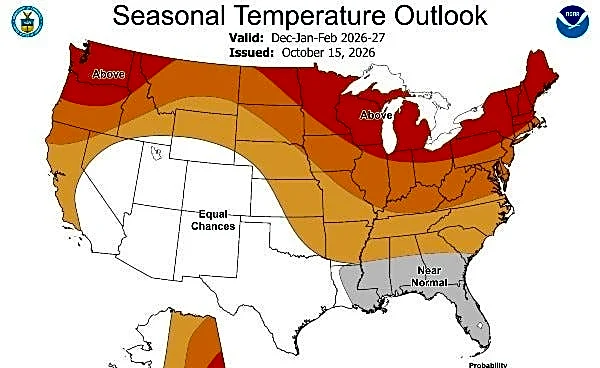
Basically the two main headlines in the winter forecast are unusual warmth across the nation's northern tier, and ongoing storminess across the southern tier.
“As we know from decades of observations, a very strong El Niño will likely bring a southward and eastward shift to the jet stream for the contiguous U.S., which tilts the odds toward stormier weather across the South,” said Ken Graham, director of NOAA’s National Weather
Service, in a statement.
“While higher chances of rain and snow may bring relief to drought-afflicted areas, too much precipitation on dry soil can fuel destructive flash floods and mudslides. Now is the time for communities and individuals to plan ahead for the upcoming winter," he added.
The center's forecast covers the months of December 2026, January 2027 and February 2027, which is known as meteorological winter.

Where will it be colder-than-normal in winter 2026-2027?
No part of the United States is forecast to see a colder-than-normal winter. The Deep South and Florida are forecast to see a near-normal winter, temperature wise, while the Southwest has equal chances of seeing above or below normal temperatures this winter, the Climate Prediction Center said.
Where will it be warmer-than-normal in winter 2026-2027?
Much of the nation's northern tier should see a warmer-than-normal winter. The greatest likelihood for above-normal temperatures include the Pacific Northwest, the Great Lakes states, and New England.

Snow forecast unclear, but NOAA predicts precipitation
Overall, the CPC said that wetter-than-average conditions are most likely across the southern tier, from the Southwest to the Southeast, and along the East Coast.
Only the northern Rockies and the northern Great Lakes are expected to see a drier-than-normal winter, the CPC said.
The forecast released Oct. 15 predicts only where above- or below-normal temperatures and above- or below-normal precipitation are most likely.
This winter forecast does not specify how much precipitation will fall as rain, snow or ice, only that more or less is likely overall. Snow forecasts depend upon the strength and track of winter storms, which generally cannot be predicted more than a week in advance, the center has said.
What about the polar vortex?
With the powerful El Niño, NOAA's Jon Gottschalk said that tends to bring about a stronger, more stable polar vortex. This would favor less Arctic air outbreaks over the United States, he said.
However, he added that cold outbreaks and snowstorms are still possible, but just less likely.
Drought update
According to the forecast, drought conditions are forecast to improve or end in the Southwest, Southern Great Plains, Southeast and parts of the East Coast.
However, drought conditions are favored to develop or worsen across parts of the northern Rockies, along with northeastern Oregon and eastern Washington.
What do other winter forecasts say?
AccuWeather also released its winter forecast earlier in October, and the private forecaster also predicts that the powerful El Niño will dominate the 2026-27 winter, bringing a wetter, stormier pattern to much of the southern United States and West, while much of the northern tier sees a warmer winter with less snow than normal.
Doyle Rice is a national correspondent for USA TODAY, with a focus on weather and climate.
This article originally appeared on USA TODAY: Official winter weather forecast released. How cold will it be?