



I am obsessed with Elizabeth Holmes.
Not because I care about her health technology company, Theranos, which falsely promised to revolutionize blood testing by drastically decreasing the amount of blood needed to just a finger prick.
Nor am I fascinated by her defrauding investors out of hundreds of millions of dollars, a con that got her sentenced to more than 11 years in 2022. It’s been reduced several times since
.My curiosity about Holmes has more to do with her artifice. She's a character unto herself – one that's inspired a national best-selling book, an award-winning television miniseries and now a three-hour documentary out Oct. 16. “You Can See Everything,” by creative genius Nathan Fielder and "Primetime" director Lance Oppenheim, has already
been deemed a "masterpiece" by critics.

"Why would I deceive you?" Holmes asks Fielder during an unsettling staring match in the documentary's initial teaser. She never breaks her piercing blue-eyed gaze. Her smirk never slips. She’s ever-committed to the bit – if it can even be called that at this point.
Holmes' pageantry – the media fanfare that bolstered her climb, the persona she donned during her short reign and her unyielding delusion on the way down – is what makes her such a sticky figure in popular culture.
The key to becoming Elizabeth Holmes
Filmed over a period of 34 days before Holmes surrendered to federal prison in 2023, "You Can See Everything" is the latest installment of Hollywood films that take aim at tech billionaires. What's most fascinating about Holmes is her refusal to acknowledge her deception. During her trial in 2021, she admitted to making mistakes as CEO and expressed some remorse, but denied trying to conceal that her company's blood-testing methods didn’t work as promised.
Even Fielder was almost caught in her lies.
"When I met her, I remember having this weird experience where she seems so genuine at times. But then I'm like, 'No,' and clocking and tracking my thoughts and being like, 'OK, I know she's a liar,'" Fielder said recently at the New York Film Festival. "It was a weird mental thing."
Holmes' knack for deception was key to her billion dollar success. She employed this skill to architect an optimized version of herself for her employees, investors and the public.
Holmes represents a particular faction of the American dream where an Ivy League dropout could invent a piece of world-shattering technology. Apple CEO Steve Jobs actually did it. In fact, Holmes modeled much of her CEO persona after Jobs, down to the black turtlenecks.
Her CEO character also donned a deeper voice in an attempt to be taken more seriously as a woman in Silicon Valley. In reality, the cartoonishly lowered voice just made her look goofy. Holmes’ fake-it-till-you-make-it ethos inspired not one but two actresses to play her on TV: Amanda Seyfried, who won an Emmy for her portrayal in “The Dropout,” and Jennifer Lawrence in “Bad Blood,” an Apple Original Films project that was never made.
Lawrence cites Seyfried's pitch-perfect performance as her reason for backing out: “I thought she was terrific. I was like, ‘Yeah, we don’t need to redo that.’ She did it.”
Holmes' con is still running – long after Theranos was found out
The unsavory part of Holmes' representation of the American dream comes as a result of her blind ambition. On the surface, the Theranos scheme seems like any other failed Silicon Valley venture.
What makes it so uniquely nefarious is that it involved real patients with real terminal illnesses. Holmes was able to showcase a product that “worked” by having patients submit real blood samples through her machine, the Edison, and get results from an alternative machine that wasn’t the Theranos model. When her machine was in use in many pharmacies throughout the country, they often gave false results.
One woman testified that she was given a false miscarriage diagnosis. Another woman, a breast cancer survivor, was falsely diagnosed with a recurrent tumor.

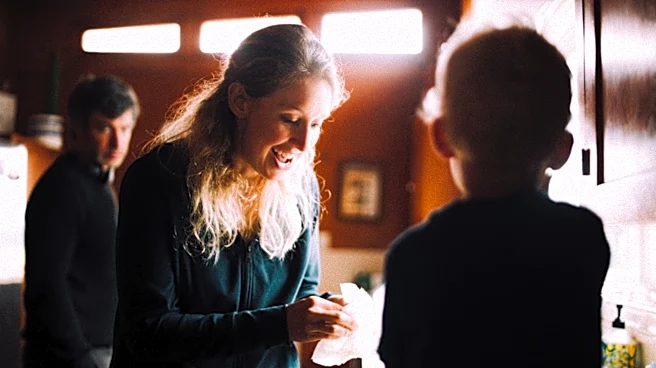
Even after it all came crashing down, Holmes still clawed at any opportunity for notoriety. She tried to rehabilitate her image in a 2023 New York Times profile before heading to prison. She dropped the Steve Jobs facsimile for a new persona – a devoted mother named Liz (she dropped the voice, too).
Even now, as seen in the “You Can See Everything” trailer, she clings to this new character still. It’s almost like watching a horrific car crash you can't divert your eyes from. But, in this case, it's a woman who ardently refuses to acknowledge her wrongs. It's almost admirable she’s held this artifice for so long.
If somewhere, deep within herself, she knows that what she did was wrong, dangerous and nearly deadly, her refusal to admit it publicly makes this one of the longest cons in pop culture. If she truly believes her proclaimed innocence, that lack of self-awareness is baffling.
Whatever the truth, or her truth, is, Holmes is certainly an interesting character to analyze. She's lied to herself and us for so long that she's completely obfuscated reality.
I even felt myself almost tricked by the trailer.
Kofi Mframa is an entertainment and culture columnist at USA TODAY.
This article originally appeared on USA TODAY: 'You Can See Everything' shows Holmes stays committed to the bit | Opinion