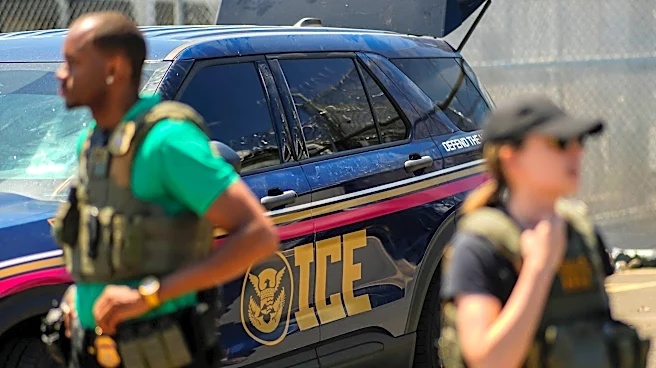

U.S. Immigration and Customs Enforcement plans to hold immigrants in locked vans – with no stated time limit – so its officers can remain in the field and detain more people, according to government contracting
documents that describe the vehicles as "mobile detention facilities."
Under the proposal, armed contractors would be assigned to ICE officers conducting operations across Pennsylvania and Delaware. Those contractors would wait at staging sites nearby. People taken into custody would be held in their vans until they are full or until ICE operations in the area have ended.
In Pittsburgh, where the agency wants to establish a new transportation hub, the documents say, ICE deportation officers are "better utilized as a force multiplier in the field to make more arrests."
The plans do not say how long detainees could remain inside the vans. They also do not explain when they would receive food, water or medical screening, how they would use a bathroom or whether they could contact their families or attorneys.
ICE has not disclosed how much the proposal would cost taxpayers. The broader solicitation asks companies to submit bids for the work. No contract award had been posted as of Sept. 29.
DHS declined to comment on the proposal, citing "operational security."
ICE has long used vans and buses to move detainees between facilities, collect them from local jails and transport them to airports or court hearings. But three former ICE officials and detention experts told USA TODAY they had not seen the agency propose using vehicles this way, essentially as holding cells on wheels.
"The only reason you need a mobile kind of support center like this is if you are trying to go catch as many as you possibly can at once," said John Sandweg, who served as ICE’s acting director and the Department of Homeland Security’s acting general counsel during the Obama administration. "It's about volume."

The documents offer a glimpse into how the Trump administration’s push for mass deportations has shifted ICE’s priorities. Former agency officials said ICE has moved away from operations focused on specific targets and increasingly turned to traffic stops and broader sweeps, leaving officers with less discretion over whom to take into custody.
That shift has unfolded during record-breaking months for ICE arrests, per agency figures. As of July 11, 70.6% of people in ICE detention had no criminal convictions, according to data compiled by the Transactional Records Access Clearinghouse at Syracuse University.
Meanwhile, the van proposal has alarmed detention experts, who said it would create an ill-defined period of confinement without clear rules for how long people could be kept inside, what care they would receive or how others could find them.
"It’s a humanitarian disaster in the making," said Eunice Cho, an immigration detention expert who previously served as a senior counsel with the American Civil Liberties Union.
The new plans
The phrase “mobile detention facility” appears in a three-page attachment buried among hundreds of pages describing ICE’s plans for four privately run detention centers in Pennsylvania, Colorado, Florida and Washington.
The document, first disclosed by the watchdog group Project Salt Box, is part of a much broader effort to build the infrastructure for the Trump administration’s mass deportation campaign. Congress has given ICE $75 billion for that work, including $45 billion to expand detention, $14.4 billion for transportation and removal operations and $250 million to upgrade its vehicle and aircraft fleet.
The "mobile detention" plans, said Sandweg, reflect an agency with more money than it has ever had to expand its operations.
"They are so flush with cash, they don't know how to spend it all," he said. "So they're spending money on stuff that never would have been spent on."
In Pennsylvania and Delaware, ICE wants 12 additional "enhanced transportation" teams operating every day: three based in Philadelphia, three in York, two in Pittsburgh, two in Dover and one each in Williamsport and Pike County.
The requirements are detailed about the vehicles and the people who would be hired to operate them. Each transport would require at least two qualified contract officers, who would be armed. The vans would have locked doors and windows, security barriers and wire cages or acrylic panels separating the front and rear compartments.
The documents also contemplate the possibility of long days. If an assignment stretches beyond a contractor’s 12-hour shift, ICE would pay for lodging, meals and overtime.
For detainees, however, the rules are far less specific.
The only explicit time limit appears in a provision about buses, with women generally prohibited from being transported for more than 10 hours except during emergencies. There is no comparable limit for men, and the provision does not apply to vans.
The principal instruction for their treatment appears among a list of motor vehicle regulations, alongside requirements that officers wear seat belts and drive defensively: Detainees must be transported "in a safe and humane manner," the document states.
The contract is moving on an expedited timeline. ICE gave companies until Sept. 4 to submit questions and initially set a Sept. 11 deadline for first-round proposals, later extending it to Sept. 14. Second-round proposals were expected around Sept. 18.
A shift in enforcement
For Claire Trickler-McNulty, who held senior roles at ICE under the Biden and Trump administrations, the vehicles are familiar. The agency has long hired contractors to collect detainees from local jails, move them between facilities and take them to airports for deportation flights. It has also brought buses and vans to workplace raids where officers expected to encounter many people in a single location, she said. What she had not seen was ICE planning to deploy them every day alongside officers making arrests in communities.
“The change in the operational tempo would make this more necessary or more helpful than it ever was before,” Trickler-McNulty said.
Sandweg said the older model was slower − and rarely required vans − because it began with a decision about whom ICE should pursue.
Officers could spend weeks tracking down a single person, searching court and immigration records, checking addresses and following leads that sometimes went nowhere. The work was deliberate, he said, in part because the people considered the highest priority could also be the hardest to find.
“You know exactly who you’re going after,” Sandweg said. Officers knew a person’s immigration history before they left the office and could prepare for the risks they might encounter. “Once we get that person into custody, mission accomplished,” he said.
Sandweg said the focus on producing higher numbers does not necessarily make the public safer. The more time officers spend pursuing whoever they can readily detain, he said, the less time they have to identify and locate people who may pose a genuine threat.
"The tactics that ICE is currently utilizing are not designed to get the worst of the worst," he said. "They are designed to get as many immigrants as possible."
'Untested territory'
Cho said the proposal pushes ICE into largely untested territory, in part because it is unclear what rules would govern people held inside the vans.
ICE has long had standards governing the transportation of detainees between facilities, including requirements for food and water on longer trips and protections for people with medical needs and other vulnerable detainees. Holding cells come with their own safeguards. But the new proposal envisions something different: vehicles that could double as detention space while agents continue making arrests, potentially for hours at a time.
“This is a total gray area,” Cho said. “As far as I can tell, the government has not tried to do this in the past.”
The documents leave some of the most basic details unresolved, Cho said. ICE’s existing transportation standards, by contrast, contemplate meals on trips lasting more than six hours and procedures for detainees with medical or other special needs.
The vans could also make detainees considerably harder to find. Unlike a holding cell or detention center, a vehicle could move throughout an enforcement operation, leaving attorneys and relatives uncertain where someone in ICE custody actually is − and potentially complicating legal challenges for which a detainee’s location matters, she said.
That concern comes as ICE has already made it harder to track thousands of people in its custody. On Sept. 15, the agency stopped displaying detainees with final removal orders in its public online locator system, the Associated Press reported. The change, which ICE did not publicly announce, has left attorneys and relatives unable to use the system to determine where many of those detainees are being held.
“If they're kind of incommunicado in a vehicle ... how is anyone supposed to be able to locate them?” Cho said.
Knowing where a client is being held can be critical, she added, because location can determine where an attorney files a habeas petition challenging the detention.
To Cho, the larger problem is that ICE appears to be creating a form of detention that does not fit neatly within the rules developed for either transportation or confinement.
“This certainly seems like a new way for ICE to try to test the boundaries of what is permissible,” she added.
This article originally appeared on USA TODAY: ICE is planning to turn vans into 'mobile detention facilities'