




Flag football is much different from the football played by the NFL on Sundays and by college teams on Saturdays. There’s no tackling, there’s less people on the field and the game is quicker.
Despite these differences, as flag football has skyrocketed in popularity, it has often been played with the same pigskin as the traditional version of the sport.
Now, Wilson is changing that.
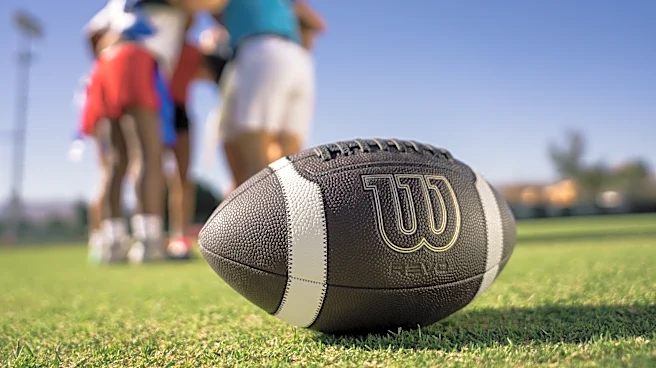
The sporting goods company announced the introduction of REVO earlier this month, the first ball engineered specifically for flag football. Wilson has already agreed to a partnership with International Federation of American Football (IFAF) and this ball will be the one used by players when flag football makes its Olympic debut in the 2028 Summer Games in Los Angeles.
Men and women will both use the same REVO ball.
Christopher Rickert, the senior director of global product at Wilson, told USA TODAY Sports that development for the REVO ball started more than four years ago.
“If we look at emerging sports over the last 30 years — whether it's beach volleyball or 3x3 basketball — the commonality between all of that is that they took a traditional product and they tweaked the ball based on the style of play of those competitions, so we kind of had that same philosophy when we started looking at flag football,” Rickert said. “We don't want to reinvent the football. We want to make subtle tweaks to your traditional football that really highlights the uniqueness of flag football.”
Rickert’s team at Wilson brought prototypes of REVO to the World Flag Football Championships in Finland two years ago, testing balls and getting feedback from men and women from all 32 teams that participated. After perfecting some tweaks, Wilson flew in six male quarterbacks from the top nations in the world earlier this year to test the final product.
“Going through that workout with them, we saw the quarterbacks increase spin rate, increase spiral efficiency. So, not only did they feel good throwing it, the data actually showed the purpose of the project. You can throw the ball tighter,” Rickert said. “This final product was truly built for the flag player and for their game, which is what they wanted. They didn't want to be little siblings of tackle.”

Wilson’s REVO has three noticeable differences from a traditional football.
The first is the size of the ball. Wilson’s team studied hand sizes for both men’s and women’s players of different demographics around the world to identify what would be the optimal size. The goal was to create a ball consistent and fair to players of all ages and genders. The REVO has a slightly smaller profile but weighs the same as a traditional football. However, that weight is rebalanced towards the middle of the ball.
“What that does — if you talk to our aerospace engineer — that's going to maximize the spin rate,” Rickert said. “So, you can spin the ball faster and it delivers passes to the targets in those tighter windows for that faster-paced game.”
Passes in flag football are much more similar to what traditional football fans might see in Bill Walsh’s West Coast offense rather than Mike Leach’s Air Raid attack. Quarterbacks typically get rid of the ball quickly, throwing to receivers running short routes like slants, drags and screens, rather than streaking bombs up the sidelines, long posts or deep outs. The average flag football pass is typically between seven to eight yards.
Rickert said women won’t feel much difference in the size of the ball, while for men, the ball will feel a bit smaller in their hands.
“They can throw it farther, make better catches, have a little more fun with it, and that's really what we want to explore in the game — fun, exciting plays,” Rickert said. “As we went through the testing, women picked it up right away, no problem. Men, there's that slight adjustment, needing a couple throws, and then in a matter of minutes they're used to it.”
The second difference are the large white stripes going around both ends of the ball in an effort to provide more grip points. Flag football often features laterals and reverse passes, meaning more than two players might touch the ball on any given play, or a non-quarterback might be throwing the ball.
“That was really driven by the style of play and the athlete feedback,” Rickert said. “You can't always find that perfect lace like you would in a tackle football environment. So, because of that nuance, you're able to feel that stripe, get the grip, make the pass, make the throw. So, visually, that will show a difference to your traditional football, but it's optimized to give you that grip.”
The final difference is Wilson used what it calls zero-proof leather to make the ball, meaning it’s ready to play with right out of the box. It’s a softer leather that requires no prep at all, immediately delivering a broken-in feel.
In addition to the 2028 Olympics, all international flag football events sanctioned by IFAF will be played with the REVO ball, including qualifying events for the Summer Games. Wilson is also working to introduce this ball to the NCAA and high school federations across the country.
Several Division I NCAA teams, including Nebraska and the Mid-Eastern Athletic Conference, will begin playing women’s flag football at the varsity level in the spring of 2027. By 2028, the sport could have its own NCAA tournament.
“The idea is, over the next one to two years, to transition everyone from your traditional Wilson football into the REVO model,” Rickert said. “We know with each league and federation, it's kind of an individual conversation of when that takes place, but the overarching goal is that when we look at the future of flag football, this is one defining ball for the game since it was purposely built for that.”
Wilson is also launching the REVO Speedskin Football made with price-sensitive material that matches the same size and weight of the leather edition. Under the REVO brand, Wilson is also releasing a full line of equipment and accessories for flag football.
Additionally, Ashlea Klam and Diana Flores have joined Wilson as its Global Flag Ambassadors. Klam is a center and defensive back for Team USA, while Flores is the quarterback and captain for Mexico.
As flag football’s rise continues, expect Wilson to be right there for every step of the climb.
This article originally appeared on USA TODAY: Designed for flag football, Wilson's REVO to be used at 2028 Olympics