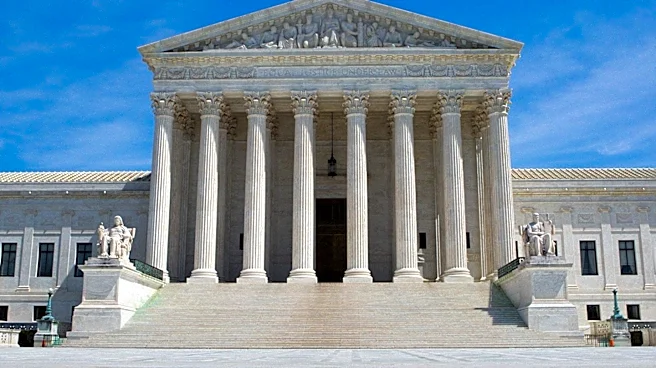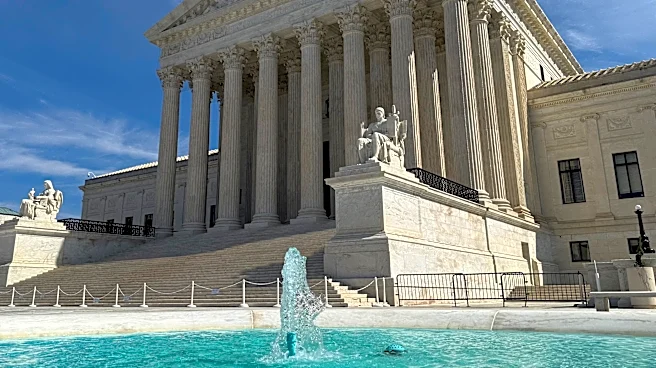





WASHINGTON – The Supreme Court sounds likely to rule against a federal prisoner who alleges he was denied proper medical treatment in a case that tests the ability to take federal officers to court.
Depending on how the justices decide the case they debated on Nov. 9, the already limited ability to seek damages from a federal employee for violating someone’s constitutional rights could be further curtailed – or blocked entirely.
The case has taken on special significance amid calls for holding Immigration and Customs Enforcement agents and others accountable for actions like the fatal shootings of Renee Nicole Good and Alex Pretti in Minneapolis.
But it centers on an inmate’s $3 million suit against a nurse at a federal prison.
Kekai Watanabe, the
inmate at the center of the current case, said he should have been hospitalized or seen a specialist after being attacked during a gang-related fight at a federal prison in Honolulu in 2021. Instead, he was given over-the-counter pain medication and told to “stop being a cry baby,” Watanabe alleges.
An X-ray taken months later showed that he had a fractured coccyx and that bone chips had migrated to surrounding soft-tissue areas. He did not receive further treatment before being released in 2024.
An appeals court said Watanabe’s claim is identical to a 1980 Supreme Court decision in which the high court said federal prison staff had violated the Eighth Amendment’s ban on cruel and unusual punishment when it failed to respond appropriately to a prisoner’s fatal asthmatic attack.
The Justice Department, however, argues that the 1980 decision is now “obsolete” because of more recent Supreme Court rulings limiting its reach.
Attorneys for the prison nurse said the justices should go further and also get rid of a 1971 decision that underpinned the 1980 ruling. In Bivens v. Six Unknown Named Agents, the court said federal officers can be sued for monetary damages.
That decision is criticized by conservatives who think the then-liberal Supreme Court used it to grant rights that aren't spelled out in the Constitution.
“Congress is really supposed to be making all of these damages remedies decisions,” Lucas Walker, the attorney representing the prison nurse, told the 6-3 conservative court.

Walker said the justices would send a confusing message if they stopped allowing claims from federal prisoners but didn’t also overrule the 1971 decision.
“On the other hand,” Chief Justice John Roberts said, “it could be viewed as a cautious, incremental approach to such a fundamental question.”
Several justices probed why prisoners can’t use other available remedies, including the Federal Tort Claims Act, which allows suits for monetary damages against the United States.
Joshua Wesneski, the attorney representing Watanabe, said there are practical challenges to prisoners using the FTCA. He also said the fact that prison officials know they could be held personally accountable for their actions plays an important deterrent role.
“Prisoners have been long understood as uniquely vulnerable,” Wesneski said. “If we’re going to hold up deterrence up in any place, I think it has to be in this context where we know these individuals are uniquely susceptible to constitutional violations.”
Justice Brett Kavanaugh wondered why Congress hasn’t passed legislation making it explicit that people can or can't sue federal officers.
Vivek Surki, an attorney with the Justice Department, said lawmakers may not have had sufficient votes to act.
“Congress has a responsibility to make the tough choices about what types of damages actions are to be available, both in prisons and in other contexts,” Surki said. “And if Congress is abdicating that responsibility to the judiciary, that’s the reason for the court to course correct.”
Justice Elena Kagan asked Surki whether the Justice Department is essentially asking the court to dare Congress to pass a law by overturning its past decisions.
Surki said he can’t discuss the department’s internal deliberations “about what Congress might or might now do.” But the fact that Congress has the ability to pass a law is not sufficient reason for the court to sit on its hands, he said.
A decision in Nielsen v. Watanabe is expected by the end of June.
This article originally appeared on USA TODAY: Supreme Court sounds ready to further limit prisoner lawsuits