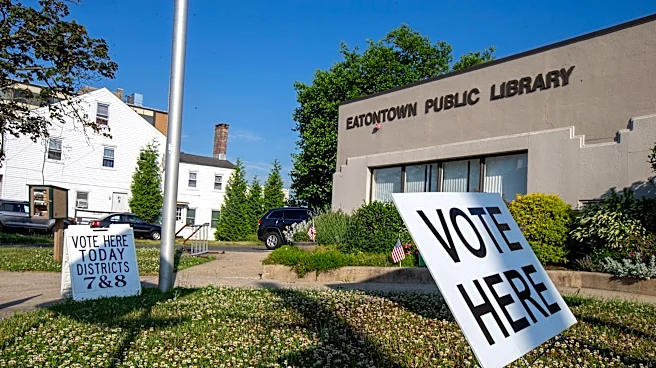






If you own stocks, you might be wondering whether the impending midterm elections will be good or bad for the stock market.
Does the market flourish after Election Day? Do traders care if a unified government becomes divided, or if one party remains in control?
The answer to both, apparently, is yes.
Morningstar examined 100 years of U.S. stock returns in election months and found that elections tend to boost the market.
Since 1926, Morningstar found, stocks have done better in November in election years than in non-election years. In the average election-year November, stocks have risen by 2.4%. In the average non-election-year November, stocks have risen by only 0.9%.
“It seems like there is such a thing as a post-election pop,” said Dan Lefkovitz,
a strategist for Morningstar Indexes and author of the Oct. 21 report.
November is a good month for stocks, period, Lefkovitz said. It’s a time of rising consumer spending with the holidays around the corner.

Why do stocks rise in election months?
The data doesn’t tell us why stocks do better in November in election years, but researchers have a theory: Elections bring closure.
“Markets hate uncertainty,” Lefkovitz said. “So, getting past the election puts an end to uncertainty. It allows markets to move on.”
The two worst election months for the stock market came in 2000 and 1948, Morningstar found.
In 2000, uncertainty lingered for many days after a presidential election that was too close to call. The 1948 election was close enough to yield the infamous “Dewey Defeats Truman” headline, rattling markets.
If those scenarios provide any guidance, Lefkovitz said, it’s that the stock market likes elections with clear winners.
Here's how the market performs before and after elections
Several other financial firms have weighed in with analyses of how stocks perform before, during and after federal elections.
A report from BlackRock finds that annual stock market returns tend to be weaker in midterm years. Over the past century, stocks have risen 7.5% in midterm years and 12.4% in non-midterm years, on average, the analysis found.
If that’s the rule, this year could prove an exception. The S&P 500 is up about 12% in 2026, as of Oct. 29.
A report from Fidelity finds that stocks tend to do well in the 12 months after a midterm. Since 1950, the S&P has gained just 4.9% in the 12 months leading up to midterms, but 14.5% in the 12 months after, on average.
Motley Fool reports similar findings.
“The biggest thing we see post-election is, we go from talking about what might happen to talking about what happened,” said Lou Whiteman, contributing stock analyst at Motley Fool. “It’s the uncertainty, or not knowing what the future holds, that tends to give traders the creeps.”
Do stocks do better under a unified or divided government?
One big question hovering over the 2026 midterms is whether the election will yield a unified or divided federal government. Polls generally predict the Republicans will lose control of at least one chamber of Congress. Republicans now hold both the executive and legislative branches.
Which is better for the stock market, a divided or unified government? Morningstar examined that question as well.
The analysis found that stocks have performed better under a unified federal government over the past century, with average past gains of 1.2% a month, compared with 0.7% a month under a divided government.
That finding cuts against conventional Wall Street wisdom, which suggests a divided government might be better for the stock market. Here’s the surprising reason: A unified government is more likely to enact policy, and policymaking can stymie business activity.
“Markets have actually performed better overall under unified government than divided,” Lefkovitz said, “but they’ve performed well in both.”
How would stocks react to election day chaos?
Heading into the 2026 election, news coverage has focused on the possibility that the federal government might interfere at the polls or question the results.
If chaos descends on Election Day, and if uncertainty clouds the outcome, the stock market might falter, Whiteman said. Markets hate uncertainty.
“There could be crazy headlines, Wednesday, Thursday of next week, and there could be an outsized stock market reaction,” he said, speaking in late October.
Lefkovitz of Morningstar agrees: “If there is any kind of doubt about the results, and lingering uncertainty, we could definitely see some market volatility,” he said.
The best way for an investor to respond to that scenario, Whiteman said, is to do nothing.
“Stay bullish on the country,” he said. “Stay bullish that, even if it takes a few days, things will get resolved.”
This article originally appeared on USA TODAY: Here's what to expect from the stock market on Election Day