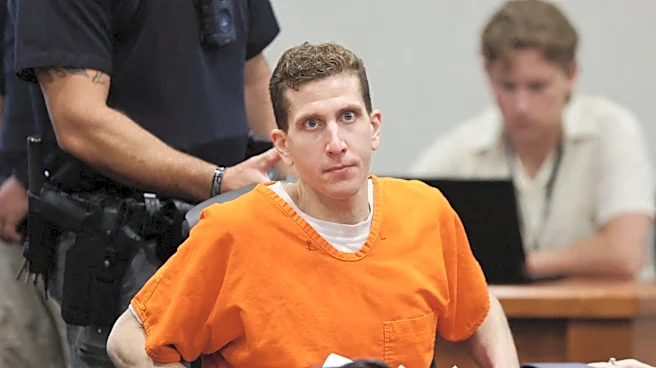



Bryan Kohberger, the man serving life in prison for the 2022 murders of four Idaho college students, faces an uphill battle in his attempt to withdraw his guilty plea, legal experts say.
In 2025, Kohberger, 31, pleaded guilty to the murders of University of Idaho students Madison Mogen, 21, Kaylee Goncalves, 21, Xana Kernodle, 20, and Ethan Chapin, 20, at an off-campus home in Moscow, Idaho, in November 2022. The controversial plea deal allowed him to avoid the death penalty, and instead be sentenced to four life sentences without the possibility of parole and a 10-year sentence for burglary.
Kohberger admitted in court to committing the murders willfully and with premeditation. But in court documents obtained by USA TODAY, Kohberger said he now
wants to withdraw his guilty plea because he was "convinced to falsely confess," placing blame squarely on his legal team.
It's not unusual for someone to have "buyer's remorse" after taking a plea deal, particular if they're facing a life sentence, said Thea Johnson, a professor at Rutgers Law School. Though Kohberger raised a number of legitimate issues legal scholars have identified within the nation's plea bargaining system, Johnson said he faces an "uphill battle" to take back his plea.
"It's very, very hard to unwind a guilty plea," Johnson said. "One avenue for unwinding a guilty plea is to claim ineffective assistance of counsel and basically say that your counsel was ineffective at the time of your guilty plea, but that also is an incredibly difficult standard to meet."
Why Bryan Kohberger wants to withdraw his guilty plea
In his petition for post conviction relief, Kohberger said he did not knowingly or willingly enter into the plea agreement because it was "induced by unkept promises" and "threats" from his legal team. He said his attorney grossly misrepresented the "horrific" conditions he would face on death row and made false promises about what his time serving life in prison would look like.
"Petitioner was convinced that actual guilt was not an important factor in considering plea acceptance: death row was imminent, and advised to lie, petitioner was to gain a 'legal victory' in entering a false plea," Kohberger wrote in the handwritten petition.
Some advocates and attorneys have argued that the pressure to take a plea deal to avoid execution is so great it can lead to false confessions, said Johnson, author of a 2023 American Bar Association report on plea bargains. While innocent people can and do plead guilty, Johnson said courts have generally rejected the idea that the death penalty is so coercive that it invalidates a plea.
"They're looking for, generally, that you really misled the client as to something fundamental about the case, the charges or the sentence or the immigration consequences," she said. "But something like 'I was promised certain things about the conditions of confinement' is probably not going to rise to that level."
Kohberger said his attorney also failed to tell him about a piece of potentially exculpatory evidence obtained during the plea negotiations: that clumps of unknown hair were found in Chapin's hands.
An FBI report included in court filings said debris from Chapin's right hand and bags placed around both of his hands "were examined for hairs microscopically consistent with" hairs taken from Kohberger, "however, none were found."
An independent review of DNA evidence by an expert witness for the defense lists three hairs found on or near Chapin's hands at autopsy that were "morphologically consistent" with Chapin's own hair. USA TODAY has reached out to the Moscow Police Department and Idaho Attorney General Raúl Labrador about Kohberger's allegation. A person who answered the phone at the office of Kohberger's former attorney Anne Taylor declined to comment on the filing.
Though this is a potentially stronger claim, Johnson said Kohberger still faces an extremely high bar to prove his lawyer acted unreasonably.
"In general, you can take a plea without having full understanding of the evidence, even full understanding of exculpatory evidence," she said.
Why taking back the guilty plea will be 'very difficult' for Kohberger
Peter Joy, professor of law and director of the Criminal Justice Clinic at Washington University in St. Louis, agreed that successfully pursuing this claim will likely be "very difficult" for Kohberger. Joy said it's "extremely rare" for a guilty plea to be withdrawn based on ineffective assistance of counsel.
"The standard is there has to be a manifest injustice to be able to prevail," Joy said of Idaho. "And I think that's going to be difficult."
That's in part because Ada County District Court Judge Steven Hippler asked Kohberger a litany of questions, known as a colloquy, to ensure he was entering the guilty plea "freely, voluntarily and intelligently."
"I want to make sure your plea is given voluntarily and I want to make sure that you actually committed the crime to which you are pleading guilty because I don't want you to plead guilty to a crime you didn't commit," Hippler said.
Kohberger confirmed to Hippler that he had not been threatened or promised anything in exchange for his plea and that he was pleading guilty because he was guilty. He further agreed that he had discussed the matter fully with his attorney and was satisfied with their advice.
Johnson said she and other academics have been critical of colloquies because the rote questioning "doesn't always tell us that somebody truly understood the plea or that they weren't being coerced."
"I've critiqued that and other scholars have critiqued that merely because you have that exchange does not actually mean always that somebody is pleading guilty because they are guilty, because we actually know from exoneration data that innocent people have pled guilty...but certainly it's going to hurt him that he had a full colloquy," Johnson said.
Contributing: Thao Nguyen, USA TODAY
This article originally appeared on USA TODAY: Bryan Kohberger faces an 'uphill battle' to take back his guilty plea