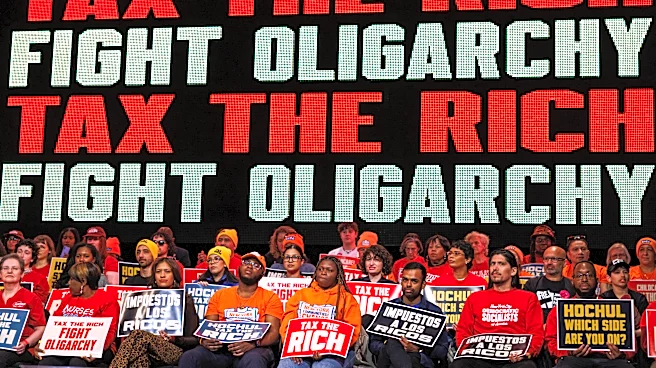





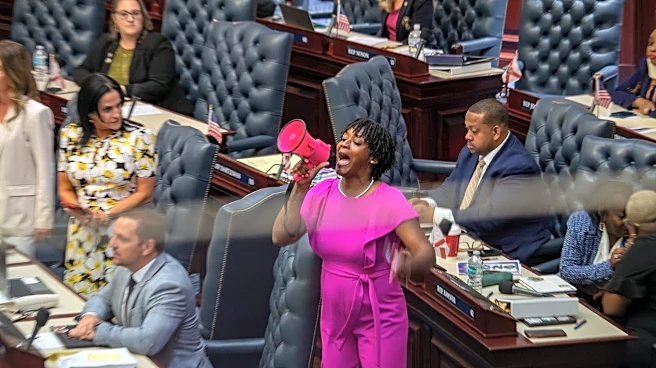

Beginning with New York City Mayor Zohran Mamdani's election victory in 2025, democratic socialist candidates have won a string of major Democratic primaries – most recently Florida state Rep. Angie Nixon's upset U.S. Senate nomination
win – and come close in several others. Vermont Sen. Bernie Sanders has long been the most prominent self-proclaimed democratic socialist in national politics, and was the runner-up for the Democratic presidential nomination in both 2016 and 2020.Democratic socialism is a terrible ideology. If implemented, its agenda would cause grave harm and imperil democracy itself. And in seeking massive state control of the economy, today's socialists ironically have much in common with the MAGA nationalists they claim to oppose.
Both promote government control over the economy, and both paths undermine liberty, prosperity and democracy. Socialists do not control the Democratic Party in the way MAGA largely dominates the Republicans. But their influence is growing.
What's the DSA's agenda? Let's look at the socialist wish list.

The democratic socialist agenda goes far beyond a marginal increase in economic regulation or welfare spending. It amounts to sweeping government control of the economy and society, on a scale that invites comparison to Cuba, North Korea and the old Soviet Union.
The platform of the Democratic Socialists of America (DSA), America's most prominent socialist organization, states the goal plainly: a system in which "food, education, energy, medicine, and transportation aren't for-profit businesses; they are common goods" – which is to say, a complete government takeover of those industries.
The DSA also envisions a society with no debt, no mortgages and no landlords, which would require government control of most housing, plus extensive rent control and a $20 an hour or higher minimum wage on whatever remains in private hands.
Economists across the political spectrum agree that this kind of wage floor would price millions of workers out of the labor market, and that rent control would greatly shrink the housing supply.
All told, the DSA agenda would add $71 trillion to $212 trillion in new federal spending over the next decade – at least doubling, and possibly tripling, today's $7.4 trillion in annual federal outlays, which are already unsustainable on their own. And there's no way to cover it by taxing "the wealthy" alone: Confiscating the entire net worth of the 400 richest Americans would cover, at most, 9% of the low-end estimate.
Democratic socialists are MAGA's mirror image
Ironically, democratic socialists have more in common with MAGA nationalists than either likely wants to admit. President Donald Trump has pursued his own version of economic central planning: ruinous tariffs, severely restrictive immigration policy and government equity stakes in Intel, U.S. Steel and roughly 30 other companies.
Tariffs and immigration restrictions are both major forms of government control over the economy. Immigration restrictions, in particular, curtail economic freedom more than any other current U.S. policy.
MAGA nationalists are also fiscally reckless much like socialists – Trump's signature spending bill is projected to add $3.4 trillion to the deficit over the next decade, with no serious effort to reform the entitlement programs that drive most federal spending.
Socialists promote an egalitarian ideology, while nationalists generally believe that government should promote the interests of the ethnic and cultural majority in a society. But, despite different rhetoric, they have similar economics and similar flaws.
The fiscal cost is far from the worst of it. A century of socialist experiments prove that.
How socialism becomes authoritarianism
When government takes over most of the economy, it destroys the incentive to produce. In a market economy, producers compete on price and quality to win customers. Under state control, those incentives vanish, and industries become government monopolies immune to competition. The result, time and again, is waste and shoddy goods.
As an old Soviet joke put it: "We pretend to work, and they pretend to pay us."
Even enterprises that want to produce quality goods are generally unable to do so under socialism. As Nobel Prize-winning economist F.A. Hayek showed in a classic article, in market economies the price system sends producers useful signals about what consumers want. Higher prices signal strong demand that producers are incentivized to respond to. Government control of production largely eliminates these price signals, leaving even well-intentioned planners without good information on how to allocate resources.
The result was massive shortages of needed goods, combined with waste elsewhere. This is one of the reasons why the socialization of agriculture and industry in the former USSR, China and elsewhere led to shortages and mass famines, killing millions of people.
One of these – Mao Zedong’s Great Leap Forward in China – was the biggest mass murder in history, taking up to 45 million lives. The Soviet Union and many other socialist states had similar catastrophes.
Government control of the economy also requires coercion to suppress private enterprise and concentrates enormous power in the hands of central planners. That combination breeds oppression, as in the Soviet destruction of the "kulaks" (independent farmers), and the small business owners Joseph Stalin's regime marked for elimination.
Concentrated power also hands rulers an obvious tool for persecuting political rivals and ethnic and religious minorities. Such repression recurred across many socialist states throughout the last century.
Right-wing nationalism has similar flaws. It, too, stifles growth by dulling incentives, and its central planning is also subject to the information problems Hayek identified. Tariffs and immigration restrictions reduce competition and growth, and government takeovers of major firms are their own form of central planning.
Despite different rhetoric and ideology, and some divergence on policy specifics, both MAGA and democratic socialists advocate massive central planning of the economy, with similar results
Nationalist movements also have a long history of repression, and there are elements of it in Trump's second term: U.S. citizens, as well as immigrants, have been wrongly detained and even deported amid the mass deportation push, and these deportations imperil Americans’ civil liberties in many ways.
Federal Communications Commission Chairman Brendan Carr has repeatedly threatened broadcasters' licenses over coverage the administration dislikes.
Nationalist repression tends to target immigrants and ethnic minorities more often than the socialist version does. But the parallels are real.
I was a refugee from Soviet communism. I know socialism doesn't work.
Today's socialists say they will avoid this fate because they champion "democratic" socialism, not the authoritarian kind. But near-total state control of the economy has never coexisted with democracy for long. A government that controls the economy can starve opposition parties of resources and weaponize control of basic goods to crush dissent.
That's exactly what happened in Venezuela, where a democratically elected socialist government became a dictatorship.
Right-wing nationalist regimes have followed a similar path, in Germany, Italy, Spain and many Latin American nations.
Many of today’s socialists even admire authoritarian socialist regimes and hope to emulate them:
- The DSA praises Cuban communist dictator Fidel Castro, who turned that country into a totalitarian state.
- Prominent socialist “influencer” Hasan Piker praised Mao – the biggest mass murderer of all time – as “one of the great leaders of this world.”
- Sen. Sanders has a long history of praising communist despots.
“Postliberal” MAGA nationalists similarly often admire right-wing despots, like Spain’s Francisco Franco, Portugal’s Antonio Salazar and others.
Progressives and others should consider whether they trust someone like Trump to have the kind of sweeping control over the economy socialists advocate for. There is no guarantee such a person – or worse – would not come to power under socialism. Far from it – as cases like those of Castro, Stalin, Mao and others show.

If nothing else, we should heed the powerful evidence of people “voting with their feet.” Almost every socialist regime in history has produced a mass exodus toward market economies, never the reverse. Venezuela's exodus is the largest refugee crisis ever recorded in the Western Hemisphere, and Cuba has had multiple waves of refugees over six decades.
I know firsthand: I was a refugee from Soviet communism myself. If socialism worked as advertised, people would be fleeing market economies to live under it, not the other way around. Right-wing nationalist regimes have produced their own refugee outflows. Refugees from Nazi Germany and fascist Italy, for instance, helped build American science, including the Manhattan Project, which developed the atomic bomb.
The choices of people voting with their feet are the most powerful verdict on both these ideologies.
Ilya Somin is visiting professor of law at the University of Virginia, professor of law at George Mason University, the B. Kenneth Simon Chair in Constitutional Studies at the Cato Institute and the author of "Free to Move: Foot Voting, Migration, and Political Freedom."
This article originally appeared on USA TODAY: Democratic socialists and MAGA share a dangerous flaw | Opinion