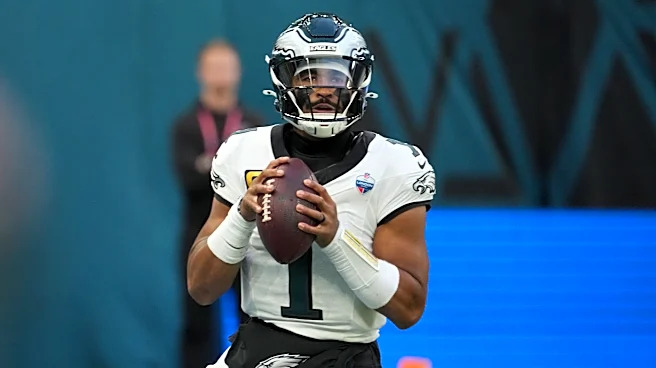



Jalen Hurts will not be on the field for a second straight week.
Hurts is still dealing with the pulmonary emboli he was diagnosed with last week. He's on injured reserve as he treats the blood clots in his lungs and will miss at least two more games after this week – and likely even more time.
The Philadelphia Eagles starter's blood clot situation was a matter of close scrutiny last week after imaging revealed that the ailment – initially diagnosed as a superficial clot – had progressed into a more serious condition. Many questioned why Hurts was allowed to play in Week 5 and take a transatlantic flight after his blood clot diagnosis.
Among those with questions was the NFLPA. The players union issued a statement on Tuesday, Oct. 20 calling for
a "full investigation" into the medical evaluation process Hurts underwent prior to being cleared to play two weeks ago. On Sunday, Oct. 25, the NFL and NFLPA released a joint statement saying they were "working together to review the matter."
In the meantime, backup Tanner McKee will lead the Philadelphia Eagles as they take on the Dallas Cowboys on "Monday Night Football."
Here's what to know about Hurts' situation:
What happened to Jalen Hurts?
Hurts was diagnosed with a deep vein thrombosis and bilateral pulmonary emboli ahead of the Eagles' Week 6 game, according to a joint statement from his agent – Nicole Lynn – and the Eagles. In simpler terms, Hurts is dealing with blood clots in both of his lungs.
Hurts was initially diagnosed with superficial vein thrombosis while in London for Philadelphia's Week 5 clash with the Jaguars. A superficial blood clot, according to medical experts, is not as severe a risk as deep vein thrombosis, but they still need to be taken seriously.
Ultimately, the Eagles determined at the time that Hurts was clear to play in the game on Oct. 11. NFL Media insider Ian Rapoport reported that Hurts played in Week 5 after staying in the hospital until 4 a.m. the night before. The quarterback played through the game and flew back to the United States from London with the rest of the team.
One week later, Hurts underwent more imaging and discovered that his superficial clot had become a more serious case of deep vein thrombosis. In addition, blood clots had moved to his lungs – a situation that could have turned lethal without treatment.
The treatment for Hurts' condition will consist of using blood thinners, which will disqualify him from participating in contact activities for a while. He'll miss several months – and potentially the remainder of the 2026 season – as he treats the blood clots.
Will Jalen Hurts ever play football again?
Hurts' future in football is up to him, but all indications are that he will return at some point.
"Jalen's prognosis is very good, and we expect a full recovery," Lynn, Hurts' agent, wrote in her joint statement with the Eagles. "We anticipate that he will have the opportunity to resume contact football activities when off the blood thinners. In the meantime, he will remain active around the team and continue to condition. More importantly, we anticipate that he will have no long-term effects."
The statement points to Hurts' eventual return to football. Barring a shocking announcement, the Eagles' quarterback will likely return either late this year or at the start of the 2027 season.
Eagles QB depth chart
With Hurts potentially out for the season, here's how Philadelphia's quarterback depth chart looks:
- Tanner McKee
- Cole Payton
- Joe Milton III
- Jalen Hurts (IR – blood clots)
McKee has been with the Eagles since they drafted him in the sixth round of the 2023 NFL Draft. Payton is a fifth-round rookie out of North Dakota State and was a two-time FCS national champion with the Bison.
Milton is on his third team since the Patriots drafted him in the sixth round in 2024. New England traded him to the Dallas Cowboys last April, and the Eagles signed Milton off of the Cowboys' practice squad on Friday, Oct. 16 after Hurts' injury.
This article originally appeared on USA TODAY: What happened to Jalen Hurts? Eagles QB's blood clots explained