

We know costs are severely affecting families whose kids play youth sports. But to what extent are those costs taxing us?
A new poll of parents, conducted by The Harris Poll and commissioned by national nonprofit Good Sports released Thursday, Sept. 17, says 68% of parents of kids under 18 who’ve had a child in sports say they have seriously considered pulling them out.
“The 2026 Good Sports Cost of Play Index” suggests that cost is the top reason parents, even those from households where the annual income is more than $100,000, are thinking about taking their kids out of youth sports.
The poll, conducted online within the United States among 574 U.S. adults ages 18 and older, found that 26% cite the unsustainable cost as the top reason they have
thought of pulling their kid out of sports, ahead of injury concerns (24%), a child’s lack of enjoyment (23%), poor coaching (23%) and a negative team environment (22%).
“Affordability is not just a side issue for some families and underserved communities only,” Christy Keswick, co-founder and president of Good Sports, told USA TODAY after her organization shared the survey with us before its publication.
“It’s really becoming central to whether families can continue to put kids into sports,” she says.
This is the second poll that Good Sports, which helps provide equipment and access for kids in high-need areas, and Harris have undertaken to unpack the rising costs of youth sports, following up one from 2024. The latest results, Keswick says, drive home the points that parents are getting increasingly worried about the cost and more likely to pull out because of it than they were two years ago.
“We've been in a fairly high inflationary environment for the last 5 to 6 years,” Keswick says. “So there are costs that just hit across the board. But then there's the cost of the product that's out there just changing.
“What used to be a localized program for 100 bucks is now your options are $3,000, $5000 or not playing on a team that's competitive or sustainable for a long term in the town. And that's what's concerning for us for sure.”

Some more figures from the Cost of Play Index:
- 53% of parents are worried they will not be able to afford sports for their child next year.
- 77% believe the growth of private clubs and travel teams risks is pricing many children out of participation.
- 67% say there has been a decrease in low-cost or public-school youth sports opportunities over the last five years, while 56% say there are not enough viable recreational or intramural youth sports options available locally.
What do these numbers mean for us? How can we help combat the rising costs? We spoke with Keswick and Jayne Greenberg, a former longtime school district administrator who specializes in helping keep kids active, to help find answers.
What's at stake with the risings costs of youth sports?
Keswick sees both financial ends of the system. She is a sports mom in the Boston area who participated in the club sports world and understands the pinch families are feeling. And, through Good Sports, she has access to thousands of program partners from the underserved communities they serve.
According to their latest poll results, 87% of those say they might be forced to reduce programming or limit enrollment within the next year due to rising equipment costs.
The stat lines up with the storyline Congressional leaders have brought up in hearings on youth sports and through introducing a Let Kids Play Act in an attempt to thwart private equity firms’ involvement in youth sports.
Those companies, some Congress members say, prey on families’ fears of missing out on athletic experiences for their kids while simultaneously extracting profit from them.
“The youth sports ecosystem is highly connected and interconnected,” Keswick says, “and if you’re making significant changes to the ecosystem on one end, it's almost impossible for it not to impact the other end of the spectrum. And so if we can make investments on the other side of that to make sure that there's more fairness in the system, I think that is the ideal solution.”
So, for example, the travel or club soccer team that charges families thousands of dollars and offers a chance to play at large complexes affects the local town team. At the least, she says, fewer kids sign up for the town team and it becomes less competitive. At worst, the team is forced to fold.
“We believe that making the pool smaller of young athletes is not good business for anybody, including private equity,” Keswick says. “We think about the opportunity is for every brand invested in sports – every professional team, every athlete foundation, leagues – to really try to invest in this part of the ecosystem for the long term health of sports in this country. So kids who play become fans. We know that they watch games, they buy tickets, they pass the love of the game onto their families.
“There's organizations like Good Sports that can help brands and partners do that.”
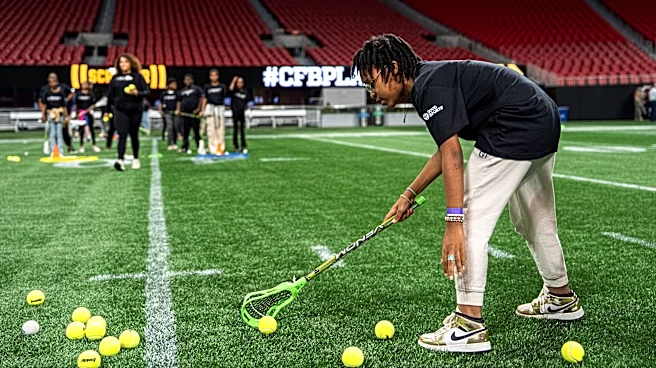
Good Sports is supported by dozens of companies, including large apparel outfits lie Adidas, Under Armour and Wilson and professional teams like the Chicago Cubs, Atlanta Hawks, Cincinnati Bengals and Tennessee Titans.
“We hear stories all the time from our programs about kids sitting in the dugout because they're sharing gloves and that's time that they're not having on the field and interacting,” Keswick says. “We recently heard from a couple different football programs that they've got multiple kids on the wait list because they don't have enough helmets to go around.
“And for us, it's like, gosh, these are solvable problems. But it requires resources to really invest in them. But there's just way more demand than our organization can take on our own.”
The travel sports conundrum and the troubled $100-plus K income bracket
According to the new poll, 58% of parents with kids currently in sports and have a $100,000 or more in household income say equipment costs have become a financial stress for their family, while 50% of those worry they will not be able to afford to put their children in sports next year.
It’s hard to underestimate the impact of travel sports, where, according to the poll, 21% of parents have driven five-plus hours in a single week for their child's sports.
Also, 24% have paid junk fees (a term Congress members use, too) for parking and admission, for example, to watch to their own kids.
But the cost of youth sports isn’t just confined to travel sports. The issue hit home for Greenberg, who spent more than two decades as a school district administrator in Miami-Dade County, Florida, when she saw a bunch of families in a lobby of a gym for a community basketball game. When she and her great nephews entered to play, the parents would peek in the door.
“For some kids, that's the only way they excel and that their families can be proud of them, but they can't afford to even watch 'em play,” Greenberg says.
Inside those gyms, as we know tensions are high among parents, and anxiety over expectations can develop within kids. There has to be a better way for younger kids to develop a love of sports.
Greenberg has long believed in the leadership and teamwork and social skills sports can bring to kids, and we know the right mix of school and sports stimulates academic success.
She always pushed the intramural sports concept, especially at the middle and grade school levels. These are spaces where an administrator can supervise, choose up sides to avoid the team-stacking we see and throw the ball to kids.
“Sports has a limited roster,” she says. “If you have a basketball squad in the middle school, and you have 12 kids, and you have 1,800 kids in the school, what do you do with the other kids that aren't making the team? And (with) intramurals, you don't have a travel cost. You can wear different colored T-shirts, you know, so it's not like you're buying uniforms. The cost is nominal, and you have as many teams as you have kids that want to play, and you can just develop your own round robin tournament. And you give ribbons to first place. You don't even need the big trophies, but it teaches kids the same lessons as playing in sports. ...
“Give them more opportunities to be physically active, so they can grow into it when they decide what they like and what they're good at. When they decide. Not the parents decide.”
How can we rebuild community sports?
Youth sports spending, the poll found, produces a roller coaster of emotions within parents. While 33% reported being satisfied, 31% were stressed and 27% frustrated.
“Parents are feeling like something's not quite right with this model,” Good Sports’ Keswick says. “They're feeling that it is kind of keeping up with the Joneses. And at the same time, every parent wants what's best for their child. And so I think they're feeling a lack of other options.
“We have all this data on how sports benefits kids, but if we fundamentally change sports so much, do those same benefits continue to be real? I think that's something that nobody's really talking about, but I find it fascinating because if that data is based on local programming, low stress for families and kids, friendship, teamwork, camaraderie, like all of those things, and we're changing it to a highly competitive, highly expensive focus, maybe one-sport only focus. Does that remain true for the long term? I just don't know.”
Working in schools, Greenberg says she was able to bring in more than $30 million in physical education money, though her district budget was always zero.
She asked teachers to survey what kids wanted, and she found ways to bring in geocaching, canoeing, kayaking, stand-up paddle boating and fitness. Then she went out into the community.
She worked with local foundations, hospitals, marketing councils and the Miami Dolphins, who trained high school teachers on weight training instruciton.
“In doing so at the time, there was a lot of federal grants out there, physical education grants,” she says. “So, fortunately, I was able to not only write (the ones) that the school district submitted, but to write them for community based organizations that submitted to work with us.
“So the Miami Dolphins, the Miami Heat, the Marlins, the (Florida) Panthers, everybody chipped into help train our teachers and provide equipment. I had to watch the high school kids with the universities, so I didn't bypass any NCAA recruiting regulations that would keep the kids from getting scholarships.”
Through Gen Youth and NFL Flag, she helped implement flag football into the physical education curriculum. The move led, she said, to varsity and junior varsity high school and middle school varsity flag football teams in her school district.
Today, the NFL FLAG-In-School program, according to the NFL, has helped than 17 million students participate through free kits distributed to 40,000-plus school communities. The NFL clubs are heavily involved with flag football at the local level.
“People need to know how to work with their community," Greenberg says. "Communities are made up of people whose kids go to school. And whether it's private, charter, public schools, community members are made of parents that have children that go to the schools.
“Anytime you donate to a school program, you get a tax write-off. And what the schools need to do is include the business corporations and business employers and employees in the programs. You know, invite them to events, bring them into your school. It's their community. It's their alumni. It's their future workers and their businesses.”
The demand is there in communities across the country. According to the poll, 88% of the youth programs Good Sports serves report that children in their communities want to participate in sports but are unable to because they lack the necessary resources.
“Is there an opportunity for parents to start reclaiming youth sports in their communities?” Keswick says. “I think that is what we're going to have to see as sort of this underlying initiative to say, ‘This is enough.’ And we need to reclaim it for the local communities and the kids making sure all kids are getting the chance to play.
Steve Borelli, aka Coach Steve, has been an editor and writer with USA TODAY since 1999. He played baseball in high school, rowed in college and spent 10 years coaching his two sons’ baseball and basketball teams. He and his wife, Colleen, are now sports parents to a college and high school baseball player. For his past columns, click here.
This article originally appeared on USA TODAY: Has cost become primary reason parents pull their kids out of sports?