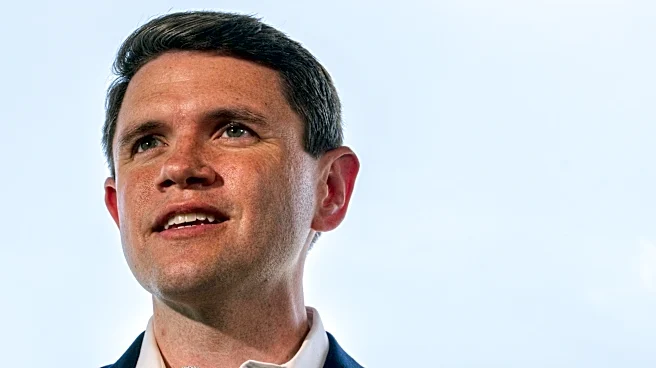







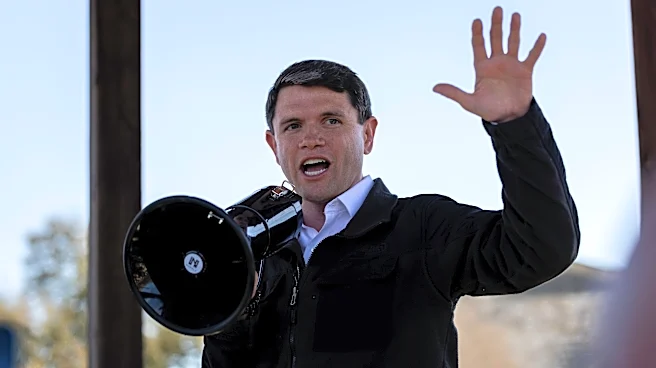
DALLAS − Texas Senate Democratic nominee James Talarico speaks enthusiastically about his Christian faith in a way few in his party do.
In his crusade against what he calls the "billionaire mega-donors and puppet politicians who have taken over Texas," the 37-year-old state legislator has stressed his Biblical grounding. His campaign website tells voters "there is no love of God without love of neighbor" and says ― referencing gospel accounts of Jesus' response to merchants in the temple ― "it's time to start flipping tables."
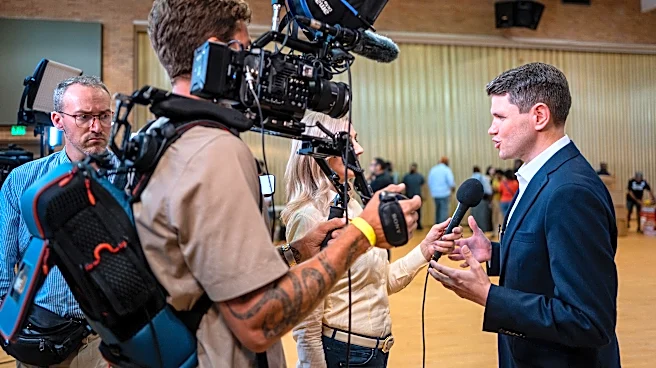
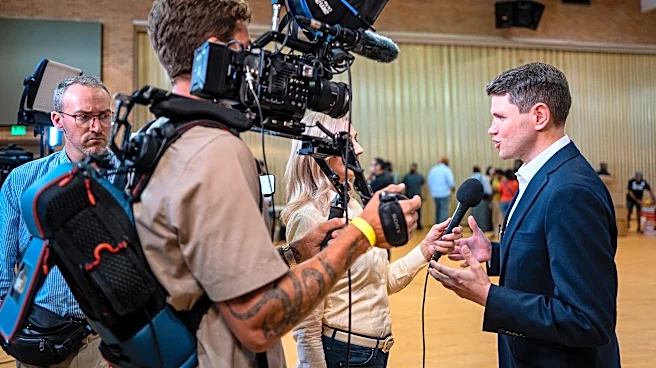
"I’m engaging with my fellow Christians all over the state who may come to different political conclusions, to different policy conclusions," Talarico said at a recent campaign stop in suburban Dallas when asked about the role
of faith in his Senate bid. "The word 'religion' literally means to re-ligament, to reconnect us into one body. I think we need leaders who remember that and who will stop weaponizing faith to divide Texans for their own gain."
A recent folksy TV ad showcases the candidate's grandfather, a longtime South Texas minister, who Talarico introduces as his "PawPaw."
"As a Baptist preacher in South Texas, he taught me to follow the two great commandments," Talarico says in the ad. "Love God...."
"And love your neighbor," his grandfather finishes.
That Golden Rule philosophy has been central to Talarico's rise. He belongs to a progressive Presbyterian church in Austin, Texas, the liberal stronghold where he's lived since early childhood. He is also pursuing a master of divinity degree at Austin Presbyterian Theological Seminary.
"Politics," Talarico told cable news network NewsNation in early 2025, "is really just another word for how we treat our neighbors."
"He’s theologically educated," said Matthew Wilson, a professor of political science at Southern Methodist University in Dallas. "He’s not faking it. He has a real knowledge base and the lived experience of being embedded in faith communities."
Texas Democrats hope that placing his liberal views in a Christian frame will help Talarico win enough voters to flip the seat vacated by Sen. John Cornyn, R-Texas. But in a state with large evangelical and Catholic populations, Republicans argue that the Democrat's support for abortion rights and LGBTQ rights is at odds with the conservative Christian values of most Texas voters.
"James Talarico has spent this entire campaign using Scripture as a prop," said Madison Cercy, a Ken Paxton campaign spokeswoman. "Faith isn't a campaign strategy, but in Talarico’s twisted version of Christianity, a follower of Christ is required to bend the knee at the altar of the radical trans agenda, disavow the oil and gas industry, support late-term abortion, and open the door to every criminal illegal immigrant seeking asylum. I’m still looking through the Bible to find those passages, but I wouldn’t call it Christian, and I don't think most Texans would."

Some previous Democrats who lost across the South, such as former presidential nominees Al Gore and John Kerry, were also churchgoers. Whether Talarico's Christianity will help him make inroads among the faithful is an open question, experts say.
"He has been willing in a way that many Democrats have not to emphasize his Christian faith," Wilson said. "It remains to be seen whether it’s successful. Is he attracting a group of people who would otherwise not vote for him?"
Texas has pushed church-state boundaries
Two-thirds of Texas adults identify as Christian, according to the Pew Research Center’s 2023-2024 Religious Landscape Study, compared to 62% of U.S. adults overall.
Lately, the Republican-led state has tested the boundaries between church and state, passing a law requiring public schools to display the Ten Commandments while the state's education board approved a mandatory public school reading list that includes Bible stories.
In a July 2025 appearance on podcaster Joe Rogan’s show, Talarico criticized the Ten Commandments bill, calling it not only unconstitutional but "un-Christian" and arguing for the sacredness of church-state separation.
"I honestly think Christianity has a lot to share with the world at this moment of crisis, but this is giving Christianity, and religious people broadly, a bad name," he said. "Because this is what people think about religious people – that we’re more interested in imposing our faith on others instead of living it out."
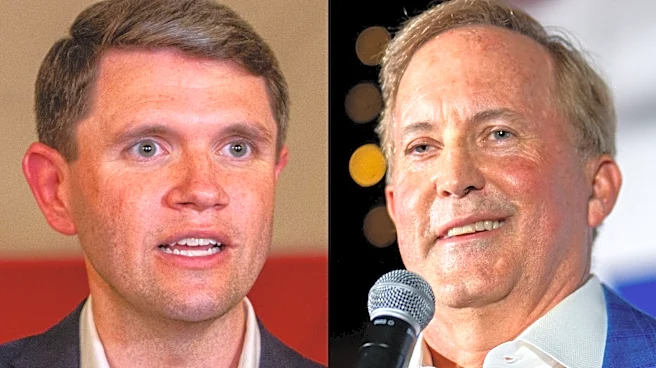
Some polls have shown Talarico pulling ahead of Paxton in the race, which would make him the first Democrat to win a statewide race in Texas since 1994. A BIG DATA POLL conducted Sept. 24–26 found Talarico leading among registered Texas voters, 43.6% to 39.3%. Among those likely to head to the polls, Talarico was ahead 44.6% to 41.6%.

Observers attribute the potential upset to Paxton’s personal and political baggage – including alleged infidelity, an indictment for investment fraud and President Donald Trump's approval rating in Texas, which is 42%, according to the most recent figures compiled by The Texas Politics Project.
Paxton's controversial history gives Talarico’s religious message more potential resonance, Wilson said.
"Given Paxton’s ethics lapses and infidelity, it highlights the contrasts with a candidate who speaks the language of faith," he said.
Fighting on Republicans' turf
Talarico’s touting of his faith has drawn blowback from Republicans, including Texas Lt. Gov. Dan Patrick, who in June told a crowd at the state’s Republican Party convention in Houston that Talarico is "going to hell for sure" for campaigning "against God, as he's been doing."

"It's James Talarico who decided to bring the Bible into this election," Patrick said in video of the event shared by Houston's KRIV-TV. "And let me tell you, that's not a Bible I've ever read. I've never seen so much blasphemy from anyone running for office."
More recently, a Paxton campaign ad used artificial intelligence to create the appearance that Talarico is saying "In the beginning, God was nonbinary, and he wasn't a Christian. And God said, let there be six genders, and there were." The statements are variously attributed to Talarico's own words taken from a 2021 Texas House floor speech, a 2023 sermon at Austin's St. Andrew's Presbyterian Church and a 2021 Texas House public education hearing committee.
The scriptural tug-of-war recalls political debates surrounding the civil rights movement, according to Eric McDaniel, a professor of government at the University of Texas at Austin.
"Think of 1963, when you had (Alabama) Gov. George Wallace saying segregation is biblical and Martin Luther King Jr. arguing it’s a sin," McDaniel said, citing Wallace’s famous inauguration speech in which he described racial integration as "a system that is the very opposite of Christ."
"It’s people of the same faith coming to two different conclusions," he said. "Talarico is trying to show that what it means to be Christian is not just one thing."

These days, Texas is a bastion of conservative Christianity, home to some of the nation’s largest and most plentiful megachurches and a formidable base of Southern Baptist Convention membership.
"White religious conservatives have been able to take over that space and progressives have not," McDaniel said.
Robert Jeffress, senior pastor of 16,000-member First Baptist Dallas and an ally of Trump, described Talarico as "a wolf in sheep's clothing" who promotes "fake Christianity."
"The Jesus that James Talarico purports to be following is not the Jesus of the Bible: it’s the Jesus of his own woke imagination," Jeffress told USA TODAY.
Bart Barber, pastor of First Baptist Church in Farmersville, a community of about 3,600 about 45 miles from Dallas in Republican-leaning Collin County, said he’s probably had more conversations outside church about Talarico than any Democratic candidate in recent memory. He doesn’t think it’s because Talarico’s beliefs differ so much; even Mitt Romney, a Mormon who was the 2012 Republican nominee for president, didn’t prompt as much discussion, he said.
"It’s the fact that Talarico seems to hold in disdain the theological convictions of the majority of my congregation," said Barber, a former president of the Southern Baptist Convention, the nation’s largest Protestant denomination.
He said Talarico, especially early in his campaign, seemed to suggest people "who vote a certain way aren’t interested in helping people around them or are angry and pugilistic, and that his faith is purer because it actually represents the teachings of Jesus… That kind of talk, I find insulting. He’s been trying to walk some of that back, and I imagine it’s because I’m not alone in feeling that way about some of the things he initially said."
Barber called Talarico and Paula White-Cain, a former televangelist and charismatic movement leader who now serves as a spiritual adviser to Trump, "two sides of the same coin."
"They’re people for whom politics is their real religion," he said. "I think the majority of my congregation sees both people as really interested in power, who have crafted their theological commitments to match their politics. And I don’t think that smells any better on the right than on the left."

But Barber said that while he’s seen Talarico signs in yards around town, he has yet to see a single one supporting Paxton. It was in Collin County that Paxton was first elected to the Texas House of Representatives in 2002.
"I still think he (Paxton) will win Farmersville and Collin County, and there’s a good shot he will win Texas, but people should not take that as being enthusiastic," he said. "It’s a difficult and bad choice for people in my congregation."
Challenges for Christian progressives
While Black Democrats have often been more openly religious, such as Georgia Sen. Raphael Warnock, a Baptist minister, Talarico is among a growing number of white Democrats, including Govs. Andy Beshear of Kentucky and Josh Shapiro of Pennsylvania, who proudly wear their faith on their sleeves.

While Talarico is unlikely to win over many evangelical Christians, Wilson said, his approach might make moderate swing voters more comfortable with the idea of voting for him.
"They may believe, rightly or wrongly, that 'Well, if he’s a good Christian, he can’t be too far out there,'" he said.
Even if Talarico loses, it’s possible his ability to compete in Texas could inspire more Democrats in the South and other conservative regions to adopt his faith-forward blueprint, said Doug Rossinow, a professor of history at Metro State University in Saint Paul, Minnesota.
"Democrats probably better hope that it does," Rossinow said. "There are big sections of the country where they’re not competitive, and they’ve got to find something to change that or they’ve got a long-term problem. Just as Republicans need to find some way into more secular areas where they’ve lost ground."

One challenge for Democrats is that progressive Protestantism has declined dramatically as a share of the church-going public over the last half-century. Ryan Burge, a political scientist at Washington University in St. Louis who studies religious trends, said that in the late 1950s, about half of all Americans belonged to a mainline Protestant congregation; that portion is less than 10% today, while evangelicals account for about 23% of the population.
"It’s a small sliver of the American religious mosaic, so it’s a tall order to reinvigorate that," he said. "But if Talarico succeeds, he will have opened the door for a wider range of Democrats to start openly talking about faith."
This article originally appeared on USA TODAY: How James Talarico promotes liberal Christianity in Texas Senate race