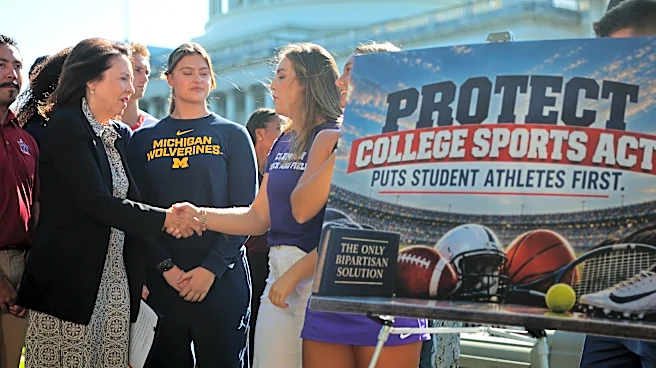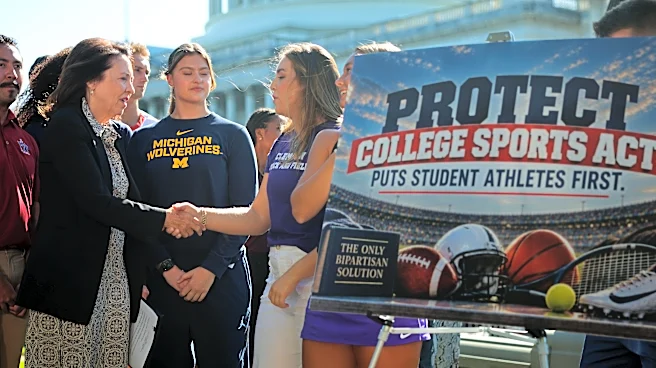

The Protect College Sports Act, a bill Sen. Ted Cruz (R-Texas) told USA TODAY Sports was crafted over three years through daily negotiations with co-sponsor Sen. Maria Cantwell (D-Wash.), easily cleared
its first major hurdle this week.
The nearly 200-page measure passed the Senate on Sept. 28 by a decisive 77-22 vote. Designed to create a federal framework for college athletics, the legislation was backed by dozens of industry leaders, including SEC commissioner Greg Sankey, Big Ten commissioner Tony Petitti, Notre Dame athletic director Pete Bevacqua and representatives from 32 college conferences.
The bill now heads to the House of Representatives. A vote likely would come after the Nov. 3 midterm elections unless House Speaker Mike Johnson (R-La.) brings the chamber back into session following its early recess.
Unlike the Senate, where the bill needed at least 60 votes to advance, it would require only a simple majority of 218 votes in the House. If approved, it would move to President Donald Trump's desk. Trump has repeatedly voiced support for the legislation.
So what exactly would the Protect College Sports Act do?
Here are the key provisions of a bill many college leaders have argued is necessary in the wake of unrestricted athlete transfers and the landmark 2025 House settlement that ushered in revenue-sharing and direct payments to athletes. The legislation also has earned support from major professional sports leagues, including the NFL, NBA, NHL, MLB and WNBA.
- The bill would establish a federal framework for college athletics, overriding the patchwork of state laws that have emerged throughout the NIL era. It also would significantly increase the amount schools can share directly with athletes. While the 2025 House settlement set an initial revenue-sharing cap of $20.5 million per school, with annual 4% increases, the Senate proposal would more than double that figure. Lawmakers say schools could distribute roughly $43 million to $45 million annually across all sports, plus an additional exemption of up to $5 million for women's and Olympic non-revenue sports.
- The bill would cap agent fees for negotiating NIL deals involving current NCAA athletes at 5%. Supporters, including Sen. Ted Cruz (R-Texas) and co-sponsor Sen. Eric Schmitt (R-Mo.), have criticized agents for charging fees they say can exceed 20% on some deals. Professional sports leagues already regulate certain agent compensation. The NFL, for example, caps fees tied to player contracts, although commissions on marketing and endorsement agreements typically range from 15% to 20%.
- The bill aims to slow the pace of conference realignment and limit the creation of even larger leagues. An earlier version included a moratorium on conference expansion and would have required any school leaving a Power Four conference to spend five years as an independent before joining another league. After extensive debate, lawmakers softened those provisions. The revised language reduces the waiting period to three years, raises the threshold for a "super conference" from 19 to 20 members, and shortens the duration of the restrictions through an earlier sunset provision.
Despite broad bipartisan support for the Protect College Sports Act, reflected in the Senate's 77-22 vote, the legislation has faced consistent opposition from Sen. Cory Booker (D-N.J.), a former Stanford football player, and Sen. Chris Murphy (D-Conn.), as well as the NAACP.
The NAACP renewed its criticism Tuesday, issuing a statement obtained by USA TODAY Sports that again condemned the legislation.
"The so-called Protect College Sports Act only serves to give even more power to colleges and universities at the expense of student-athletes,” NAACP President Derrick Johnson said. “It protects those powerful schools from accountability while stripping student-athletes' ability to collectively bargain and limits their compensation for their hard work and skill.
“On top of that, the bill offers vague promises of funding for HBCUs as a political trade-off for the harm this legislation will do to Black student-athletes. We cannot continue to ask Black student-athletes to generate billions in revenue on the field and the court while they shoulder all the risk and receive none of the guaranteed security they deserve, like secure long-term healthcare and educational protections. Sharecropping is over, and this bill will only serve to harm student-athletes."
Supporters of the bill point to its significant investments in athlete health care and HBCUs. The legislation would provide $180 million annually to historically Black colleges and universities from fiscal years 2027 through 2032, totaling more than $1 billion over the life of the program.
In revisions made a week before the Senate vote, lawmakers also changed the bill's health-care language, replacing a proposed spending cap with a minimum spending requirement. Under Sections 106 and 107, participating schools, conferences and governing bodies would be required to cover all out-of-pocket medical expenses tied to injuries or illnesses athletes suffer during their collegiate careers.
The bill also guarantees athletes access to independent second medical opinions at no cost, rather than relying solely on a school's preferred medical providers. Additionally, it would require catastrophic injury insurance for cases involving more than $90,000 in medical expenses and provide five years of post-eligibility medical coverage.
Supporters argue those provisions represent some of the bill's most meaningful athlete protections. They say the legislation would ensure injured athletes receive care with no out-of-pocket costs for five years after their eligibility ends, while also establishing a long-term injury and brain health fund with at least $60 million in funding.
What do Protect College Sports amendments aim to do?
Three amendments ultimately survived the legislative process and were incorporated into the final version of the bill, sponsored by Sens. Tammy Baldwin (D-Wis.), Ashley Moody (R-Fla.) and Tim Scott (R-S.C.).
Baldwin's amendment preserves the authority of state governments and courts when state laws do not directly conflict with federal law. It is designed to promote greater consistency in NIL, transfer, compliance and eligibility rules while reducing uncertainty for schools as they navigate the legislation's requirements.
Moody's amendment makes a targeted change to the bill's conference realignment provisions, raising the "super conference" threshold from 19 to 20 members. The issue carried particular significance in Florida, where Florida State and Miami have long been linked to potential moves from the ACC to either the SEC or Big Ten.
Scott's amendment would require schools to disclose outside funding from foreign sources. The provision has gained traction as athletic departments increasingly explore alternative funding mechanisms, including private-equity partnerships. The University of Utah, for example, has turned to private investment in exchange for a share of future athletics revenue.
This article originally appeared on USA TODAY: Protect College Sports Act explained: What the bill means for athletes; who opposes it?