




The government is violating the rights of an Afghan woman accused of being a terrorist in a first-of-its-kind attempt to remove her from the United States despite her permanent resident status, her attorney said in court.
Nazira Haji Zada, 47, a resident of Fort Worth, Texas, is the subject of proceedings within the U.S. government's Alien Terrorist Removal Court, established in 1996 but never before used to deport someone accused of being an "alien terrorist."
Federal prosecutors said Zada supported a plot by her son and son-in-law to carry out a mass shooting inspired by the Islamic State. Abdullah Haji Zada and Nasir Ahmad Tawhedi both previously pleaded guilty to charges related to the 2024 Election Day plot. The Trump administration's Justice
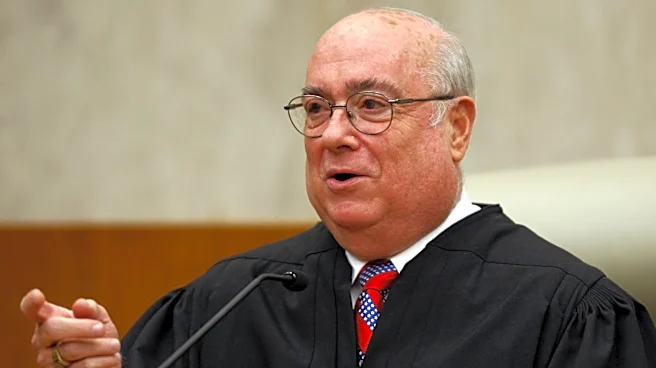
Department filed an application to remove the woman on July 15, and she appeared in Alien Terrorist Removal Court before Chief Judge Joan N. Ericksen on July 30.
The court gives federal prosecutors the opportunity to remove someone from the country "swiftly," the DOJ said, by establishing by a preponderance of the evidence that the person is a terrorist, a lower burden of proof than required in criminal court. The DOJ said the court allows the government to present classified information as evidence, which the department said would pose a risk to national security if disclosed to the public.
But Nazira Haji Zada's public defender, Matthew Farley, said the process violates her due process rights.
“This entire scheme is in violation of due process and unconstitutional,” Farley said in court on July 30. "This is a runaround to bringing a criminal case."
Farley asked Ericksen to dismiss the case and release Nazira Haji Zada, which Ericksen denied.
Farley declined to comment when reached by USA TODAY on July 31.
What is the Alien Terrorist Removal Court?
Congress created the Alien Terrorist Removal Court as part of the Antiterrorism and Effective Death Penalty Act of 1996, authorizing the U.S. Chief Justice to appoint five U.S. District Court judges to oversee applications for the removal of alleged "alien terrorists," defined as any noncitizen who is deemed a terrorist.
Under the statute, the U.S. attorney general may make an application for removal and submit it to the court.
"A single judge may grant the application upon a finding that the alien in question has been identified correctly as an alien terrorist present in the United States and that removal under other available legal means would pose a risk to national security," according to the Federal Judicial Center.
If the application is granted, a removal hearing will be held at which the accused terrorist can be represented by an attorney. Federal prosecutors can prepare an unclassified summary of any classified information being used as evidence in the case.
“The ATRC embodies the recognition that the government should not have to choose between allowing a dangerous alien to remain in the United States and disclosing sensitive classified information in a traditional removal proceeding,” Assistant Attorney General for National Security John A. Eisenberg said in a statement.
The court must provide an attorney to defendants who can't afford one, and cases can be appealed before the U.S. Court of Appeals for the District of Columbia Circuit.
The ATRC has never been used to remove someone from the United States, and no cases have been heard until now. It has been a "veritable zombie court," wrote Aram Gavoor of the George Washington University Law School and Timothy M. Belsan of the Foundation of Defense Democracies in 2019, arguing it is the sole means to remove an alleged terrorist lawful permanent resident against whom the only evidence is classified.
What is Zada accused of?
Nazira Haji Zada was arrested earlier this week, prosecutors said. Her son and son-in-law were convicted of crimes related to a plot they hatched to commit a mass shooting on Election Day 2024 on behalf of the Islamic State. They were arrested after purchasing firearms to be used in the planned attack from an undercover FBI employee, prosecutors said.
Nazira Haji Zada entered the United States as a lawful permanent resident in 2018, according to an unclassified declaration of support for her removal by Immigration and Customs Enforcement. She has no criminal history, according to the declaration.
The DOJ summary of her case says that the FBI has evidence that Nazira Haji Zada has formally pledged support to ISIS and supported the plot by her son and son-in-law. She also worked to "indoctrinate" her children with pro-ISIS ideology and concealed her actions from her unsuspecting husband, the government claimed. The DOJ said she signed off on selling the family house to financially support the terrorist plot.
"The allegations in this case show the matriarch of an ISIS-sympathizing family aiding in a plot to launch a mass casualty attack on American voters on Election Day. The Department’s application in this court makes clear that terrorists have no place in the United States of America," Acting Attorney General Todd Blanche said.
Contributing: Christopher Cann, USA TODAY; Reuters
This article originally appeared on USA TODAY: Afghan woman accused of terrorism fights deportation in 'zombie court'