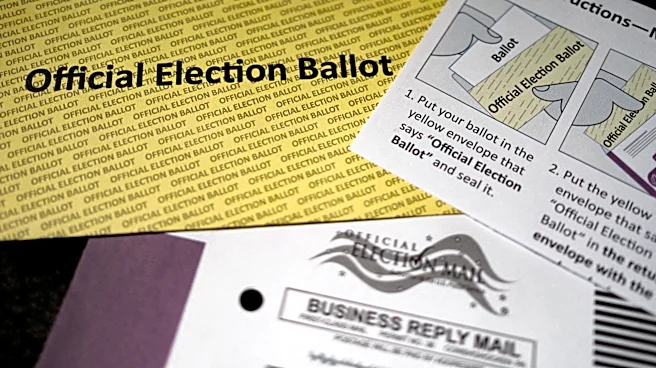

North Carolina will start sending out the first general election mail ballots on Sept. 4 for the Nov. 3 midterms. Whether the voters who use those types of ballots in that state and across the country
get disenfranchised will likely soon be decided by the U.S. Supreme Court.
President Donald Trump
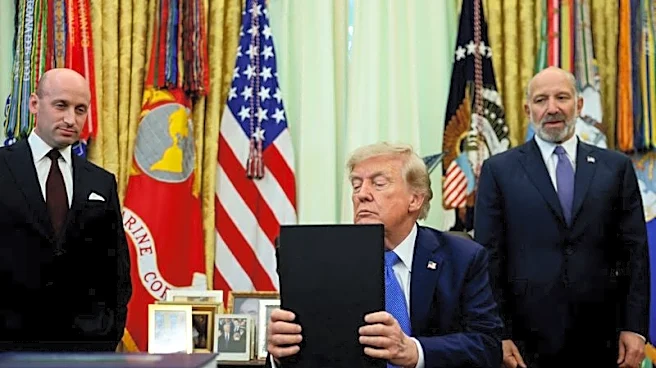
and his administration have been battling in federal court with voter rights groups and 24 states that are trying to prevent him from what clearly seems to be an unconstitutional federalization of our elections.Trump, in an executive order in March, directed the Department of Homeland Security to compile state-by-state lists of eligible voters and then have the U.S. Postal Service develop rules about who can vote using mail ballots.
As always with Trump overreach, this has become a mess in every kind of way.
Trump is fighting a legal battle for control over mail-in voting

A federal whistleblower involved in the development of those rules has warned that they could cause "major disruptions" in voting and that the Trump administration seemed intent on hiding that, according to a letter to the Postal Service from U.S. Sen. Richard Blumenthal, a Connecticut Democrat.
And there is also a major legal problem with Trump's executive order: The U.S. Constitution says states run elections, not the president. Trump can't just decide he has a new power and then act on it.
That prompts three very serious questions. Will the conservative-heavy Supreme Court stop Trump? Will Trump follow judicial orders? And will the Republican-controlled House and Senate force Trump to obey the courts?
To sort out where this goes next, I spoke to three former federal judges from the Article III Coalition, a good-government effort from Keep Our Republic to preserve an independent judiciary.
Will the Supreme Court eventually stop Trump's election antics?

Former Judge John E. Jones III, who was chief judge for the Middle District of Pennsylvania, predicted a swift return to the Supreme Court for Trump's executive order.
Procedural issues prompted a majority of the Supreme Court justices on Aug. 24 to block a federal judge in Boston from temporarily pausing Trump's executive order. But by week's end, that judge's temporary restraining order was back in place – and Trump's administration was appealing it.
Jones told me he expects the federal courts at every level to find Trump's executive order unconstitutional.
"I struggle to find a scenario where the Supreme Court does anything other than find that this is a violation of Article I, Section 4 of the Constitution, in that these are executive agencies, and absent lawmaking by the Congress, the executive branch simply doesn't have the authority to do this," Jones said.
Retired Judge Liam O'Grady, who served in the U.S. District Court for the Eastern District of Virginia, told me the Supreme Court might take control of the case directly, skipping over the appellate court, because the subject already reached the high court once and the midterms are looming.
"They may look at 60 days before an election and say, we now should decide this issue," O'Grady said. "You would hope they would, because the states need direction."
Former Judge Jeremy Fogel, who served in the U.S. District Court for the Northern District of California, was leery of handicapping the Supreme Court on this because the justices could have put an end to the executive order the first time it reached them.
"I think they're sending ambiguous signals," Fogel told me. "That may be just because you've got justices in a lot of different places."
Trump has spent years fighting the US voting system

Jones, who was still a judge when Trump tried to overturn the 2020 election in more than 60 court cases, said the federal judiciary had prepared back then for the potential wave of legal filings and will be ready again. And he pointed to recent controversies – aggressive federal agents demanding to inspect Wyoming's primary election in August, the FBI's seizure of 2020 ballots in Georgia's Fulton County earlier this year – as potential harbingers for future cases.
"I think past is prologue, and given the administration's repeated attempts to, in effect, federalize election administration, almost anything goes from this point on," Jones said, adding that Trump is trying to drive a narrative that "elections are inherently fraudulent."
O'Grady noted that the federal judge in Boston, while pausing Trump's executive order with an Aug. 27 temporary restraining order, pointed out "that the government didn't put in any evidence of fraud occurring in mail-in voting to substantiate the need to act so quickly."
Fogel sees a Trump-led public influence campaign to question election integrity as a "coordinated effort to suppress the vote," recalling how judge after judge in 2020 threw out Trump's legal challenges for lack of evidence. He expects more of the same in November.
"I think it's likely they're going to use all of the levers available to prevent losing control of Congress," Fogel said.
My last question for the judges worried Fogel: What if Trump tries to overturn the results of the midterm elections while ignoring court orders meant to stop that?
"I have such a hard time believing that would happen," Fogel said. "But I think you have to consider the possibility that it might."
Fogel and Jones saw two off-ramps for that kind of chaos.
For Fogel, it depends on "how much integrity" Trump's Republican allies in Congress will show if he tries to defy court orders. Will Congress step in? "That's the big question," he said.
For Jones, he recalls the consequences that Trump's attorneys faced for their actions in 2020. One big example: Former New York Mayor Rudy Giuliani, who led Trump's 2020 legal challenges, was disbarred in 2024 for actions he took in that effort.
"Lawyers are going to have to think hard about whether they want to jeopardize, as we call in the trade, their ticket to practice law," Jones warned. "I think lawyers are likely to be much more circumspect about diving into some of these potentially ill-considered cases because of the experiences in past elections."
Follow USA TODAY columnist Chris Brennan on Bluesky, @bychrisbrennan.bsky.social, and on X, @ByChrisBrennan. Sign up for his weekly newsletter, Translating Politics, here.
This article originally appeared on USA TODAY: Will SCOTUS stop Trump's mail ballot scheme? I asked judges. | Opinion