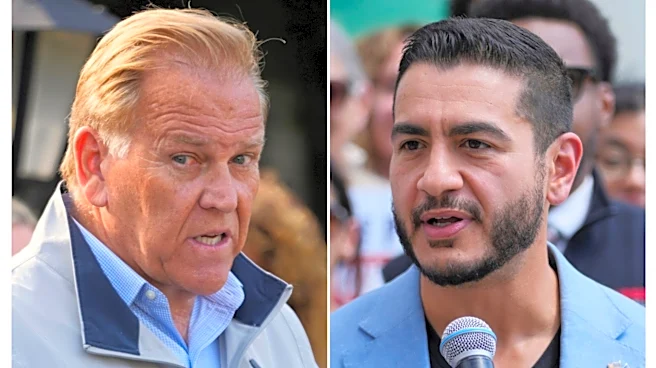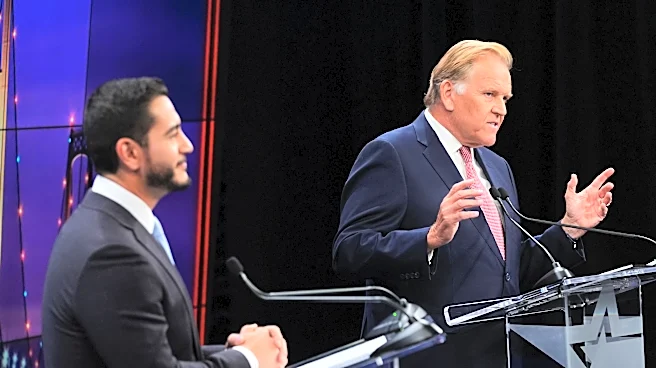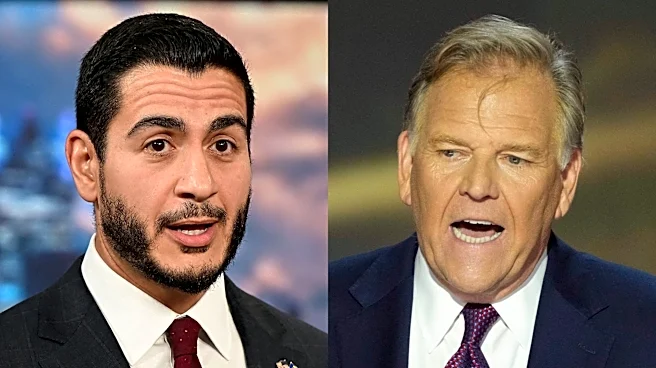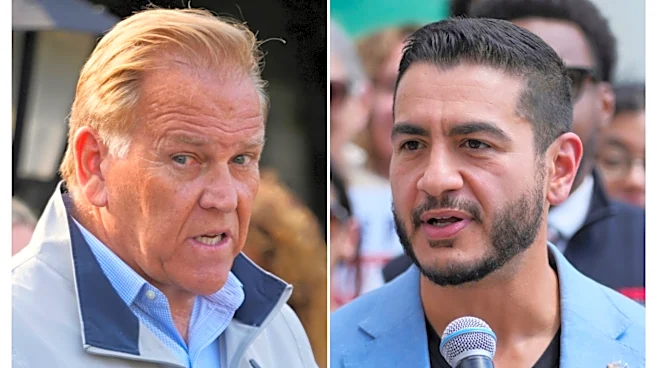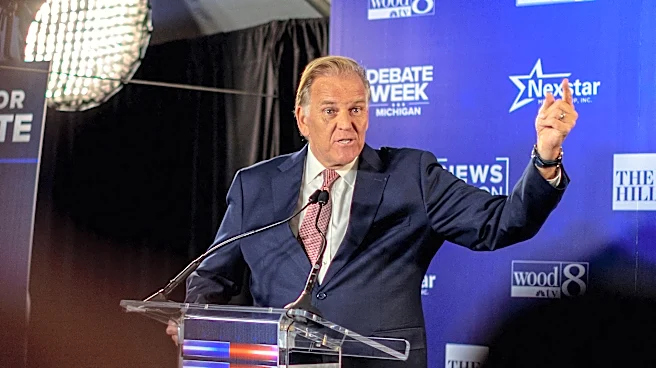



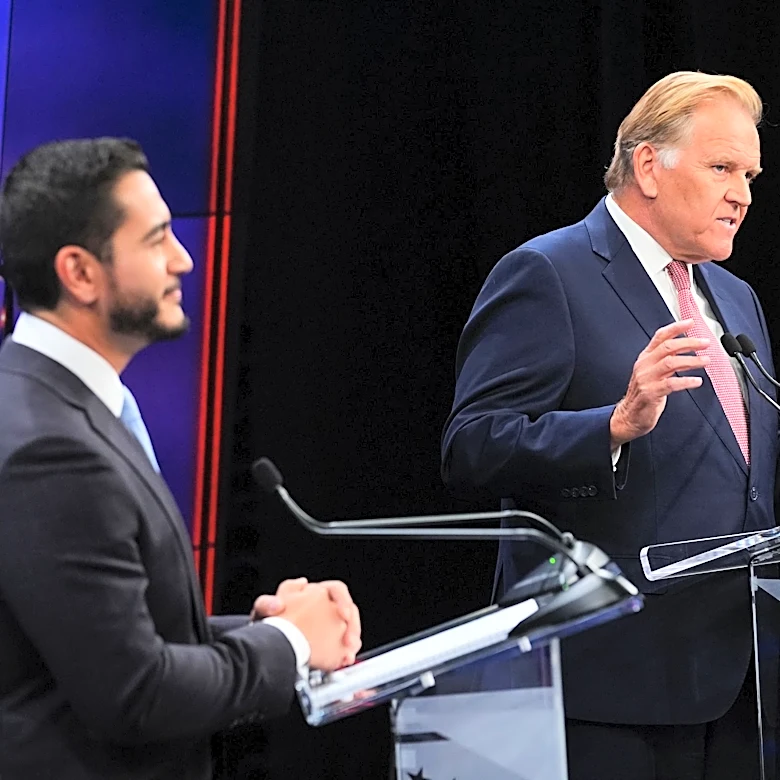
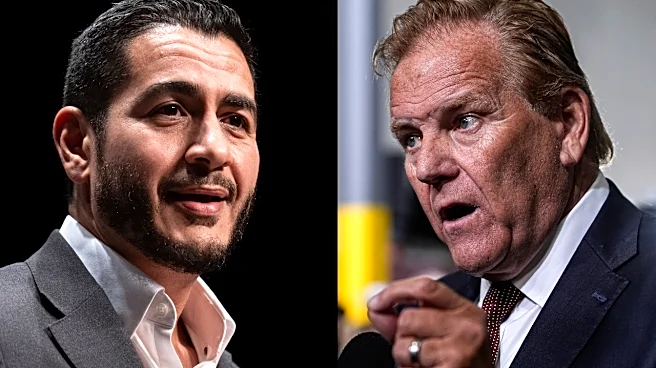
Democratic nominee Abdul El-Sayed and former Republican U.S. Rep. Mike Rogers traded barbs over trade, the war in Iran and affordability — while lobbing plenty of personal insults — during a heated, high-stakes Michigan Senate debate less than four weeks before Election Day.
El-Sayed, a former Wayne County health director, faced questions about the feasibility of progressive stances such as Medicare for All and abolishing Immigration and Customs Enforcement, and was pushed on his opposition to military aid for Israel.
Rogers, a former Army officer who served seven terms in the House, was pressed on his recent flip-flops on President Donald Trump’s trade war with Canada and the war in Iran.
But the policy questions were largely overshadowed by interruptions
and bitter attacks, leading moderator Rick Albin to repeatedly admonish both men.
The hour-long standoff marked one of the candidates’ biggest platforms to date to pitch themselves directly to voters. El-Sayed has sought to expand his pool of support beyond the progressive voting bloc that helped him win the Aug. 4 primary and assuage concerns from some voters, including Jewish Democrats wary of his staunch criticism of the Israeli government. Rogers, who has tried to win over those same voters, attempted to push back on El-Sayed’s efforts to tie him to unpopular Trump policies and corporate donors.
To win back control of the U.S. Senate, Democrats need to net four Senate seats, a goal that becomes exponentially more challenging without Michigan, where incumbent Democratic Sen. Gary Peters is retiring. Polls show a close race between Rogers and El-Sayed.
The Oct. 8 event marked the first onstage meeting between the two candidates, after Rogers declined to attend a Sept. 15 debate, accusing the moderator of being biased.
Here are four takeaways from the debate:
Personal attacks dominate debate
The debate frequently devolved into personal attacks, name calling and accusations of corruption.
During one of the most tense exchanges of the night, El-Sayed raised privacy concerns about Flock cameras and Rogers responded that surveillance would bother someone if they “have somebody in your family that might be on the watch list."
El-Sayed challenged Rogers to be more explicit.
“Go ahead and say it,” he said. “You’ve been tiptoeing around it.”
Rogers also repeatedly invoked El-Sayed's roots as the child of Egyptian immigrants and brought up Islamic terrorist groups.
During one back-and-forth, Rogers incorrectly said El-Sayed, who would be the first Muslim U.S. Senator if he wins, had refused to “condemn a terrorist act that happened on our soil in the state of Michigan,” in reference to a March attack on a Michigan synagogue.
El-Sayed condemned the attack at the time, but also said that “hurt people hurt people” in reference to news the attacker had lost relatives in an Israeli strike on Lebanon. Critics took that as an attempt to justify his actions and El-Sayed later apologized for the comment.
“He can’t condemn Hamas. He can’t condemn the Muslim Brotherhood,” Rogers said.
The attacks came just days after Trump referred to El-Sayed as “Mohammed” and called him a “RADICAL Extremist, Terrorist Sympathizer” in an Oct. 7 Truth Social post. El-Sayed responded a day later, saying the president wasn’t just attacking him. “He thinks he can use my name and my faith to distract us from the suffering his policies are inflicting on us at the pump, at the grocery store, and at the doctor’s office,” El-Sayed wrote on X.
Also in the debate, El-Sayed attacked Rogers’ wealth and his time living in Florida, and accused him of being beholden to corporate interests. During an exchange on health care costs and Medicare for All, El-Sayed said Rogers wants to be a “champion” for the pharmaceutical industry.
Rogers called his opponent “a glitchy AI chatbot” that says “the same thing over and over and over again.” The Republican said El-Sayed was essentially accepting corporate donations after being backed by the Senate Majority PAC, a super PAC aligned with Senate Democrats.
Asked about ending the Iran war, El-Sayed took another jab at Rogers, who he said “wants to be a sock puppet for the Trump administration.”
Rogers argued El-Sayed, who earned a medical degree from Columbia University but is not a practicing physician, was "not really a doctor."
The jostling apparently continued even off camera.
“In 30 years of doing debates, I’ve never seen it continue during the commercial,” Albin said after one break. “But it did”

Debate highlights importance of affordability issues
El-Sayed has focused his affordability attacks on Rogers on the impact the Trump administration’s trade policies have had on Michiganders and the high cost of gas due to the war in Iran, seeking to tie the GOP nominee to an increasingly unpopular president.
The Michigan Democrat pointed to Rogers’ past support of the war in Iran, which the former congressman called a “win-win-win” in May, and criticized the Republican's past support for Trump's trade policies.
Rogers has more recently tried to distance himself from the president’s policies. He released a video in September calling for an end to the war in Iran. On Oct. 7 he released an ad calling for the end of the Canada trade war.
“Weak, cowardly, won't stand up until his poll numbers drop,” El-Sayed said at the debate.
Rogers, meanwhile, pointed to his support for a diesel rebate and a federal and state gas tax holiday.
He argued that the state “cannot afford Abdul,” specifically his support for Medicare for All.
Cost of living concerns remain a key issue for midterm election voters. A Pew Research Center poll released Oct. 8 found that 84% of voters said the economy was “very important” to their vote in November, the highest share of any issue.

El-Sayed defends progressive policies
As he seeks to broaden his appeal to a general election audience, El-Sayed has worked to pitch his progressive policies to a wider field of voters and sought to do so at the debate.
As the topic turned to health care, he was asked whether Americans would be able to keep their private insurance.
El-Sayed said that would be “fine by me,” but he was concerned about people who lose their health insurance when they lose their job, get divorced, age out of their parents’ plans or face other major life changes.
“I want to guarantee every single person in this country, cradle to grave, coverage without premiums, copays, deductibles,” he said.
The Democratic nominee was also asked about his support for abolishing ICE, and used the question to criticize the agency, support a “safe and secure Southern border,” and push for immigration reform.
“We are a country of laws and a country of immigrants, and I think we need a pathway to legal immigration for folks,” he said.
Two approaches to U.S.-Israel relations
One of the starkest policy differences between the two candidates is their views on U.S.-Israel relations. The American Israel Public Affairs Committee and its allied super PAC spent more than $30 million trying to prevent El-Sayed from winning the August Democratic primary against Rep. Haley Stevens.
Rogers was asked about reporting from Axios that he and his allies asked AIPAC to stay out of the race, and whether he would want the pro-Israel group’s support.
“Anybody that wants to help my campaign stop a guy who can't condemn terrorism in our own country … I'll take all of that help,” Rogers said.
Asked if there was anything Israel could do to lose his support, Rogers raised the use of nuclear weapons.
El-Sayed was asked if he would vote to send defensive weapons to Israel if it was attacked by Iran. The Michigan Democrat said he wants U.S. tax dollars spent here and criticized Israel for lobbying the U.S. to enter the war with Iran.
“Ask yourself: Are we safer because of that war? He wants unconditional support for a foreign government,” El-Sayed said of Rogers. “I want unconditional support for kids in our schools, unconditional support for our health care, child care, things that he would vote to defund.”
He was also asked whether he views Israel or Iran as a bigger threat.
“I think both of them have proven dangerous in their own way,” he said. “One at risk of attacking us. One getting us into wars we have no business fighting.”
This article originally appeared on USA TODAY: El-Sayed, Rogers clash: 4 takeaways from the Michigan Senate debate