







Democratic socialists can’t decide whether they’re radicals.
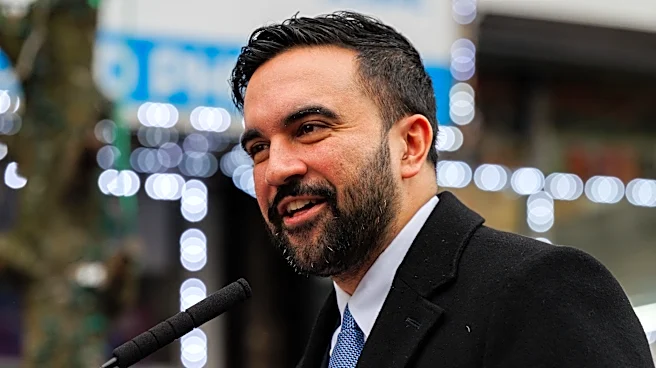
“If today you and I were to introduce the idea of a building that lends out books for free, we would be slandered in the same way that so many new ideas are slandered today,” New York Mayor Zohran Mamdani said in a recent interview with Jon Stewart. “And yet that’s the library. And the same thing with the fire department. And the same thing with public schools.”
While Mamdani insists democratic socialism is misunderstood, the Democratic Socialists of America are remarkably candid about their ambitions. The group’s platform says some of its goals “will require building a new society from the ground up.” Among them: abolishing the Senate, abolishing the Electoral College, and replacing
the president and Supreme Court with "an executive and judiciary chosen by and subordinate to Congress."
Mamdani presents democratic socialism as little more than libraries, public schools and fire departments. The Democratic Socialists of America describe something far more sweeping. Recasting those ambitions as familiar public services is an effort to launder radical ideas into the mainstream.
DSA's moderate pitch hides democratic socialists' radical platform

The Democratic Socialists of America’s platform begins with policies that fit comfortably within Mamdani’s pitch, including “universal healthcare at no cost to individuals” and “free, quality public education from pre-K to college.”
Democratic socialists in office aren’t shy about wanting to replace capitalism. They are, after all, socialists. But their ambitions extend well beyond shifting some industries from private to public ownership. The Democratic Socialists of America’s platform calls for abolishing the police and prison system, abolishing Immigration and Customs Enforcement, establishing universal rent control, enacting reparations and much more.
It is no surprise that democratic socialists favor the House of Representatives and disdain the Senate.
The House is more responsive to sudden shifts in public opinion. All 435 members face reelection every two years, allowing a wave election to produce a new majority almost overnight.
The Senate was designed to resist those swings. Senators serve six-year terms, and only a third of the chamber is up for election at a time. The filibuster’s 60-vote threshold also forces the majority to seek broader support before passing sweeping legislation.
For a movement eager to enact rapid structural change, those restraints are obstacles.
Even more objectionable to democratic socialists is the Senate’s role in balancing the interests of states against the interests of the people. Every state, regardless of population, elects two senators. Together with the Electoral College, that limits the extent to which the nation's largest population centers can unilaterally dictate policy for the rest of the country.
The DSA platform also calls for replacing the president and Supreme Court with an executive and judiciary “chosen by and subordinate to Congress.” That would make both branches extensions of the legislature, eroding the separation of powers that lies at the heart of the constitutional system.
The DSA platform is fundamentally anti-American
The Democratic Socialists of America’s platform isn't just a collection of left-wing policy proposals. It calls for concentrating power in a single branch of government by weakening or eliminating many of the constitutional checks that stand in its way. The Constitution was designed to prevent exactly that, dividing authority among three coequal branches so each can check the others.
Slow, deliberate change is a feature of our system, not a bug. The Constitution is built on the idea that narrow majorities should not be able to radically remake the country overnight. Sweeping change requires broad consensus. That deliberate pace helps ensure major reforms are tested and debated.
“The necessity of a senate is not less indicated by the propensity of all single and numerous assemblies to yield to the impulse of sudden and violent passions, and to be seduced by factious leaders into intemperate and pernicious resolutions,” the Founding Fathers wrote in The Federalist Papers: No. 62.
The Senate was designed to temper the passions of the moment and slow the rush toward sweeping political change.
I call democratic socialists anti-American because they seek to dismantle the constitutional safeguards that have defined American government since its founding. Abolishing the Senate, subordinating the executive and judiciary to Congress, and concentrating power in a single branch would upend the separation of powers and federalism that are central to the Constitution's design.
Democratic socialists are gaining influence within the Democratic Party, and many Democrats are still making up their minds about the movement. Pew Research Center found that while just 32% of Democrats view democratic socialists favorably, 56% remain undecided. Those voters will help determine the party’s future.
The real question isn't whether Democrats embrace democratic socialism. It's whether they embrace a movement that sees the Constitution not as a framework to work within, but as an obstacle to overcome.
Dace Potas is an opinion columnist for USA TODAY and a graduate of DePaul University with a degree in political science.
This article originally appeared on USA TODAY: Don't let democratic socialists pretend they're moderates | Opinion