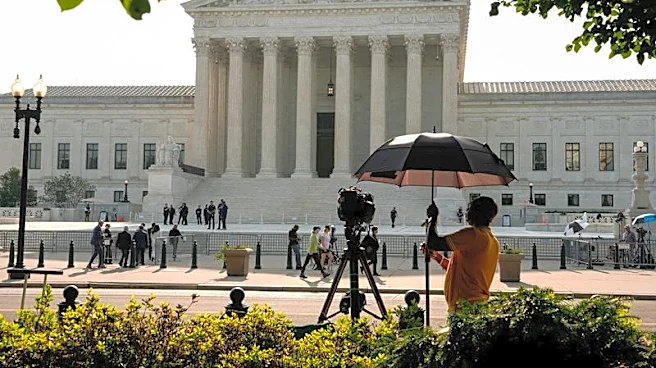









WASHINGTON – The Supreme Court’s conservative majority seems wary of broadly applying a 1988 video-tape privacy law to the modern digital age.
How the 6-3 conservative court decides the case they debated for 90 minutes on Oct. 14 could have far-reaching consequences for the large swaths of the internet that rely on targeted advertising – and for the internet users who are the target of those ads.
The law at issue, the Video Privacy Protection Act, was enacted in response to the decision by the Washington City Paper to release a list of 146 movies rented from a local video store by Robert Bork, who had been nominated by President Ronald Reagan to serve on the Supreme Court. The outrage surrounding disclosure prompted Congress to create stiff penalties
for any video tape service provider who discloses personally identifying information about a customer.
Almost 40 years later, the court must decide whether and how that law applies to websites. The California man at the center of the case says it does.
Michael Salazar used his free digital subscription for 247Sports.com, which is owned by Paramount Global, to watch videos about college sports. He was logged into Facebook at the time. Like many websites that provide content outside a paywall, 247Sports makes money through advertising. Online tracking tools inserted in the webpage send information about the user to a third party – in this case, Facebook's parent company, Meta.
Salazar is seeking to bring a class action suit against Paramount under the Video Privacy Protection Act, arguing the law bars Paramount from sharing his video watching history and other personal information with Meta to create targeted advertising in his feed.

The legal debate centers on whether the privacy protections kick in only when someone signs up or pays money specifically to watch a video.
The law protects “any renter, purchaser, or subscriber of goods or services from a video tape service provider.”
Salazar’s lawyers argue that the phrase “goods or services” covers everything offered by a company, including a free newsletter.
Paramount’s lawyer said that when the phrase “goods and services” is read in context with the rest of the law, it's clear the protections apply only to renting, purchasing or subscribing to audiovisual materials.
Justice Brett Kavanaugh, one of the court’s six conservatives, seemed to express sympathy for that position, saying that the court often avoids interpreting a law too literally to not stretch it beyond what Congress intended.
“Isn’t there a concern about repurposing a statute that was really about public disclosure of what individuals viewed into a statute that regulates data sharing for targeted advertising on the internet?” he asked Salazar’s lawyer. “Those are very different things.”
Chief Justice John Roberts likewise asked whether the court has to look first at the law’s general purpose “before determining that the statute reaches as far as you would have it?”
But Justice Elena Kagan, one of the court’s three liberals, said the statutory language is “relatively clear,” leaving websites with the option of getting consent from a viewer before disclosing information – or not disclosing it.
Kagan said the practice would be similar to other notifications that already pop up on websites asking visitors if they will allow “cookies” on the site to track their interactions.
“We do that a thousand times a day,” she said.
Paul Clement, the attorney for Paramount, said getting consent won’t necessarily be easy and could destroy the business model for much of the internet.
“The reason that material is available for 'free' on the internet is precisely because it’s being financed by targeted advertisement,” he said.
If Salazar’s class action lawsuit is successful, he said, Paramount could be on the hook for $250 million.
Salazar’s attorney said that figure illustrates how much personal information is being passed along to a third party without consent.
“This is a huge-scale disclosure regime,” Joshua Hammack said. “That large liability is only possible because of the scope of the disclosures of personally identifiable information here.”
A decision in Salazar v. Paramount Global is expected by the end of June.
This article originally appeared on USA TODAY: Supreme Court weighs if privacy law can limit targeted ads online