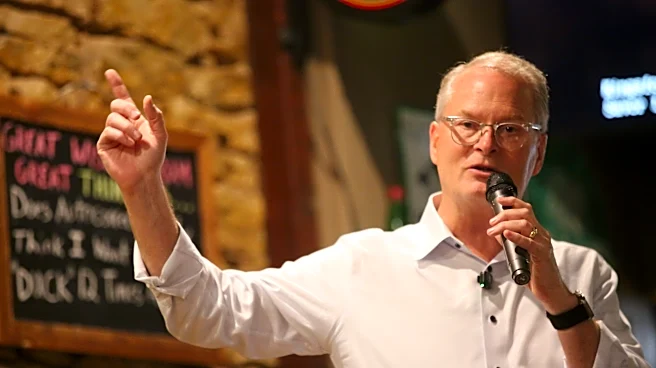




Kansas City-area pastor Adam Hamilton has preached about morals and ethics for decades.
"I have called our congregation to look at the community and say, 'What doesn't look the way it's supposed to look?'” he told USA TODAY.
Hamilton also has taught that "people who love Jesus and try to live out our faith" should be involved when they see poverty, injustice and racism.
"But over the last year and a half, what I found coming out of Washington was an assault on the values that I've preached for the last 36 years," he said.
Earlier this month, Kansas Democrats selected him as their nominee to challenge incumbent Republican Sen. Roger Marshall.
For years, Republicans have had a lock on those who base their vote on religious preferences and values, something
that has only grown with the rise of the evangelical right. But this year an unusually high number of Democratic candidates in red states are sharing their faith in an effort to connect with voters in the midterm elections.
Many of the campaigns have devolved into arguments about the proper interpretation of theology and scripture, as well as the role people of faith and the government should play in shaping society.
At the root is debate about what it means to be Christian in America, according to experts. That debate contrasts traditional conservative values – including protecting the unborn and preserving the nation’s Judeo-Christian heritage – against liberal values that embrace a society made up of people of different religions and backgrounds.
Many of the Democratic candidates come from more liberal or mainstream denominations.
Hamilton is the founding pastor of Church of the Resurrection, which describes itself as the largest United Methodist Church in the United States. He said he started it "for people who didn't go to church anywhere, for people who maybe had been turned off by faith altogether, and to let them know you didn't have to check your brain at the door of the church, that it was okay to ask questions and have doubts.”

It has been more than 90 years since a Democrat was picked to represent the ruby red state of Kansas in the U.S. Senate, though the Cook Political Report changed its prediction for this year's race after Hamilton won the primary from “solid Republican” to “likely Republican,” meaning it has moved into a slightly more competitive position.
Marshall's campaign did not return a request for comment.
Attack ads
Days after the primary, Main Street Fund, a new Massachusetts-based super PAC, launched a commercial casting Hamilton as “way too woke for Kansas.” The ad splices together quotes from two sermons Hamilton delivered in 2020 about climate change and the mass Black Lives Matter protests after George Floyd's death. A slew of right-leaning and religious publications have since delved into his extensive sermons and writings.
Hamilton said he expected his sermons and writings to be dissected when he entered the campaign. Still, he hopes people will read the full text and watch the sermons online, not just clips.
“They've taken three words from one paragraph and then they grab three words from another paragraph and two from another and they sew them together and they put them into a commercial, making me say something that I never actually said,” he said.
Hamilton said his sermons are in line with beliefs held by the Catholic Church, mainline Christian churches and some evangelical churches.
“It's easy for them to take a line or two out of context. But I really hope when people listen to those lines, they're going to go, 'Oh, I want to go back and listen to the whole sermon.' And when they do, I think they're going to find that what I preached is consistent with Scripture, and it actually makes a lot of sense to most people,” he said.
Will it work?
It's difficult to quantify how many Democratic candidates are placing faith in the center of their campaigns. Some have faith-based careers. Others talk frequently about their personal faith, but not through a partisan lens.
Democrats' coalition of voters tend to be the most religiously diverse, but also the most secular, said David Campbell, Director of the Notre Dame University Democracy Initiative.
"Democrats actually have to walk a line between attracting those moderately religious voters that are certainly inclined to vote Democratic without alienating that more secular base," Campbell said.
His research has also shown that secular voters don't mind Democratic candidates talking about religion, but do mind when Republicans do.
For years, Republican candidates have successfully woven their faith into their campaign strategies, said Daniel Williams, who teaches history at Ashland University in Ohio. And Black Democrats, who are used to their churches talking about the intersection of faith and politics, have been vocal as well, he said.
“It's only been very recently that we've seen the Democratic Party experimenting with the idea of having religiously devout white Christians talking very publicly about the connection between their faith and progressive policies. And we'll see how the experiment works,” Williams said.
What's changed? The electoral map, Williams said.
“I think that the Democrats have realized that they have gotten into a situation where the electoral math has locked them out of being very competitive in a number of conservative leaning states. And so the question has been, 'What is going to change the electoral math?'” he said. "There's a hope among some Democrats who have been locked out of any prospect of winning a statewide race for some time... that perhaps this might be the key to winning over a few swing voters.”
Because many Democratic candidates come from more liberal denominations, they might struggle to break into the traditional Republican electorate in socially conservative red states, he said.
“The division between mainline or liberal Protestants and evangelical Protestants on cultural issues is significantly greater today than it was in the 1970s or 1980s," Williams said. "There is a fair amount of distance between their policies and the way that they think about the world and the way that conservative white evangelical Republicans have traditionally thought about the world.”
Republicans say it's fair to point out how the candidates interpret their religion, if they plan to base policy on it.
"Democrats are so lost when it comes to talking to Christians that they think the answer is to say God is transgender, Satanism is OK, and Pagan witchcraft should be embraced. Only the coastal elite puppet masters of the Democrat Party could possibly be so out of touch to think running woke caricatures of Christians appeals to hardworking Americans," Republican National Committee spokesman Zach Kraft said.
Democrats say questioning a candidate's faith is not acceptable.
“Democrats are proud to have candidates of every background, including faith leaders, who are bringing their authentic voice to the campaign trail and fighting for their communities. It's shameful and absurd that Republican officials are questioning someone's faith simply because they're a Democrat. Faith is not a political test," Democratic National Committee spokeswoman Daniela Campos López said.
Key races in Iowa
In Iowa's 3rd Congressional District, Democratic state senator and Lutheran minister Sarah Trone Garriott is challenging Republican U.S. Rep. Zach Nunn. Republicans are attacking Trone Garriott's faith, labeling her a "so-called" minister and questioning her Christian credibility over her support for LGBTQ rights and critiques of Christian nationalism.
The race is one of the nation’s top battleground matchups in the 2026 midterm elections. The RNC has asked "Is Sarah Trone Garriott a Witch?" calling her the "wicked witch of woke."
Nunn's campaign did not respond to a request for comment.
Trone Garriott told The Des Moines Register the attacks are unlikely to stick with voters in a community where she has long woven her faith into her public service.
“I live that out in a way that respects my neighbors who have different beliefs, and stands up for the rights of my neighbors who see the world differently than me, and really centers the dignity of all of my constituents,” Trone Garriott said. “And that is, I think, a fulfillment of my faith — as I said, that calling to love God and love my neighbor. There is no one who is not my neighbor.”
In Iowa's 2nd Congressional District race, state Rep. Lindsay James, a college campus chaplain, faces off against Republican former state Rep. Joe Mitchell. James has experienced Republican attacks centered on her legislative record, pointing to her support for LGBTQ rights and gender-affirming care for minors as evidence that her politics are out of step with her religious background.
The criticism has focused on a 2023 speech she gave against a bill prohibiting gender transition procedures for minors in which she said "when has protecting children meant denying them what can be lifesaving care?"
"If you're a 'pastor' and think that 6 year olds can change their gender, then I don't think you're much of a pastor," Mitchell said in a statement.
At the Family Leadership Summit in Des Moines in July, Mitchell took aim at both James and Trone Garriot.
"They’re not real pastors, right? They don’t profess the true gospel of Jesus Christ,” Mitchell said.
James, a Presbyterian, said the criticism has been "extremely disappointing."
"It's not just insulting to me as a pastor, it's insulting to every Christian and pastor that serves communities in this district, in this state and across the country," she said.
Texas focus on Scripture
Texas U.S. Senate hopeful James Talarico, a Presbyterian studying to become a minister, faces similar criticism of how he interprets Scripture. Talarico faces Republican nominee Ken Paxton, the state’s longtime attorney general.
Talarico's campaign did not respond to requests for comment.
He has made the New Testament's command to love thy neighbor a centerpiece of his campaign.
“Scripture says you can’t love God and hate other people,” Talarico said in a sermon posted on TikTok in December 2025. “You can’t love God and abuse the immigrant. You can’t love God and bully the outcast. You can’t love God and oppress the poor.”
“We spend so much time looking for God out there that we miss God in the person sitting right next to us, in that neighbor who bears the divine image. In the face of a neighbor, we glimpse the face of God,” he said.
Paxton's stump speeches routinely allege Talarico's liberal theology doesn't reflect Scripture. He first drew attention to a past remark that sparked backlash where Talarico referred to God as “nonbinary.”
“In Talarico’s twisted version of Christianity, a follower of Christ is required to bend the knee at the altar of the radical trans agenda, disavow the oil and gas industry, support late-term abortion and open the door to every criminal illegal immigrant seeking asylum. I’m still looking through the Bible to find those passages, but I wouldn’t call it Christian,” Paxton campaign spokeswoman Madison Cercy told USA TODAY.
In May, Talarico told CBS News' Ed O'Keefe he was being "intentionally provocative with that statement." He accused Paxton of "intentionally clipping my cringy comments."
Polling over the last three months shows Talarico and Paxton neck and neck, and on Aug. 20, The Cook Political Report moved the race from its "leans Republican" category to "toss up."
A changing perspective
Robb Ryerse grew up in Christian nationalism and spent the first 10 years of his career as a pastor in a fundamentalist Baptist church. Overnight his interpretation of Scripture changed
"I woke up one day and it was like the answers I was given no longer make sense," he said.
Shortly after, he moved south to Arkansas with his wife and started a non-denominational church, where he has preached for the last 20 years. After watching the rise of Christian nationalism within the Republican Party in Washington, D.C., he decided it was time to enter politics. He challenged incumbent Republican Rep. Steve Womack in northwest Arkansas in 2018 as a Republican. This year he is the Democratic nominee challenging Womack.
"I wanted to be a pastor who stands up and says, "No, no, no, there's a much different way to integrate faith and politics, and it is not that," he said.
Womack declined to comment. The Cook Political Report rates the race as "solid Republican."
Faith can motivate action, but shouldn't be the basis for the nation's laws, Ryerse said. Instead, he said, the basis should be what is best for everyone. That message has resonated with voters, he added.
"I'm not running to take America back for democratic Jesus," he said. "It's not like a progressive version of Christian nationalism. I'm running because my faith motivates me personally, but the Bible's not the basis for laws."
Contributing: Des Moines Register statehouse reporter Marissa Payne
This article originally appeared on USA TODAY: 'Faith' becomes a new battleground for Democrats