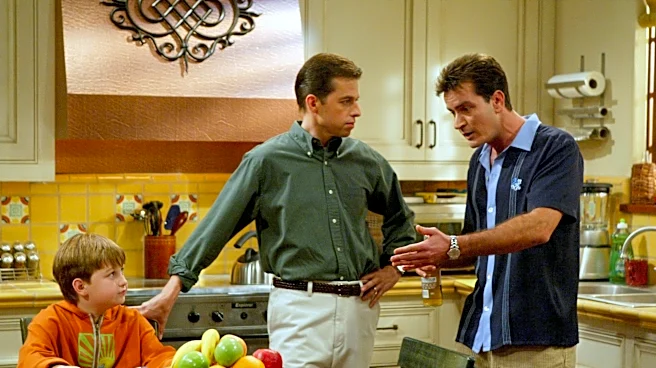








Charlie Sheen's spectacular meltdown on "Two and a Half Men," the CBS sitcom that paid the star approximately $1.25 million per episode, is the stuff of Hollywood legend, not to mention docuseries and books.
Including Chuck Lorre's new memoir, "Sitcom" (out now).
However, Lorre, co-creator of the CBS comedy juggernaut that ran for 12 seasons and 262 episodes, makes clear that the network's biggest perceived threat to the sitcom's success came long before Sheen's infamous TV implosion.
Back then, CBS executives were fearful of casting Jon Cryer, who not only endured Sheen's antics, but went on to win two Emmys playing Sheen's perpetually put-upon brother, Alan Harper, throughout the 12-season run of "Two and a Half Men."
"Just be warned, we don't
want to hear the words 'Jon Cryer,'" Peter Golden, CBS's head of casting, told Lorre during a phone call discussing the Alan Harper role, according to the memoir.

Lorre had worked with Cryer on the failed 1997 ABC pilot "It's Good to Be King" and on the successful sitcom "Dharma & Greg," in which Cryer played an ex-boyfriend of Dharma (Jenna Elfman). Lorre writes that he "was always impressed by him. So I asked why."
The answer: Before landing "Two and a Half Men" in 2003, Cryer had starred in four short-lived sitcoms, none of which survived beyond one season.
“I was told ... yep, you know where this is going ... (Cryer) was the death of comedy,” Lorre writes. “He’d been cast on several failed pilots and series, ergo he must be to blame. All by himself. Jon Cryer, the beloved Duckie in ‘Pretty in Pink,’ was the death of comedy.”

Lorre's memoir is filled with accounts of the writer and show producer bowing to network demands to survive in Hollywood. But when it came to Cryer, Lorre took a stand, pushed by his casting director. Cryer landed an audition before highly skeptical CBS executives, including a "grim" network chairman and CEO Les Moonves.
Cryer crushed it, displaying perfect chemistry with Sheen. Lorre burst into applause as the network brass stewed.
"Really? Applause?" Moonves asked, clearly irked.
"You saw what I saw, he was great," Lorre recalls replying.
Moonves reluctantly relented on the casting ban, offering to give Lorre "enough rope" – leaving the implied "to hang yourself" out in the air.
The pilot was an immediate success and, duh, "Two and a Half Men" became an instant hit, with Cryer proving a series saver, far from the "death of comedy."

Lorre also delves into the "cesspool" of Sheen's final days on the show in his dishy memoir, chronicling sex tape stories to exploding Bic lighter excuses from Sheen to miss filming. But Cryer remained a stalwart, winning his second Emmy for the role in 2012, a year after Sheen's firing.
In Netflix's 2025 documentary "aka Charlie Sheen," a head-shaved Cryer delivered a memorable zinger about his tumultuous eight years working alongside Sheen on "Two and a Half Men."
"I worked with Charlie Sheen for eight years," Cryer said. "And if you wonder what it's like to work with Charlie Sheen for eight years, when I started, I had hair."
Ashton Kutcher replaced Sheen, appearing in 84 episodes over the show's final four seasons before "Two and a Half Men" ended in 2015.
This article originally appeared on USA TODAY: 'Two and a Half Men' creator says network feared Jon Cryer would be 'death of comedy'