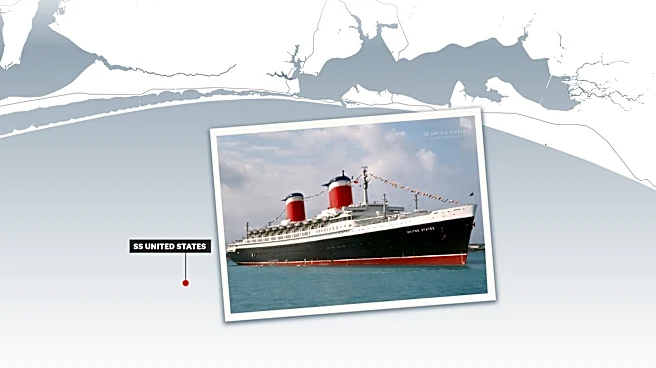








The ocean liner SS United States will soon become the world's largest artificial reef off the Gulf coast of Florida, slipping beneath the waves on Nov. 11 in a final plunge that will be closely watched by thousands of admirers – and of those who sailed aboard it.
"There's no ship like this ship, ever," said Warren Jones, who crossed the Atlantic to London aboard the ship at the age of 8 and has never forgotten it.
"It was a long time ago and yet the memories are so detailed," said Jones, now a member of the SS United States Conservancy. "I can remember the wind on my face and conversations with my parents as we walked through the ship."
Submersion was moved to Nov. 11 by Okaloosa County, Florida, after heavy winds and unsafe weather conditions
were forecast for Nov. 12. The county purchased the vessel in 2024 with plans to convert it into a reef.
Tugboats began moving the 990-foot ship away from its berth in Mobile, Alabama, on the morning of Nov. 9. The ship will find new life as a marine habitat and major dive attraction about 22 nautical miles southwest of Destin, Florida, and 32 nautical miles southeast of Pensacola.
Can't see our graphics? Click here to reload the page.
The submersion will begin at 1 p.m., the county said in a news release. A sendoff ceremony originally scheduled for 1:30 p.m. has been canceled. A live viewing link will be available on thessus.com.
The United States, 100 feet longer than the RMS Titanic, will sit on the Gulf floor 180 feet deep. Its upper decks will be about 60 feet from the surface, according to officials from Okaloosa County.
But though the liner won’t be seen, except by adventuresome scuba divers, it won’t be forgotten. A museum, featuring the ship's two massive funnels and other fixtures, will keep the ship's memory alive.
SS United States was bigger and faster than RMS Titanic
On its maiden voyage in July 1952, the SS United States became the fastest passenger liner to cross the Atlantic by winning the Blue Riband, an honor it still holds.
The ship traveled from Ambrose Lightship at the entrance to New York Harbor to Bishop Rock off Cornwall, England, in 3 days, 10 hours and 40 minutes. It averaged 35.59 knots, or 41 mph over a distance of about 2,942 nautical miles.
The Blue Riband was an unofficial distinction awarded to the passenger liner making the fastest scheduled transatlantic crossing. It was based on a ship's average speed rather than its maximum speed.
The previous record holder was the Cunard liner Queen Mary.
What will it take to sink the SS United States?
Workers on the ship have finished a process called remediation, in which hazardous materials are removed from a vessel before it’s sunk.
A lot of physical labor – and paperwork – are needed to prepare a ship for submersion.
The SS United States left its longtime Philadelphia berth under tow on Feb. 19, 2025. It arrived in Mobile, Alabama, on March 3 after an 1,800-mile journey.
In Mobile, engineers from Coleen Marine worked with about 30 contractors on specific tasks, said Alex Fogg, Okaloosa County's chief of natural resources.
Coleen Marine is a maritime company based in Mobile. It's transformed ships into artificial reefs on the Gulf and Atlantic coasts.
More than four dozen people worked on the United States, said Capt. Tim Mullane, who started Coleen Marine with his wife Coleen O’Malley in 2014.

The furniture and interior fixtures aboard the SS United States were cleared out decades ago, Fogg said. "So we're talking about the equivalent of working on an empty building."
But workers had plenty to do. They removed "the fuel, the remaining fuel oil or contaminated water in the fuel tanks, liquids from the bilges, grease and doors from the water tight doors, or the elevators, and miles of wiring," Fogg said.
"We had some subcontractors that have been in and out, but on any given day, you could count on 40 to 50 people being there," Mullane said. It was a six-day-a-week schedule.
What did the workers do?
Cleaning: Hazardous materials were removed, including paint, oil, fuel and other lubricants and chemicals.
Removal: Items including 400 portholes, windows, electrical wiring, pipes and ship’s fittings were taken off the ship. Cargo hatches and other items were removed.
What's been done to submerge the ship
With remediation complete, regulatory officials inspected the ship to ensure environmental standards have been met. Okaloosa County obtained approvals from the U.S. Army Corps of Engineers and the Environmental Protection Agency.
The ship left Mobile at about 9 a.m. Nov. 9 and was towed to its submersion point off the Florida coast. A security perimeter was established around the liner for safety, keeping onlookers at a distance of at least one nautical mile.
"We'll get it on the site and anchor it up," Mullane said. About two dozen workers will stay aboard. Some will use cutting tools to carve a series of square holes, strategically pre-located, into the hull and decks.
The cut panels will be "a minimum of 4x4 in size," Mullane said. "Some may be much larger, 8x10, 10x10. It's all a matter of figuring out where they need to be and how big they need to be and how things are going to progress as we're in the sinking process," he said.
"We'll have some areas pre-marked and pre-cut, where it takes minimal cutting to knock out some panels on the sides," Mullane said. "We’ll proceed with a ballasting plan where you monitor the ship for list and trim the entire time and just start pushing the ship down in the water."
Valves controlling intake pipes will be opened and the hull of the ship will slowly begin filling with water, allowing it to settle upright into the Gulf.
How long will it take? "That's a million-dollar question," Fogg said. "It could take three hours or it could take all day."
The team from Destin-Fort Walton Beach will inspect the ship a few hours after deployment and determine its exact coordinates. Groups that have equipment on the vessel will go down and recover it.
No other divers will be allowed to dive on deployment day.
How did the SS United States get from Blue Riband to deep blue reef?
The SS United States "really represented the pinnacle of American prestige and optimism, power and technical ability back in the 1950s and 60s," said Charles Anderson, whose father, Commodore John Anderson, was the ship's captain from 1953 to 1964.
"I think we've kind of forgotten about that."
As a transatlantic passenger vessel, the United States sailed between New York and Europe from 1952 to 1969. It had a crew of more than 1,000 and accommodated more than 1,900 passengers.
With World War II in the nation's wake, the ship was designed and built in partnership with U.S. Lines and the U.S. Navy. It was a passenger liner that could be quickly converted into a troopship capable of carrying 14,000 soldiers and a crew of 1,444. It also had space for a 400-bed hospital.
But the ship never felt like a troopship.
"It was sleek, it was fast, it was like sailing on the flag," said Sharon Young, who traveled aboard the liner at age 7. "You would just stare at those slanted funnels, and you would be so proud of being on the ship."
Despite its speed, the ship could not compete with expanding commercial air travel and suffered years of financial losses. It was abruptly taken out of service at Newport News, Virginia, in November 1969.
Officers and crew were stunned, said the SS United States Conservancy. "Some left their equipment and personal items on board in anticipation of returning to work the next day, only to find the gangway doors sealed shut."
It was a sad downhill slide after that. The ship did not sail, but was docked and kept ready for nine years in case the U.S. Navy needed it for troop transport.
It was put up for sale in 1978. Over the next 32 years it passed through the hands of four owners with different plans, including a seafaring condominium and a return to traditional passenger service.
None of these projects materialized, and a lack of financial support ate away at the ship over time.
The interior fittings were auctioned off in 1984. The vessel was towed to Turkey in 1992 and then to Ukraine in 1993 for removal of hazardous material, including asbestos, which was used extensively in the ship’s fireproof construction.
The asbestos had to be removed ahead of a planned makeover of the ship into a modern cruise liner. Walls were taken down, fittings and insulation were pulled out, and the ship's interior was reduced to a bare steel shell.

It was towed to Philadelphia in 1996 and sold to Norwegian Cruise Line in 2003. But the economic crisis starting in 2007 killed plans to put the ship back into service. After 2009, Norwegian started looking at bids from scrapping companies.
It was purchased in 2011 by the SS United States Conservancy, which sought to save the ship by redeveloping it into a floating hotel or other East Coast tourist attraction. Financial backing fell through, and the liner was sold to Okaloosa County in 2024, which offered a plan to sink the ship as an artificial reef that would attract scuba diving enthusiasts, and a museum for landlubber aficionados.
What are reefs and why do we need them?
Reefs are natural or artificial undersea structures that serve multiple functions:
- Shelter and space that attracts fish, algae, corals and other species
- Physical barriers against coastal erosion
- Protection against storm and hurricane damage by breaking up waves
Increased numbers of fish and other marine life benefit commercial fishing. It also attracts recreational divers, which bolsters the local tourism industry.
What was it like to sail aboard the SS United States?

Why do SS United States enthusiasts feel a sense of loss at the ship's transformation into an artificial reef? Much of it is from what they get from the ship, its impressive size, grandeur and history.
Before thousand-foot-plus oil tankers and container ships appeared, "ocean liners were the largest moving objects that humans had ever made," Guardian columnist Ian Jack wrote in 2018.

It took 40 years of work by naval architect William Francis Gibbs to create the SS United States, according to Steven Ujifusa, author of "A Man and His Ship: America’s Greatest Naval Architect and His Quest to Build the SS United States." Gibbs' dream "was to create the finest, fastest, most beautiful transatlantic liner in history."
Those who've sailed aboard the United States acknowledge the result. Once aboard, "you felt you'd been invited to a beautiful party," Young said. "The music was good. The food was good. There were even finger bowls at dinner."
And while it’s wonderful to fly across an ocean, “it's not four or five days on a ship,” Jones said. "Stepping out on the decks and feeling the North Atlantic wind in your face, feeling the ship roll and pitch, that one day of seasickness. That’s an experience."
Okaloosa County initially said the SS United States would be sunk as an artificial reef in late 2025, but the project was subsequently delayed. Delays have been "administrative in nature," according to Okaloosa County officials.
"Okaloosa County maintains a tradition of deploying artificial reefs the correct way. Sometimes that takes time," Shannon O'Malley, a representative of the county, told USA TODAY. "There are multiple agencies that are involved to ensure the vessel is environmentally safe and agencies involved to ensure she is moved in the safest and most effective way."
On Nov. 7, a federal judge in Florida denied an emergency restraining order from SS United States Preservation Foundation to halt submersion of the liner.
The organization's complaint alleged the U.S. Army Corps of Engineers approved the project without adequately examining environmental risks or complying with historic preservation requirements, according to the Pensacola News Journal.
Source: USA TODAY Network reporting and research; Reuters; ssusc.org; Coleen Marine; Okaloosa County Tourist Department; Environmental Protection Agency
This article originally appeared on USA TODAY: How the SS United States will be sunk to become an artificial reef