
Every team trading for a player ahead of the NFL trade deadline is trying to improve its roster. Not every team that makes such a move is successful.
The NFL has seen many midseason trades throughout its history. That's been especially true over the last decade, as the league's decision to move the trade deadline to its current spot after Week 9 has correlated with a higher volume of moves.
While most transactions ahead of the annual cut-off have ended up forgotten, only a few have gone down as all-timers – either for better or worse. Seven trades in particular have aged especially poorly. Many of them have come within the last decade as trade volume has increased.
Here are seven of the worst midseason trades in NFL history, including one widely
considered among the worst in sports history:
Worst trade deadline deals in NFL history
7. Bills deal a third-rounder for Kelvin Benjamin (2017)
Spoiler alert: this is the first of three trades on this list to feature a former Panther underachieving with his new team.
As a first-round rookie in 2014, Benjamin made a strong impression with his 1,008 yards and nine touchdowns. He missed all of 2015 after tearing his ACL in training camp, then returned in 2016 to the tune of 941 more yards and seven more touchdowns.
Before the 2017 season, the Panthers exercised Benjamin's fifth-year option. He rewarded his team with another 1,000-yard season pace through eight games and going into the trade deadline. But in a fascinating move for the then-playoff-contending Panthers, who were 5-3 after Week 8, they traded Benjamin to Buffalo in a move that reportedly came together three minutes before the trade deadline.
Panthers officials explained it was to eliminate redundancy with the skill set of Devin Funchess, a 2015 second-rounder, and give the team more speed options. For the Bills, they got a big, downfield target for then-quarterback Tyrod Taylor after their 5-2 start inspired hope for an end to their 17-year playoff drought.
Benjamin never reached the heights he had in Carolina after heading to Buffalo. He tore his meniscus in his second game with the Bills and only played six games for the team in 2017. Benjamin caught 16 passes for 217 yards and a touchdown. He also had one, nine-yard catch in the playoffs.
Twelve games into his second season with the Bills, Benjamin had an NFL-low 37% catch rate: 23 catches on 62 targets. Buffalo released him on Dec. 4, 2018.
6. Dallas Cowboys use fourth-round pick to trade for Jonathan Mingo (2024)
Is this recency bias? Perhaps.
But the 2024 trade that sent Mingo to the Cowboys certainly has not gotten off to a good start. The Ole Miss product was a second-round pick by the Carolina Panthers in the 2023 NFL Draft and had a mediocre rookie season.
Despite having the second-most targets of any Carolina wideout (85), Mingo caught just about half (43), which was third-most on the team and barely ahead of running back Chuba Hubbard's 39 catches on 44 targets. His 51.8% catch percentage was the fifth-lowest among wideouts with at least 40 targets and the lowest among those with more than 65. Mingo also struggled with contested catches, creating separation on routes and generating yards after catch.
Mingo's 2024 season started worse, with an even lower catch rate (46.2%) on fewer targets (26) and still disappointing production (121 yards) through nine games. Yet Carolina managed to bundle their second-year wideout – who still hadn't recorded a touchdown in his career – with a seventh-round selection for a fourth-round pick at the 2024 deadline.
With the Cowboys in 2024, Mingo recorded five catches on 16 targets for 46 yards, and still no touchdowns.
Carolina used their fourth-round pick to select running back Trevor Etienne – who showed promise in limited touches as a rookie last year. Mingo began the 2025 season on injured reserve with a PCL sprain and saw five targets in six games. So far in 2026, Mingo has appeared in eight games, tallying three catches on eight targets for 30 yards.
5. Diontae Johnson doesn't make it two months with Ravens after trade (2024)
The 2024 trade deadline did not age well for most of the season's buyers. Meanwhile, the Panthers came away as relative winners.
Where the Cowboys' trade for Mingo was bad for several reasons – it was an overpay, Dallas was 3-5 at the time and missed the playoffs, Mingo has never been a top contributor – at least the receiver is still with the team. Such is not the case for Johnson. He didn't even make it through his second month with Baltimore.
At first blush, the rich (Ravens) appeared to get richer with the trade. Carolina was 1-7 and in clear "sell" mode. Baltimore was 5-3, just had a 100-yard game from Rashod Bateman and a 100-yard game from Zay Flowers in back-to-back weeks. General manager Eric DeCosta still felt the team needed one more offensive weapon to take it over the top, and Johnson seemed like the fit.
The Ravens sent a fifth-round pick to the Panthers for Johnson and a sixth-rounder on Oct. 29, 2024, and by Dec. 29 that same year, Johnson was off the team. On Dec. 4, the team suspended the wideout for one game for conduct detrimental to the team – refusing to enter a game because he was cold. Johnson never played again for the Ravens – the team waived him on Dec. 20, one day before his scheduled return from a suspension.
Johnson appeared in one more game that year – for the Houston Texans, the team that claimed him off of waivers – but was waived by Houston before the playoffs and never played another NFL snap.
With the pick return, the Panthers selected tight end Mitchell Evans out of Notre Dame. To date, he has 29 catches for 298 yards and two touchdowns in his two NFL seasons.
4. Chicago Bears trade for Chase Claypool (2022)
Chase Claypool enjoyed two seasons of solid production with the Pittsburgh Steelers after the team made him its second-round pick in 2020. Across 2020 and 2021, the Notre Dame product had 121 catches for 1,733 yards and 11 touchdowns.
In his third season, Claypool's role in the Steelers' offense diminished slightly after the team selected receiver George Pickens in the second round of the 2022 draft.
After Week 8 of the 2022 season, the Chicago Bears were 3-5 after a loss to the Dallas Cowboys on the road. Seeking a boost for its passing offense, Chicago traded its 2023 second-round pick for Claypool, matching the Packers' offer for the Steelers wideout.
The British Columbia, Canada native never played a full season for the Bears. In seven games in 2022, he caught just 14 passes for 140 yards. The next year, Claypool played in just three games, tallying four receptions for 51 yards and his only Bears touchdown before expressing frustration about how the team was using him to the media. He never played another snap for the Bears before they traded him to Miami in Week 5.
Chicago went on to lose every game after trading for Claypool in 2022, and the second-round pick it gave up became the first pick on the second day of the 2023 draft. Pittsburgh drafted cornerback Joey Porter Jr. with the selection, and he went on to finish fifth in the Defensive Rookie of the Year voting.
3. Indianapolis Colts send first-round pick to Browns for Trent Richardson (2013)
Trent Richardson tallied 950 yards and 11 touchdowns on the ground, 367 receiving yards, and one touchdown catch as a rookie in 2012. At the time, he seemed the lone bright spot in an otherwise brutal year for the Cleveland Browns. First-round quarterback and 28-year-old rookie Brandon Weeden had the fourth-worst passer rating in the NFL. Cleveland finished 5-11 and in last place in the AFC North.
So, when the Browns traded Richardson just two games into the 2013 season, it was a bit of a shock to the NFL world. The shock faded once the Indianapolis Colts got their hands on Richardson in his second year in exchange for a first-round pick.
By Week 12, in early December, Indianapolis had already demoted Richardson to a backup role after nine games, averaging fewer than three yards per carry and just two touchdowns.
The Alabama product was only slightly better in his first full year with the Colts in 2013, and the team waived him the following offseason. He never played another regular-season snap in the NFL.
Thanks to a solid second year from Colts quarterback Andrew Luck, the pick Indianapolis sent to Cleveland ended up in the back third of the first round. That year, the Browns traded up from that 26th pick to take another swing at a franchise quarterback: Johnny Manziel.
2. Green Bay Packers think John Hadl is their franchise quarterback (1974)
In 1973, a 33-year-old Hadl played in his first season with the Los Angeles Rams after 11 years with the San Diego Chargers. By the end of the year, the former Kansas Jayhawk earned a sixth Pro Bowl nod to go along with his first-team All-Pro honors (a career first) and second-place finish in MVP voting behind running back O.J. Simpson.
The following year, Hadl started the Rams' first five games before being benched in the fifth game in favor of James Harris, who became the first African-American quarterback to start an NFL playoff game later that year.
Seeing an opportunity to bring in a battle-tested veteran quarterback, the Green Bay Packers sent five draft picks (two first-round picks, two second-round picks, and a third-rounder) to Los Angeles in a midseason trade for Hadl in 1974. The deal only came about because a similar trade attempt for New Orleans Saints quarterback Archie Manning fell through.
Hadl was a disaster in Green Bay. During his one-and-a-half years with the Packers, he led the team to a 7-12 record while throwing just nine touchdowns to 29 interceptions.
Meanwhile, the Rams went on to win six straight NFC West division titles and made a Super Bowl appearance with the help of some of those draft picks. Both cornerbacks Monte Jackson and Pat Thomas, second-round picks for the Rams in 1975 and 1976, earned multiple Pro Bowl nods with Los Angeles.
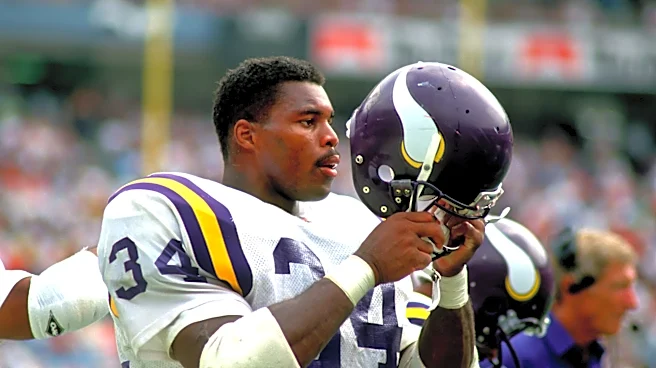
1. Minnesota Vikings trade their future for Herschel Walker (1989)
The Minnesota Vikings' trade for Herschel Walker is among the worst trades in NFL history, midseason or otherwise. It even has its own Wikipedia page.
Walker had established himself as Dallas' best player by 1988, his third season as a pro.
The year before, the former Georgia Bulldog led the NFL with 1,606 yards from scrimmage on 269 touches and earned Pro Bowl and second-team All-Pro nods. In 1988, he rushed for 1,514 yards and five touchdowns and caught 53 passes for 505 receiving yards to put him at 2,019 scrimmage yards. It was enough for another Pro Bowl appearance, second-team All-Pro honors, fifth place in MVP voting, and a sixth-place finish for Offensive Player of the Year.
It was enough for a Vikings team fresh off two straight playoff appearances to make a blockbuster deal for the running back five weeks into the next year. In October 1989, Minnesota received Walker and three future draft picks for five players, three draft picks, and additional picks conditional on the Cowboys cutting those five players.
Ultimately, Dallas didn't play any of the players it acquired in the trade. As a result, the Cowboys got the Vikings' first- and second-round picks in 1990, 1991, and 1992, as well as Minnesota's sixth-round pick in 1990 and third-round pick in 1992.
The Cowboys eventually used those picks to make several additional trades, landing five other players, including running back Emmitt Smith and safety Darren Woodson, to build a roster that dominated the 1990s. Dallas won three Super Bowls between 1992 and 1995.
Meanwhile, Walker played just two full seasons for the Vikings and never exceeded 850 rushing yards in a season. Minnesota missed the playoffs in all but that first year, 1989, with its new running back.
This article originally appeared on USA TODAY: What are the worst NFL trade deadline deals ever? These 7 top the list