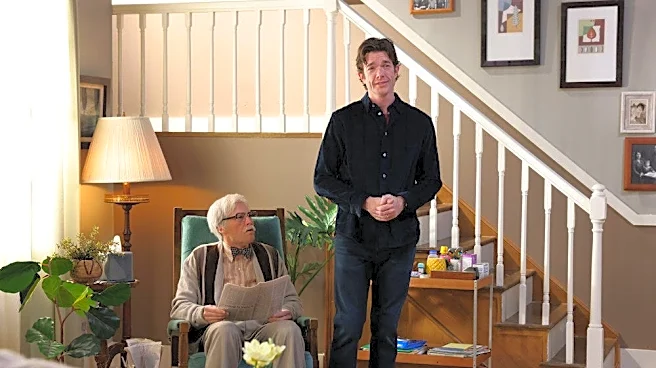







The "Sister" sketch from "Saturday Night Live" has been flooding my group chats and feed since it aired Nov. 14. The responses range from: “I am Sister!” and “What about Wife?” to “I feel so seen right now.”
For the unindoctrinated, in it John Mulaney plays a man who needs to find care for his aging father. Then he discovers Sister, a free, live-in elder care service that is, of course, his actual sister. And just like that, he can go back to his life. Easy – and affordable!
The reason “Sister” is so funny is because it’s also painfully true. Of course he could call the doctor or handle the medication schedule – he knows he could. But he also knows that his sister will do it.
What 'Sister' skit gets right about women's unpaid labor

I’m the sister in my family, too. And I will be the first to admit how
quickly I’ll respond with “I’ll figure it out” before I’ve even had a chance to think through what it means for my day.
Women are so often expected to put their own lives on hold to care for everyone else, while everyone else gets to keep living theirs. Then we call her selfless, which is meant to be a compliment. And that’s what makes it that much harder for her to say no.
But this goes far beyond caring for aging parents. We see it with who takes on the responsibility of raising children, who steps away from their career to care for family or who simply fills the majority of the caregiving roles in our workforce.
Yes, some of those expectations have shifted. Dads today do far more childcare than their own fathers did. Now we need to ask the same of our sons and brothers: Who answers the "Dad fell" text? Who helps Grandma restock her fridge now that she can no longer drive? And who takes in Mom when she is unable to live independently? All of this has real economic consequences.
Caregiving costs mothers $295,000 in lost wages

In the United States alone, about 63 million people are family caregivers – roughly 6 in 10 are women. AARP estimated that family caregivers provided more than $1 trillion worth of care to adults in 2024.
The Urban Institute estimates that unpaid family care costs mothers an average of $295,000 in lost earnings and retirement income over a lifetime.
Think about that. Our economy depends on an enormous amount of unpaid caregiving labor, disproportionately performed by women. The keyword here is unpaid. Yet the very women sustaining that system are often sacrificing their own earning potential, career advancement and long-term financial security.
Some families have less room to absorb these costs. In an AARP and National Alliance for Caregiving survey of people caring for adults 50 and older, 27% of Black caregivers and 29% of Hispanic caregivers said they took on more debt because of caregiving, compared with 17% of non-Hispanic White caregivers.
And this is how patriarchy persists – through expectations so deeply ingrained that we don't even question them. We’ve collectively accepted that women will give up some say over their own lives so the men around them can keep living theirs.
You can see how differently we value women’s time in the way we assume whose plans we check first or whose plans can change.
And women do this, too. We call our sister because we know she’ll show up. Sometimes we’re the ones getting the call, and we say yes before we’ve even checked our calendars. I think it’s worth asking how often we’ve been on both ends of that conversation.
FMLA is a start, but law should require pay for family caregivers

“I feel so seen right now” is the reaction I keep coming back to. There’s a relief in hearing someone so plainly say what your family has treated as a given. Then the sketch ends and somebody still has to call the doctor. It’s easy for patriarchy to carry on when calling “the sister” is easier than getting anyone else time off work.
But why do we continue to treat caregiving as a personal sacrifice instead of a shared societal responsibility?
The federal Family and Medical Leave Act gives eligible workers unpaid leave. As of September 2026, 12 states and Washington, DC, had active paid family and medical leave insurance programs.
But we need to take this a step further: We must ask Congress to make paid family and medical leave available nationwide and demand that it provides enough wage replacement that people can actually afford to take it. Because the reality is, caring for a family member – whether an infant, an ill partner or an aging parent – shouldn’t depend on who in the family can go without a paycheck.
The next time Dad needs a ride to his doctor's appointment, she can say to her brother, “I can take him Thursday. Who’s taking him next week?” He can say, “I am,” and call the office himself.
Her Thursday is worth as much as his.
Alex Taylor is a women's health advocate and cofounder and board member of Perelel, a Unilever-backed women's health company. Formerly president and executive editor in chief of Who What Wear, she pivoted to advocating for women's health after a rare autoimmune diagnosis. Her advocacy takes her to Washington, where she presses lawmakers from both parties to invest in women's health.
This article originally appeared on USA TODAY: 'SNL' 'Sister' skit is, and isn't, funny. Here's the problem | Opinion