
The controversy surrounding Flock Safety, a company that operates automated license plate reader cameras across the nation, has opened a larger conversation about widespread surveillance in America.
Law
enforcement agencies have partnered with the company to speed up investigations by having access to a database thatlogs vehicle information like license plate, make, model, dents or modifications. While the company says the technology is not used to track individual people, opponents argue the wealth of information obtained by the cameras can create a picture of a person's whereabouts, including where they work, where they go to school or church and where they spend their days, effectively creating a personal profile.
According to theAmerican Civil Liberties Union, the cameras have already been used by ICE and CBP to find immigrants, by Kansas police to find a man who wrote a critical op-ed and by Colorado police to wrongfully accuse a woman of theft.
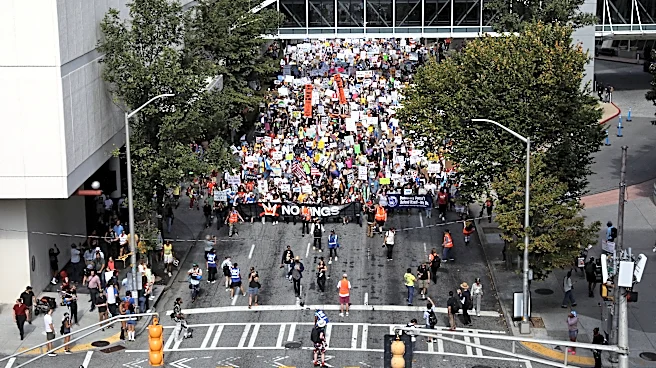
So, what will happen when "No Kings", or other political or non-political protests, are planned or break out this fall in the middle of a tense midterm election season?
Flock teaches agencies to watch large gatherings
In a webinar that is provided by Flock Safety for law enforcement agencies, the company says its cameras can be used to help manage both planned an unplanned events. The company says these can range from "small parades, to unexpected protests, to unprecedented disasters."
A recent recording of the training went viral on X, when a Flock Safety employee was describing how Flock cameras could be used by law enforcement officials that were monitoring a hypothetical No Kings protest. In the recording, the Flock employee describes how officers could watch live footage of the protest and see if roads were blocked or if "things start to go sideways."
Officers are told they will be able to "know when the environment is starting to shift." In some cases, cameras that were pointed at roadways would be able to see if traffic had been stopped by the protest. But in other cases, cameras may be pointed toward a park that was used as an example in the demonstration, and not toward cars.
Another example used in the training showed Flock drones flying over a car show, where the Flock employee said law enforcement could watch the event. She said the show was "likely to turn into some nefarious activity" based on who was promoting the show, and the cameras could be used to see if people start running, suggesting a possible shooting or other violence.
The Flock employee also said law enforcement could watch drivers driving in circles at the car show, also known as doing donuts, and then wait until those drivers were far enough away from the show to enact a traffic stop and pull the drivers over, despite not being present at the actual car show. Specific makes, models and car modifications were considered "more likely" to participate in illegal activity, according to the training, and could tip off law enforcement before any crime was committed.
According to the Flock Safety website, the company's cameras are also promoted for safer parks and recreational spaces where events like a protest might take place. Aside from being able to track vehicles along a park's perimeter, the company says "always-on outdoor security cameras" can help to "prevent vandalism, monitor behavior and respond to complaints." Unlike the actions directly attributed to ALPRs, these security cameras do not specify reading license plates.
USA TODAY reached out to Flock Safety regarding their policies on protests and other large gatherings, as well as with questions about the training video, and did not receive a response.
Clashes between Flock, Atlanta communities escalate during investigation
Flock Safety is headquartered in Atlanta, and the city has become one of the most surveilled metro areas in the nation as much of the state has quickly adopted the technology from a home-grown company.
However, that also means conflict between the company and the communities they serve are happening across the metro.
Atlanta News First investigative reporter Brendan Keefe recently described an incident with police after he noticed a Flock camera being installed near his home in Milton. Keefe said he parked a safe distance away from a Flock employee working on the camera and set up his equipment which included marking his vehicle as a press vehicle and wearing a yellow vest that identified himself as a member of the press. Keefe saw the employee quickly pack up and drive away, and Keefe says he followed the work van from a distance of several cars away to see where the employee may be going to work on another camera.
Instead, Keefe was soon pulled over by Milton police who said the employee had called 911 to report that he was being followed and harassed. Body camera footage of the interaction was shared by Keefe and Atlanta News First, and showed Keefe repeatedly identifying himself as press and stating that he was following the Flock vehicle, but was not chasing or harassing the employee. Keefe was released without any charges.
In Georgia,more than two dozen law enforcement officers have been accused of misusing Flock camera databases to conduct non-investigative searches, and in some cases stalk and harass citizens in their communities.
Kishon Hickman, Sr., a lecturer and program director for the Law Enforcement Executive Leadership Program at Seton Hall University in New Jersey, told USA TODAY in a previous interview the responsibility for reform in this area is split between both law enforcement and Flock, as well as other ALPR companies.
Irene Wright covers Flock Safety as the Atlanta Connect reporter with USA Today’s Deep South Connect team. Find her on X @IreneEWright or email her at ismith@usatodayco.com.
This article originally appeared on USA TODAY: Could Flock be used to track No Kings, other protestors? What we know