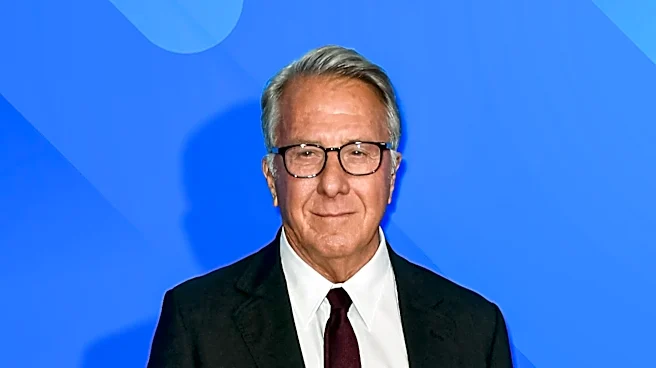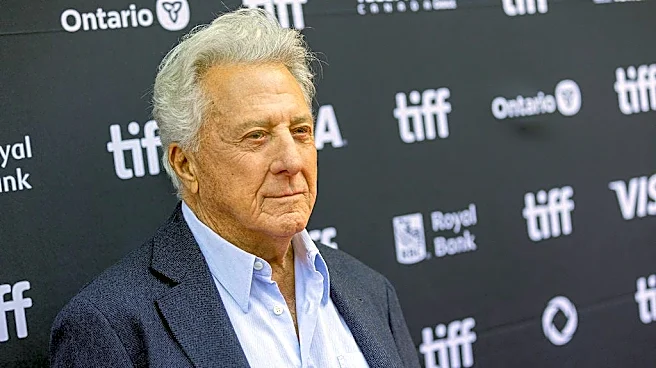





In his unfiltered new memoir, Dustin Hoffman bluntly recounts the highs and lows of making "The Graduate," "Kramer vs. Kramer" and "Rain Man."
But "Look at Me" (out Nov. 10), which is cowritten with journalist Ariel Levy, also finds the Oscar winner opening up for the first time at length about multiple allegations of sexual assault. In 2017, eight women came forward accusing the actor of sexual misconduct, including groping, lewd comments, indecent exposure and forced oral sex. Two of the women claimed they were ages 15 and 17 at the time of the alleged harassment.
No lawsuits or criminal charges were brought against Hoffman, who denied the accusations. In 2017, his attorney dismissed them as “defamatory falsehoods” in a statement to Variety.
In “Look at Me,” Hoffman paints himself as a jokester who will do anything for a laugh, whether he's acting on set or hanging out among friends.
“I’m not looking to humiliate or offend anybody,” the actor writes. “I’m not a person who gets off on having power, or pressuring people to do things. To be perfectly honest, I never thought of myself as a person with power in the first place.”

He continues to write that he was initially very encouraged by the #MeToo movement, as numerous women and men spoke out about alleged misconduct by powerful Hollywood figures such as Harvey Weinstein, Louis C.K. and Kevin Spacey.
“When a reckoning started making its way around the internet, and tearing through Hollywood, I thought it was a very good thing,” Hoffman writes. “I knew by then that plenty of women had put up with way too much for way too long in my industry. Not for a second did I worry that anything negative would be said about me, because the idea of taking something from someone sexually that they didn’t want to give … it’s just not something I’ve ever done. Or been tempted to do.”
Yet suddenly, “my entire life changed,” Hoffman adds. “There was no innocent until proven guilty. There was no ‘proving’ anything at all.”
He compares his cancellation to the McCarthy-era blacklist in Hollywood, in that nobody wanted to meet or speak with him. During that time, he leaned on Lisa, his wife of 46 years, with whom he shares four children.

“Lisa says I went into a state of shock,” Hoffman writes. “ ‘I’ve got to get out of here,’ I told her. ‘I’ve got to get away from every other human being.’ We hid in our house in Connecticut. The first time we went out to a restaurant there, we were both shaking, imagining that every person we encountered was staring at the pariah and his enabler.”
The entire situation was “so crazy, I was sort of bewildered by how to defend myself … or if I should even try,” Hoffman continues. “I didn’t want to be fighting against something that I thought was important. I didn’t want to be on the wrong side of my own values. The only problem was that things were being said about me that just weren’t true. I’m sure it’s true that in my life, especially forty years ago, I made some women uncomfortable. … But ‘uncomfortable’ is a subjective emotional state. What is crass and offensive to one person, another individual might find hilarious."
Hoffman admits that he does have blind spots, like not realizing the misogyny in his 1971 thriller “Straw Dogs.” But he also explains that he’s always loved a “dirty joke.”
“That’s not the same thing as pressuring someone to do something they didn’t want to do. Or firing someone because they wouldn’t do it,” Hoffman writes. “If I were a woman, would bawdy jokes between takes seem threatening instead of fun to me? Would I have a totally different sense of humor? This is something I’ve thought about a lot. And honestly? My guess is probably not. I’ve spent my life analyzing character, human behavior, and I don’t think women are inherently any more wholesome than men are.”
Hoffman has continued to work fairly steadily since his 2017 accusations, appearing in Francis Ford Coppola’s “Megalopolis” in 2024 and crime drama “Tuner” this past summer.
This article originally appeared on USA TODAY: Dustin Hoffman went into 'shock' after sexual misconduct accusations