




On the Friday, September 18, 2026, episode of The Excerpt podcast:
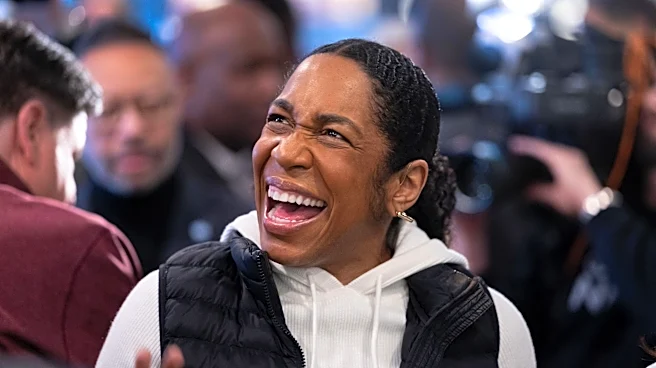
Illinois Lt. Governor Juliana Stratton could make history if she's elected to the U.S. Senate, but her campaign is also rooted in a deeply personal family story. USA TODAY Senior Reporter Jay Stahl joins The Excerpt to discuss how her father's experience with segregation, along with the loss of her father last year, continues to shape her candidacy to replace Sen. Dick Durbin.Hit play on the player below to hear the podcast and follow along with the transcript beneath it. This transcript was automatically generated, and then edited for clarity in its current form. There may be some differences between the audio and the text.
Podcasts: True crime, in-depth interviews and more USA
TODAY podcasts right here
Dana Taylor:
If Illinois Lieutenant Governor Juliana Stratton wins her US Senate bid this November, she won't just fill Dick Durbin's seat. She'll make history. USA TODAY Senior Reporter Jay Stahl decided to dig deeper into Stratton's story and the very personal story that's driving her campaign. This is USA TODAY's The Excerpt. I'm Dana Taylor. Jay Stahl joins me now to dig into this story. It's good to have you here, Jay.
Jay Stahl:
Thanks for having me, Dana.
Dana Taylor:
I want to look into how this story came together for you. What made you want to look at Stratton's senate run through this lens of history making?
Jay Stahl:
Well, I started out this story as a profile. I'm from the Midwest and I thought that the contours of this race were really interesting. Juliana Stratton is from the south side of Chicago. She was running against two sitting house members, and she actually was sandwiched between Representative Robin Kelly, who's a fellow black woman, and then Representative Raja Krishnamoorthi. And what made the race so interesting is she was running to the left, she's the Lieutenant Governor of the state, but she just wasn't able to break out in polling for much of the race. And obviously there's also the historic nature of Illinois. Illinois has sent many, many black representatives to the Congress and obviously Carol Mosley Braun, the first Black woman elected to the Senate, served there, and then also former President Barack Obama from 2004 up until his presidency. So a very historic nature in that state of electing Black people to Congress.
Dana Taylor:
If Stratton wins, she's going to be replacing Senator Dick Durbin. Is she positioning herself as his heir or is she running as something different?
Jay Stahl:
Senator Durbin is interesting because he's the number two to Chuck Schumer. And what's interesting about Lieutenant Governor Stratton is on the campaign trail, she's pledged not to support Chuck Schumer if the New York Senator runs for leader. He was previously the Senate majority leader. And so I think that tells you a lot about how Juliana Stratton plans to differ herself from Dick Durbin if she's elected in November, which she's presumptively expected to do.
Dana Taylor:
You bring up this compelling through line between Juliana Stratton and her father, Henry W. Wiggins Jr. What did Stratton share with you?
Jay Stahl:
Dr. Wiggins was her dad, but she kind of talked about how he grew up in this small town of about 6,000 people in Pennsylvania called Clearfield. And when he was in high school, he wanted to go to Washington to visit the Capitol with his high school classmates. And the Lieutenant Governor shared with me that he couldn't go because it was a different time in America. And so he wouldn't have been able to eat at the same restaurants or stay in the same hotels, and so he just couldn't go on the trip. And she talked about during the interview how it wasn't her great-grandfather that she was talking about or her grandfather, it was her dad. Her dad died last year, and so he won't be able to see her elected to the Senate if she wins in November. Obviously in this country, we have an ongoing conversation about race and civil rights, and I thought it was interesting how she pointed out how this happened just 60 years ago. It wasn't something that happened so far away.
Dana Taylor:
We've touched on Dick Durbin's legacy, but it's impossible to tell this story without someone you mentioned, Carol Mosley-Braun, right?
Jay Stahl:
Yeah. Carol Mosley-Braun was the first black woman ever elected to the Senate in the country and served Illinois like Lieutenant Governor Stratton lived on the south side of Chicago. And so what's interesting about Carol Mosley-Braun is she actually represented Illinois at a different time in the state's history before Barack Obama, when the state was more like my home state of Wisconsin. Wisconsin is a swing state. It helps decide presidential elections. At the time, Illinois actually elected her and then she lost to Senator Peter Fitzgerald, who was the first Republican to win Illinois in 28 years. So she served just for one term.
Dana Taylor:
If Stratton wins, what would her victory mean historically both in Illinois and nationally?
Jay Stahl:
Well, I think it would be notable in Illinois that they would send another lawmaker who has blocked the Senate, but it would also mark the first time that three black women would serve concurrently in the Senate. In the previous Senate, only Senator Lafonza Butler served. She was appointed after Senator Diane Feinstein died. In this Senate, Senator Angela Alsobrooks of Maryland and Senator Lisa Blunt-Rochester of Delaware were elected. And so those two will still be serving in the Senate. They're only two years in, and so Lieutenant Governor Stratton would join them and it would make the first time that three black women served together in that body.
Dana Taylor:
Then I wonder if you can dig into how their wins helped you frame your story.
Jay Stahl:
Well, I think it's really interesting to think about the fact that those two won in such an interesting election cycle. Obviously, President Donald Trump returned to the White House. There were mixed results for Republicans and Democrats in swing states, and so I think their wins and their reliably blue states really provided a role for representation within the Democratic Caucus.
Dana Taylor:
Well, you've had some time to see their first two years in office. What have those two serving senators said about their experiences?
Jay Stahl:
They share a deep friendship. I talked with both senators, with Angela Alsobrooks in her office, and she told me that they refer to each other as sister senators, that when they're in Democratic Caucus meetings, which are those private meetings that lawmakers have to talk through policy priorities, they can look at each other without saying anything and know what the other is thinking. She shared with me that Senator Blunt Rochester and her had this interesting personal relationship where one time her father was sick and she had a delivery at her door and it was soup from Senator Blunt Rochester. So obviously a close bond there.
Dana Taylor:
Well, if Stratton wins, what did analysts say about the potential policy impact of having these three women serving together?
Jay Stahl:
Well, I talked with two experts and both of them told me that they focus on areas like healthcare and education. Maternal health is a really big one because Black women are impacted at a greater level with maternal health issues. One professor from Washington University in St. Louis told me that what happens sometimes when Black women serve in the Congress is that they focus on issues of race and gender differently than just race or gender on a single axis, meaning that they focus on issues that matter to both and and not just for. So it was a super interesting perspective. I think those experts expect for them to add a little bit of a diverse perspective when they enter the Senate if those three serve together in the next class.
Dana Taylor:
Well, it's interesting you said both and, or any of these policy issues that could attract bipartisan support.
Jay Stahl:
Well, I certainly think that maternal health is important for senators and the Republican Party. A lot of senators have bonded over motherhood. Katie Britt and Ashley Moody are both moms of young children, and so I think it's certainly an area where there could be bipartisan consensus found.
Dana Taylor:
Jay, if Stratton wins this November. As you said, her father, Wiggins Jr. won't be there to see her take office as he passed away this last November. That's one of the more emotional pieces or threads in your piece. How much did that inform the story that you told here?
Jay Stahl:
I'm close with my dad. We're extremely close. I call him every day and he'd probably like me to stop. And so when I was listening to her talk about this, I felt like it was a relatable element. So many of us use our fathers to help guide our careers, and I thought it would be an interesting way to thread that storyline of loss through the piece. I think the Lieutenant Governor was really close with her father, with both parents. Her mom, Velma, was a Chicago Public Schools teacher, and she talked about how both of them would, if they were here, they would say, Juliana, you're doing everything we taught you to do. And I just felt like no matter your party or what you believe, that's a relatable theme and through line.
Dana Taylor:
I know that you had a rich conversation with the Lieutenant Governor. Is there anything that didn't make it into your piece that resonated with you?
Jay Stahl:
Well, I think she was very candid about her work with Governor J.B. Pritzker. The governor is obviously a potential 2028 aspirant. And so when we think about the 2028 field, this race was framed in the media as if she lost, what would it spell for his 2028 hopes? And what we know is that she didn't lose and she actually won by a lot more than I think people were expecting at the outset of the race. She surged in the polls last minute, and so it really, in the race its final days, was seen as a prediction or a bellwether about how J.B. Pritzker's endorsement record would fare in the same way that we measure President Donald Trump's.
Dana Taylor:
Jay Stahl is a senior reporter for USA TODAY. Thank you so much for sharing your reporting here, Jay.
Jay Stahl:
Thank you.
Dana Taylor:
That's today's show. We love hearing from you. You can drop us a line at podcasts@usatoday.com. I'm your host, Dana Taylor. I'll see you next time.
This article originally appeared on USA TODAY: If Juliana Stratton wins, the Senate makes history | The Excerpt