





You can kick the fraternities off campus, but that doesn't necessarily stop the trouble.
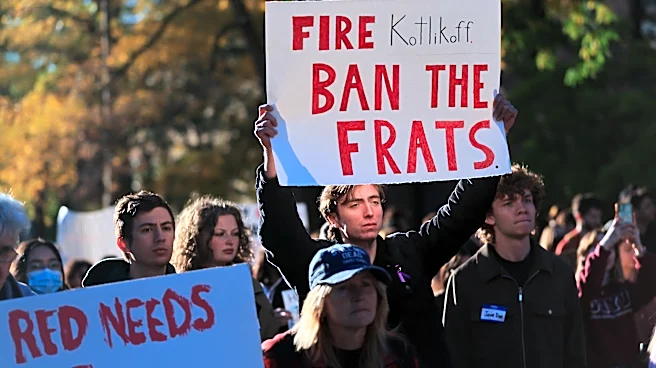
Calls to disband these groups have exploded after allegations of a gang rape at a Cornell University fraternity. Other incidents only add to the case against Greek-letter organizations, from charges against a fraternity drug ring at Penn State in August to the suspension of a fraternity at Ohio State this week after allegations that two men were set on fire during what police are investigating as a hazing incident.
Similar controversies tied to sexual assault or hazing have been reported in recent weeks at campuses in Arizona, Colorado, Indiana, Illinois, North Carolina and West Virginia. Cornell’s president said Greek life on that campus could end if “fraternities
cannot exist in a safe environment” following the rape allegations.
But once they're untethered from the university's influence, fraternities can continue to cause problems. Take the Sigma Chi chapter at Penn State, a group unrecognized by the university, where some members were caught up in the drug charges. At the Alpha Epsilon Pi chapter at the University of Wisconsin, police found 30 partially clothed pledges in a hot basement in September, and a city police report said some had “visible injuries consistent with being physically assaulted.” The university hadn’t recognized the group since 2015.

And it’s not just individual chapters. Whole systems can exist without university oversight or approval.
That’s what happened at the Bloomsburg campus of the Commonwealth University of Pennsylvania, an institution that cut ties with Greek life groups in 2021 after the deaths of two students at Greek life events and repeated hazing issues.
But by Rylan Mears' freshman year in 2024, he was welcomed "with open arms" into Delta Pi, one of 20 fraternities and sororities that incorporated off campus. He's now the president of his fraternity, one local to the community.
“Without Greek life, I don’t think Bloomsburg would be the way it is,” he told USA TODAY.
It’s happening at other universities too. Duke University tried to limit when fraternities could recruit in 2021. Rather than comply, the largest groups broke away to operate independently. Santa Clara University in California moved to end fraternities and sororities in 2001, but chapters there still thrive off campus with support from national organizations. Georgetown University has tried repeatedly in the past decade to warn students away from unrecognized Greek-letter groups that continue to persist there.
Fraternity and sorority advocates say calls to ban the groups unfairly target organizations that have done nothing wrong. They say students in Greek life report better mental health, are more likely to volunteer and stay in school longer. And efforts to end fraternities and sororities also run up against the fact that student interest in the organizations is surging.
A growing population despite controversies
Calls to end the system are not new. As recently as 2020, Vanderbilt students called on the university to “Abolish Greek Life,” corresponding roughly with the Black Lives Matter protests across the nation that summer. Similar calls took place in 2017 after footage emerged of 19-year-old Penn State student Timothy Piazza dying in a fraternity house after falling down a flight of stairs. In 2014, the majority of Dartmouth faculty voted to end Greek life at the school. Fraternities and sororities remain active on all those campuses.
At Cornell, the nexus of the recent calls, the university banned fraternities and sororities from social activities through the fall semester, with President Michael Kotlikoff suggesting that the school may ban the groups outright.
But the calls to end Greek life also come at a time when some colleges are adding fraternities and sororities to campus or making it easier for students to join. And despite the recent critical media attention, the leaders of the North American Interfraternity Conference, the largest trade group for fraternities, and the National Panhellenic Conference, said recruiting remains strong among their chapters. They also said enrollment has been rising since the pandemic.
“We’re projecting that we’ll be at our largest ever this year and that’s with declining male enrollment,” Jud Horras, the president of the Interfraternity Conference, told USA TODAY. “The reality is even in the past three weeks we have had a record number of men joining. The interest is stronger than we have ever seen it.”
The fraternity group shared data that represents about 65% of its chapters with USA TODAY that showed membership had increased from around 125,000 in the 2003-2004 academic year to about 200,000 currently. There was a dip starting around 2018-2019 that bottomed out during the onset of the coronavirus pandemic in 2020-2021, but membership has been on the rise since.

The story was the same for the sororities in the Panhellenic Conference, whose head, Dani Weatherford, said enrollment had risen to nearly 400,000 members in the 2025-2026 academic year. That’s a 6% increase from the prior year.
That aligns with a USA TODAY review of data at several large public universities, which found that either enrollment in these organizations or their share of the student body has risen since 2023.
At the University of Alabama, for example, there were 12,420 students in Greek Life in 2023 and 13,410 by 2025, which is roughly 37% of all students. The University of Tennessee saw undergrad enrollment rise from roughly 29,000 in fall 2023 to 32,100 in 2025, while the Greek life population grew to as much as 30% in the same time periods.
Greek life historically is overrepresented in the South, but Iowa State, Ohio State, the University of Arizona and the University of Michigan have also seen similar increases in the percentage of students involved in Greek life.
At Florida State, where enrollment in fraternities is up, college-age men told the USA TODAY network that they condemned the allegations at Cornell and grappled with what it meant for Greek culture. Reed Rousseau, a Sigma Phi Epsilon member, said fraternity life gave him lifelong friendships and opportunities to serve the community.
"People see the headlines of all the wrongs fraternities have done, but rarely see the pros of fraternities," Rousseau said.

That growth highlights one of the benefits to universities: Greek life helps recruitment at a time when college enrollment is expected to drop in the coming years. Some colleges around the country, such as Molloy University, a private university on Long Island, are adding chapters or entire Greek communities. Fraternities, Horras said, can help attract male students, a demographic long on the decline in America’s colleges.
What’s more, when fraternity and sorority members graduate, they’re more likely to donate to their alma mater. A 2021 Gallup survey conducted on behalf of the Interfraternity and Panhellenic conferences found that 54% of their alumni donated to their schools, compared to 10% of those who were not in fraternities or sororities.
National groups can support Greek life after university sanctions
Greek groups affiliated with universities often have access to on-campus housing, the ability to recruit on university grounds and can tap into school funding. They also carry the implicit backing of the university. When the university cuts those ties, that help all goes out the window. But that doesn’t mean they’re without support.
Many fraternities and sororities are chapters of larger national groups that guide how they operate and provide resources. When a college cuts ties with a chapter, it can survive off campus with support from its national organization.
That’s what happened with the Sigma Chi chapter at Penn State, one of the two fraternities tied to the drug ring allegations at the school. Penn State suspended the fraternity in 2020 for violations of the university’s COVID-19 policies. The local group opted to break away from the university, and Sigma Chi said it backed its decision to keep “operating unrecognized, paired with improved risk management planning, rather than see it disappear.”
It went on to say it has suspended the members tied to the ring and will expel them if they’re found guilty. It also suspended the unrecognized chapter at Penn State, saying, “this does not mean we believe the chapter, as it stands today, is guilty of the conduct now being alleged from years past.”
Alpha Epsilon Pi, the fraternity at the center of the hazing allegations at the University of Wisconsin-Madison, was also backed by its national organization. The school had stopped recognizing it in 2015, but it retained its recognition from the national group. The national organization has since issued a cease-and-desist order to the Madison chapter.
For sororities, the Panhellenic Conference, the trade group representing them, also recognizes groups that lack university backing. Weatherford said the conference prefers to work with chapters associated with their college, but sometimes there are “differences of opinions.”
“Even when the university administration doesn’t want to support women in these experiences, the women themselves want to do it,” she said.
She added that the group does not support sororities that had been sanctioned, but rather those on campuses that don’t recognize Greek life, like Georgetown, Santa Clara University and Bloomsburg.

Greek life at a campus that doesn't recognize it
By May 13, 2021, administrators at Bloomsburg University in Pennsylvania had had enough. In a two-sentence email, then-President Bashar Hanna said the school was terminating its ties to fraternities and sororities.
The move came after the deaths of two students, Justin King in 2019 and Leah Burke in 2021, and repeated run-ins with the campus leaders, some tied to hazing allegations. The university said at the time that its decision wasn’t tied to the students’ deaths.
The university’s attempt to stamp out Greek life didn’t deter students. In November 2021, the student newspaper reported some chapters sought recognition and support from their national organizations. Others registered with the state as nonprofits. Phi Sigma Sigma, of which Burke was a member, disbanded in 2021. Some of the members then formed Zeta Chi, a local sorority established in 2022.
Kait Turnbull is the president of Zeta Chi. Even before she was a student, sororities reached out to her via social media. It was nice, she said, to have a group of people to talk to when she didn’t know anyone on the campus. By the time she got to Bloomsburg in 2024, everybody around her was rushing. She did the same.
She knew about the student deaths, but they didn’t worry her. She felt the university cutting ties with fraternities and sororities meant the groups had essentially reset.
“I just always had in my mind that if I felt something wasn’t right, I could just disaffiliate," Turnbull said.
The group, she said, has given her friendships, experience at fundraising and even taught her how to file taxes. The lack of university support never bothered her, she said, and new recruits don’t ask about it.
Mears, the president of Delta Pi, said he has never faced pressure from the university. He and his members still come to campus to recruit, and he feels the groups have been given free rein as long as their activities don’t affect the university’s image.
He also regularly meets with chapter alumni to update them about the fraternity. They provide “constructive criticism” and make sure the members are staying on top of their grades, Mears said.
In 2024, the school announced that it planned to bring back Greek life. Commonwealth University of Pennsylvania spokesman Doug Spatafore told USA TODAY that those plans have “been paused as the University focuses on its financial sustainability and organizational restructuring efforts.”
But as Turnbull and Mears have found, they don’t need the university’s blessing to exist.
Contributor: Brooke Meotti, staff writer for FSViews & Florida Flambeau, part of the USA TODAY network.
This article originally appeared on USA TODAY: Colleges can ban fraternities. But they can't make them disappear