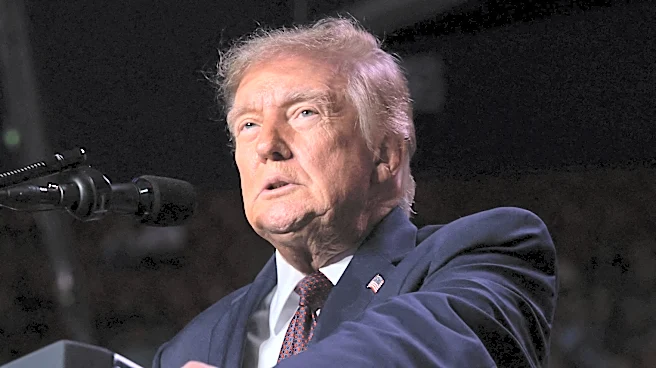

WASHINGTON — For one hour and 22 minutes, President Donald Trump plowed through his greatest hits, calling his opponents "sick individuals" who "hate America," declaring MAGA "the greatest political movement"
in the nation's history and telling his followers "we gotta win" the midterm election.
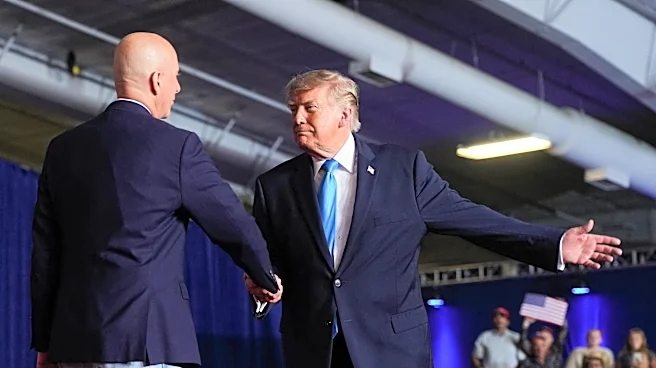
But Trump wasn't speaking to a crowd in a traditional battleground state. He was addressing an arena full of cornhuskers in ruby-red Nebraska, which he carried in the 2024 presidential election by more than 20 percentage points.
"They're all saying we're in trouble in the midterms," Trump said in a meandering Oct. 5 speech as he campaigned with Republican Nebraska Sen. Pete Ricketts in Grand Island, Nebraska, warning that pieces of the MAGA agenda are at risk. "It could all be taken away if you start losing a couple of little elections."
Nebraska received little attention at the start of the midterm campaign cycle. Republicans expected to focus their efforts on states like Maine, North Carolina, Georgia, and Michigan. Polling over the summer moved Texas and Iowa into the toss-up category and landed with a shock.
But one month before the Nov. 3 election, Democrats are increasingly playing offense in historically Republican states and districts as the battleground map expands into even redder parts of the country: Alaska, Kansas, Nebraska, and even South Carolina.
It's the latest evidence that the expected blue wave could be even bigger than expected, and could not only give Democrats control of the House, but also the Senate, once thought to be a long shot.
"This election has all the signs of a blue tsunami coming, and there's not really anything that the Republican Party can do to stop it," said David Cohen, a political science professor from the University of Akron.
Cohen compared the election outlook to the 2006 midterms, when Democrats flipped the House and Senate while George W. Bush was president. He said all the trends favor Democrats, including the presence of a deeply unpopular Republican president and hardened anxieties about the economy. He called Trump "an anchor for Republican candidates" and argued the president is making making matters worse by campaigning alongside them in their home states.
He also predicted Republicans' mid-decade congressional redistricting efforts, which added a number of GOP-leaning seats, won't be enough to stave off significant gains for Democrats.
"I mean, my gosh, we're talking about Democrats potentially winning seats in Alaska, and Iowa and Texas," Cohen said.
In the fight for the Senate, the dynamics have forced Trump and Republicans to spend valuable time and resources in Alaska, Texas, Iowa, and Ohio ‒ and more recently Nebraska, South Carolina and Kansas, each of which Trump won with double-digit margins in 2024. Polls show Democrats competitive or leading in each of these states, while also leading in the first-tier of battlegrounds such as Georgia, North Carolina and Michigan, and tied in Maine.
On the House side, where Democrats are now heavy favorites to take over, the Democratic Congressional Campaign Committee this week added six Republican-leaning seats to its midterm target list, including two seats Trump carried by more than 20 percentage points in 2024.

The political climate has also forced Republicans to begin making some tough choices on how to triage the expanding battleground map down the final stretch, including pulling money out of North Carolina, where the race to defend retiring GOP Sen. Thom Tillis's seat seems increasingly out of reach, while pouring funds into Kansas, where a Democrat hasn't won a Senate race since 1932.
The fresh signs of growing Democratic momentum come as Trump's approval rating is floundering at all-time lows, with Americans overwhelmingly opposing the U.S. war in Iran and blaming the president for high gas prices and their concerns over the economy.
"We win when they lose," said John Anzalone, a longtime Democratic pollster. "This was the guy who was supposed to fix the economy, and he's actually made it worse. His biggest strength has turned into his biggest weakness, and that's penetrated down to his candidates, who have followed along with him."
At the same time, the Democratic brand remains weak. Only 38% of Americans have a favorable opinion of the Democratic Party, about the same as when Trump returned to the White House in January 2025, according to a Wall Street Journal poll, conducted in September by Democratic pollster Hart Research and Republican pollster National Research Inc.
Though Republicans acknowledge several additional red states have turned competitive, they're banking on the party's significant financial advantage and Democrats' unpopularity to prevent a political earthquake. Trump and Republicans have worked to seize on the trend of far-left Democratic Socialists of America candidates winning primaries this cycle.
"There's no doubt that independent voters want to put a check on Donald Trump, but they also don't think that this Democratic Party ‒ with the DSA rising ‒ is worthy of putting in charge," said Republican strategist Brad Todd, partner of OnMessage Public Strategies.

A 'perfect storm' for Democrats in midterms
Republicans have been on the defensive in several solid red states and districts for months, but the emerging battlegrounds are a deeper shade of crimson.
The expanded map has opened new paths for Democrats to get the net gain of four seats they need to take over the Senate, where Republicans have a 53-47 seat advantage.
Among the Senate races that popped onto the national radar in recent weeks, Trump carried Kansas by 16 percentage points and South Carolina by 18 in 2024. Republicans are now ramping up spending in both states amid concerns that Democrats have momentum.
The six House districts Democrats recently added to their target list – spanning the map from Arkansas to Colorado, New York, Florida, Tennessee and Nevada ‒ went for Trump by an average of 16 points.
Trump's recent travel schedule reflects the GOP's need to protect home turf. In addition to deep red Nebraska, he has visited Ohio, Oklahoma, Alabama, and Texas (twice) over the last week, all states he carried handily.
He said he also plans to travel to Alaska to stump for Sen. Dan Sullivan, who is in a tough election against Democrat Mary Peltola, a former congresswoman.

Sean Spicer, who served as White House press secretary during Trump’s first term, said it makes sense for Trump to "shore up places that are critical to maintaining the majority" and expand from there.
"I’d rather that we don’t have to go to Nebraska," Spicer added. "I’d rather we didn’t have to be in Alaska. But you know, it’s a midterm, there’s headwinds, gas prices are where they are."
Republicans are facing "a bit of a perfect storm" of challenging midterm conditions, said Mike DuHaime, a GOP strategist and former political director for the Republican National Committee. The fact that GOP candidates are now facing tough Senate races in Kansas and Nebraska is "an obvious warning sign" for the party, he said.
"The political wind is blowing very heavily for the Democrats," DuHaime said.
In a year when affordability is top of mind for voters, the September Wall Street Journal poll, which surveyed 1,500 registered voters, found 68% of Americans believe the country is headed in the wrong direction; 65% rate the U.S. economy negatively; and 60% say Trump's policies have made the economy worse.
Despite Americans' pocketbook concerns, Trump has said the economy is the greatest in U.S. history and "the country has never done better." But he's suggested the White House has struggled selling his achievements.
"We're doing a great job in running the country, but we're not doing a good job of public relations," Trump said in an Oct. 1 speech in Durant, Oklahoma.
Why Republicans are struggling in the Great Plains
Among the factors contributing to tighter-than-expected races in some of the emerging Senate battlegrounds: Republicans are facing candidates with more centrist profiles and encountering growing pushback over some of Trump's recent policies, which have hit regions with large agriculture industries particularly hard.
"For a Democrat to win Kansas or Nebraska … you need a very good candidate on your side, you need a flawed candidate on the other side and then most importantly, you need the political environment to be in place," DuHaime said.
The Iran war has driven up the cost of fertilizer and diesel fuel for farm equipment, and the president’s trade fights also are weighing on rural communities in the Great Plains.
"The farm economy’s been hurt very badly," said Byron Dorgan, a former Democratic U.S. senator from North Dakota.
Rep. Don Bacon, R-Nebraska, who opted against reelection in November to retire, said the agriculture industry's struggles are giving the GOP "headwinds" in that region.
"You couple that with Trump throwing out verbal boomerangs every day, the headwinds get worse," Bacon, one of only three Republicans elected in districts carried by 2024 Democratic presidential nominee Kamala Harris, said.
Kansas is another state that was largely overlooked at the start of the campaign cycle, but is now among the most competitive Senate races in the country. Democrat Adam Hamilton, a megachurch pastor, is tied with Republican Sen. Roger Marshall, a physician, in the average of recent polls.
Hamilton has campaigned as a moderate and leaned on his faith. Marshall, meanwhile, has faced questions about suing his patients over unpaid medical bills. While Marshall has been a staunch Trump supporter, he recently distanced himselffrom the president in questioning immigration enforcement efforts in the state.
In Nebraska, Independent candidate Dan Osborn, a former union president, is trying to unseat Ricketts, while in South Carolina Republican nominee Darline Graham, the sister of late Sen. Lindsey Graham, faces Democratic physician Annie Andrews.
Trump has signaled concerns about both races. On the same day he campaigned with Ricketts in Nebraska, where a recent YouGov surveyhas Osborn leading, the president lashed out at Andrews on social media.
Axios reportedRepublicans are planning to spend $5 million in South Carolina to help Graham in the final stretch.
'Save as many seats as you can'
As Democrats expand the races they're targeting, the GOP has pulled back in contests that once seemed highly competitive.
Republicans once viewed North Carolina and Georgia as key pieces to their strategy to hold on to their Senate majority. But Senate Republicans' top Super PAC pulled its spending in North Carolina, according to ad tracking firm AdImpact, a sign they believe Democrat Roy Cooper's lead over Republican Michael Whatley is likely insurmountable. Democratic incumbent Sen. Jon Ossoff remains comfortably ahead of Republican challenger Mike Collins in Georgia, according to recent polling.
DuHaime said it's smart to shift resources to more winnable races.
"It's frankly mature that they are recognizing it… the worst thing would be to ignore it," he said, adding it's smart to: "Face the triage, face it for real, save as many seats as you can. You know, this is a long game. There'll be another election in two years."

Texas, where Democrats have not won a Senate race since 1988, has become a money pit for the GOP and is increasingly looking like a must-win state for Republicans to stop a Democratic takeover. Outside Republican groups have poured $122 million into Texas to air ads slamming Democrat James Talarico and boosting Republican nominee Ken Paxton.
But even if Democrats again fall short in their decades-long quest to turn Texas blue, competitive races in other Republican-held states would leave the door open to a Senate takeover.
"America has become the battleground," Anzalone said, emphasizing Republican spending in states such as South Carolina, Kansas, Nebraska and Alaska. In the current political climate, he's convinced strong Democratic candidates running in some House districts Trump carried by 15 points have legitimate chances to win.
"We're in that territory," he said.
The GOP's hopes of blunting any potential blue wave rest on the party's cash advantage and ability to make Democratic candidates unpalatable to voters through a flood of negative campaign ads. Republican spending on ads for congressional campaigns outpaced Democrats by $200 million in September, according to ad-tracking firm AdImpact.
National Republican Congressional Committee spokesman Mike Marinella said Democrats are spreading themselves thin "pretending every district in America is suddenly a battleground."
"Democrats can put as many names on a list as they want, but they’re still begging for resources just to match Republicans’ air superiority while bailing out their radical socialist nominees," Marinella said.

Meanwhile, even as more red states have become competitive, Democrats are facing tough contests on more favorable political territory in Maine, New Hampshire and Michigan. That's given hope to Republicans that a blue wave isn't inevitable.
Sen. Susan Collins, R-Maine, is virtually tied with Democratic nominee Troy Jackson in a Real Clear Politics average of recent polls. Trump lost Maine by 7 percentage points in 2024, but Collins has worked to carve out an independent image and has won the seat five times before.
Democrats in Michigan, which Trump won by one percentage point, and New Hampshire, which Trump lost by 3, lead in the polls. But the races are closer than other traditional battlegrounds.
"We might get a lumpy election, where you have some odd results," said Todd, the GOP consultant. "I could easily see Republicans winning Senate races in Maine, New Hampshire and Michigan, and losing them in Kansas and Alaska. That'd be an odd election result, but it's entirely possible."
Reach Joey Garrison on X @joeygarrison and Zac Anderson @zacjanderson
This article originally appeared on USA TODAY: 'Blue tsunami?' Democrats expand midterm fight into deep-red states