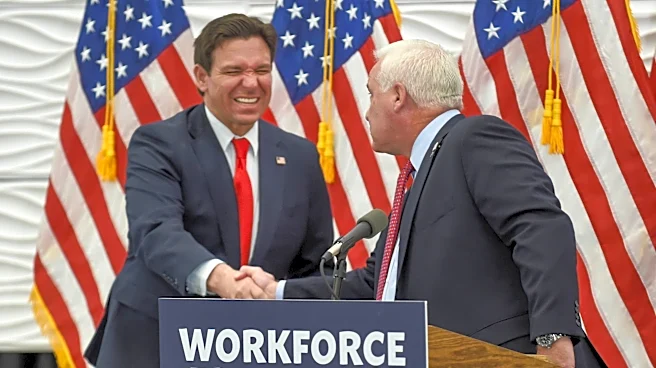

As his final term as Florida's governor winds down, Ron DeSantis has been trying to position himself as a diehard critic of wasteful government spending.
He's offered his on-again, off-again support for
Amendment 3, a measure on the Nov. 3 ballot that would sharply limit the ability of city and county governments to collect property tax revenues for critical services.
DeSantis and other amendment supporters have suggested Florida's 67 counties and hundreds of cities could make up for the loss of a projected $12 billion per year by simply tightening their belts.
Yet recent actions taken by a board of DeSantis appointees illustrate the hypocrisy of the once-and-maybe-future presidential candidate's words.
They also demonstrate how much magical thinking is required to believe a single policy change, no matter how sweeping, could root out all of the government spending taxpayers might find questionable.
Six-figure bonus and glowing performance review, despite heavy criticism

Last month, for example, Indian River State College's board of trustees approved a six-figure bonus for the school's president, Tim Moore, despite the fact that state officials have criticized the school's spending practices in each of the past two years.
The board gave Moore a $103,400 performance bonus, equal to one-fifth of his base salary, then also bumped his base salary another 3%, to $532,510.
Along with his annual $40,000 housing allowance and $20,000 car allowance, Moore is set to receive just under $700,000 in the 2026-2027 budget year.
That's nearly 10 times the median income for Florida households.
Moore's base salary already was the highest in Florida's public college system, even though the four-county region the college serves isn't among Florida's largest metro areas. Several colleges in the system have substantially higher enrollments – including those in Miami, Orlando and Fort Lauderdale, which are more than double Indian River's.
While Florida's public colleges play an important role in their communities, primarily awarding two-year degrees and job training certifications, they don't offer the same scope of services – such as extensive four-year and postgraduate degree programs and research projects – like the larger schools in the public university system do.
Given some of the college's recent issues, the board's actions seem puzzling.

In April, the Department of Commerce announced plans to withdraw state funding for a data center project the college wanted to build in Okeechobee County, claiming the plans were based on "falsehoods and pretenses" about energy and water use.
That came about a year after the state Auditor General's office accused the college of requesting $12 million more in grant funding than it actually needed to build a new nursing school.
Despite those issues, the board gave Moore a glowing performance review. The trustees rated him as meeting or exceeding all of the listed standards, in spite of potentially troubling comments a couple of them made.
Board member Anthony George wrote that turnover within the upper levels of the college's administration was "concerning," and some of the upper-level hires had been "disappointing." George questioned the college's ability to keep an attorney on staff and hinted at a "problematic relationship" between Moore and state representatives and senators.
George also referenced a call he allegedly received from the governor's appointments office in which he "was being asked to basically fire Dr. Moore."
Most of the other board members were more complimentary, although trustee Melissa Kindell wrote that Moore's actions led to "a lot of negative publicity on multiple levels" and vaguely referenced conversations "behind closed doors" that caused "Dr. Moore's integrity not to be shown in the best light."
DeSantis, Indian River State College officials mum on Moore's money

Neither DeSantis nor college officials seemed anxious to talk about Moore's compensation package. Molly Best, DeSantis' press secretary, didn't respond to repeated emails.
When I reached Milo Thornton, the board's chairman, by cell phone, he instructed me to direct my questions to "the college," presumably Moore or his administrative staff.
"Right now, I'm at the sheriff's office, and that's the business I'm handling right now," said Thornton, a deputy chief with the St. Lucie County Sheriff's Office.
When I asked him if there was a more convenient time when we could speak, he repeated his instruction that I should contact the college.
Lindsay Skully, the college's associate vice president of brand experience, declined to answer direct questions about the compensation package.
Since Moore was hired in 2020, the board has routinely given him annual bonuses up to 20% of his base salary. For anyone looking only at base salary figures, that conceals the total amount of compensation he's receiving.
Moore's contract also allows the board to grant him supplemental pay "in the form of either a direct salary increase or other compensation based on a percent revenue model of funds raised from new ventures." That might explain the college's interest in the data center project.
That might also explain why, during his six-plus years as president, Moore has lobbied for the college to get involved in other private business enterprises, including a convention center/hotel/museum/restaurant complex, a bed-and-breakfast and a marina.
Also, if Moore resigns or is fired, he's eligible to collect payment from a $2 million life insurance policy.
Not too shabby for a guy first hired at a base salary of $365,000.
If at least 60% of Florida's voters support Amendment 3, none of this will change. The amendment wouldn't impose any spending limits on state government, including the college system. Rather than focus on state spending that he and the Legislature could control, DeSantis has instead pointed an accusing finger at local government officials.
However, Moore's pay package does a good job of illustrating how government officials can hide spending taxpayers might consider wasteful or excessive. It's naive to think city and county leaders are going to target that type of spending for cuts if the amendment is approved.
What will get cut – either directly or indirectly – are expenses like road maintenance, parks, libraries, social service programs and maybe even public safety. Meanwhile, the Dr. Moores of the world will continue to get theirs.
Blake Fontenay is USA TODAY's commentary editor.
This article originally appeared on USA TODAY: DeSantis' spending hypocrisy starts with his own appointees | Opinion
Our editors independently choose our recommendations. Some content is produced with paid support from a third party, however our editorial decisions remain independent. If you buy through our links, the USA TODAY Network may earn a commission. Prices and availability may change.