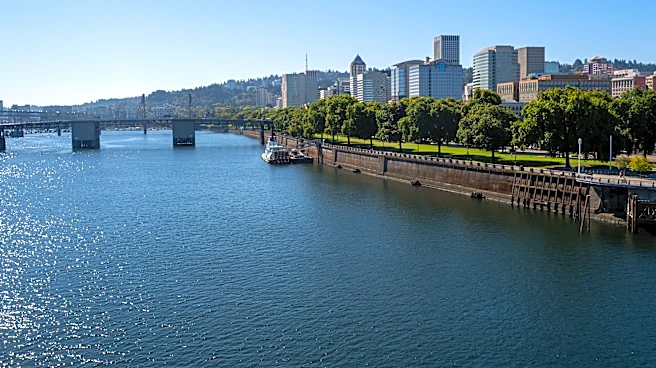



A battle is raging in Portland, Oregon, between the NBA Trail Blazers' new ownership and city officials over the future of the basketball team's longtime home, the Moda Center.
The Blazers want the city, county and state to help finance a proposed $573 million arena renovation. The Portland City Council is expected to vote Aug. 12
on a negotiating framework that could determine whether the franchise stays in Portland for the long haul.Most of the debate has centered on the staggering amount of public money the Blazers are requesting. But at a recent public meeting, team officials pointed to a second, arguably bigger sticking point: Portland's business and political climate.
“Portland's current stagnant business climate, high income taxes and divisive
political environment make this a tough city to invest in," said Dewayne Hankins, the Blazers’ president of business operations. "It makes it harder to sell tickets, secure corporate partnerships and, as I said, recruit players."
That's a remarkable admission from the president of one of Oregon's most prominent businesses. Stripped of the corporate diplomacy, the message is simple: Portland's taxes, stagnation and toxic politics have made running the franchise needlessly hard. Operating the team elsewhere would be easier and more profitable.
The Blazers didn't create those conditions. Portland's left-wing leaders did.
Conservatives are typically skeptical when a billion dollar sports franchise asks taxpayers for hundreds of millions of dollars. Subsidies for politically connected businesses are cronyism, not free-market capitalism.
But the Blazers' argument points to something bigger than a stadium financing fight. Portland has made its economic environment so unattractive that even one of the most desirable businesses imaginable believes it needs a massive taxpayer subsidy to justify staying for the long term.
Portland's tax burden is only part of the problem

Oregon has the highest individual income tax burden in the country, and Portland's is worse still. According to the Tax Foundation, the city has the nation's highest marginal tax rates on corporate and pass-through business income. Its top marginal rate on wage income is the second highest in the country, trailing only New York City.
Businesses and residents in the Portland area also navigate nine state and local income-based taxes: Oregon's personal and corporate income taxes, the state's corporate activity tax, Multnomah County's "preschool for all" tax, Portland's business license tax, Metro's supportive housing services tax, and two transportation taxes.
The top marginal rate for corporations in Portland is now 21%, and for individual filers earning $125,000 annually, the top rate is 14.77%. Both rates are by far the highest in the country.
Florida, by comparison, has no personal state income tax and a corporate rate of just 5.5%.
Portland’s tax burden is only part of the problem. Oregon also ranks among the worst states for businesses surviving their first year. Entrepreneurs contend with mountains of regulations, high costs and political leaders who routinely treat successful businesses as sources of revenue rather than engines of prosperity.
Portland has also spent much of the past decade becoming nationally notorious for riots, homelessness, open drug use, crime and political extremism. Although state and local officials have reversed some of their most disastrous policies in recent years, the reputational and economic damage has already been done.
Companies have been closing stores, shrinking their footprints and moving investment elsewhere for years. Even popular brands with deep roots in Oregon increasingly struggle to justify expanding in the state.
Now the Trail Blazers are warning that the same conditions are making it harder to sell tickets, attract corporate partners and recruit NBA players. Why is anyone surprised?
Portland's political leaders cannot spend years punishing businesses and then act outraged when those businesses demand concessions to stay. They cannot impose some of the highest tax rates in America, tolerate disorder and embrace a divisive left-wing political culture, and then expect companies to behave as though none of it matters.
Portland should serve as a warning to lawmakers nationwide at a time when socialism and other radical left-wing ideas are gaining support across America.
Left-wing policies inevitably destroy the economic growth needed to sustain the very communities progressives claim to care about. They drive away entrepreneurs, workers, investors and families, until the only businesses willing to stay are the ones getting special treatment or a massive taxpayer subsidy.
That's what appears to be happening with the Trail Blazers. Portland's leaders have made the city so economically dysfunctional that only cronyism can keep its NBA franchise in town.
If negotiations collapse and the Blazers eventually leave Portland, Oregonians should direct their anger at the politicians who spent years destroying the city's business climate, not at the team. The Trail Blazers didn't make Portland hostile to investment. They're simply telling the city what its left-wing policies now cost.
Justin Haskins is a New York Times best-selling author and the president and senior fellow at Our Republic, a national nonpartisan think tank.
This article originally appeared on USA TODAY: Blazers arena tension reveals why Portland is bad for business | Opinion