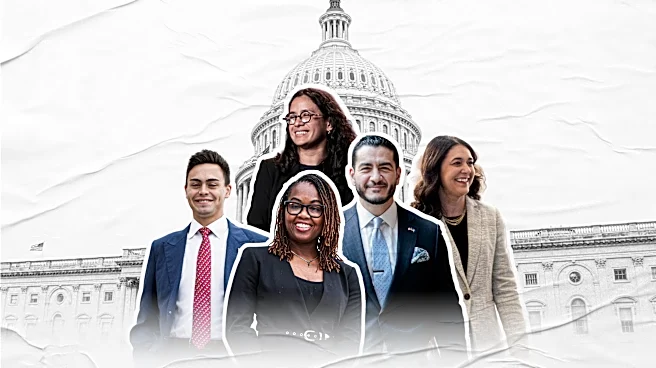







Capitol Hill is on track to look more like the country it represents as Washington, D.C., welcomes a class of lawmakers that is more diverse than ever before.
The incoming Congress, which begins Jan. 3, will have a record number of members who are women, Hispanic and Muslim, and the Senate will have the highest number of Black members in U.S. history.
Virtually all of the increases in diversity are coming from incoming members of the sweeping Democratic majority, while the Republican ranks will see a decrease in the number of women and Black members.
The Capitol will also see a generational shift. A new class of millennials, Generation Xers and even a handful of members of Generation Z are replacing dozens of baby boomers and members of the Silent
Generation who retired or did not win reelection.
"Congress has never been more diverse," said Sarah Treul, an American politics professor at the University of North Carolina at Chapel Hill. "We’ve brought in all types of people from all types of backgrounds. It’s not just white, male lawyers anymore."
A record for women, driven by Democrats
Women are set to make up more than 30% of Congress, an all-time record. That includes record numbers of women who are Black, Hispanic, or Native American, according to Jean Sinzdak, the associate director of the Center for American Women in Politics at Rutgers University.
There will be at least 137 women in the House and 26 in the Senate. But the Senate count may decrease after the next session starts since Sens. Amy Klobuchar of Minnesota and Marsha Blackburn of Tennessee both won the governorships in their states. It's still unclear who will replace them in Congress.
The increased number of women could mean different priorities come to the forefront, according to Sinzdak. That’s because women tend to bring their own life experiences to the table that some men might not have even considered, she said.
“Women legislators do bring richer perspective to a lot of issues, especially economic issues,” Sinzdak said. That can include anything from social safety net programs to regulations on what insurance must cover after giving birth.
Craig Volden, the co-director of the Center for Effective Lawmaking, said women are also more likely to put forward bills related to “the most gridlocked issue areas in Congress,” such as education and health care.
"We’re curious about whether they’re gridlocked because men who have been in positions of power have been more dismissive in those topic areas or whether there’s something else going on," Volden said.
But Republicans will see a backslide of women in their ranks. Sinzdak counts a decrease from 41 to 27 and calls it “really quite something.”
"The Republican Party really needs to invest in recruiting and supporting more women candidates if they’re going to improve on that front," Sinzdak said. "We’ll never get to parity if both parties aren’t making an effort to support more women running for office."
That doesn’t mean the Republican women who remain won’t get things done. Volden said his research shows that women tend to be more effective lawmakers than their peers when they move into the minority.
Black representation increases among Democrats
Even with the widespread push in 2025 for Republican state legislators to carve up majority-minority districts after a Supreme Court ruling that weakened part of the Voting Rights Act, there was no significant decrease in Black representation in the House.
Dedrick Asante-Muhammad, the president of the Joint Center for Political and Economic Studies, said the current House of Representatives, which started with 61 Black members, was the first in history to have Black representation proportional to the population. The incoming House will have at least 60.
"There was a concern that we would hit (proportional representation) once in history and then it was going to be pulled away," said Asante-Muhammad, who clarified that he is unhappy with a major Supreme Court decision on redistricting. "I think what we're going to be seeing is it’s not pulled away."
The numbers in the Senate are even more striking.
There have only ever been 14 Black senators in history, and there will be seven this year, including Scott Colom, the first Black person to represent Mississippi in the Senate since the Reconstruction era.
Even with historic gains among Black representatives, the House will lose all four of the current Black Republicans, even though as much as 12% of Black voters identify as Republicans, according to the Pew Research Center.
Rep. Byron Donalds won the governorship in Florida; Rep. John James lost the governor’s race in Michigan; Rep. Wesley Hunt of Texas lost a primary for the Senate; and Rep. Burgess Owens of Utah did not run again. The only Black Republican in Congress come January will be Sen. Tim Scott of South Carolina.
Nonetheless, Asante-Muhammad said there is a substantial increase in Black power with Democrats moving into the House majority.
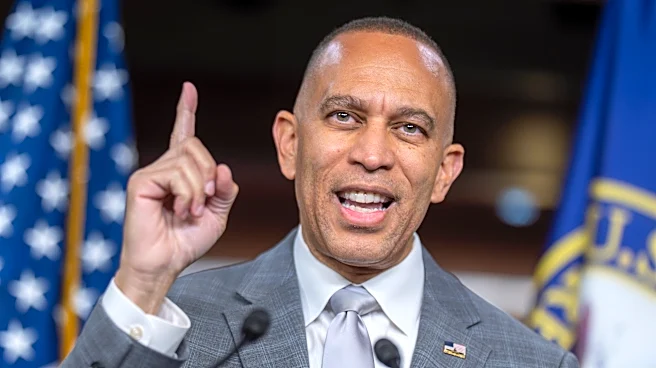
House Minority Leader Hakeem Jeffries is on track to become the first Black speaker of the House in history.
“It’s one thing to have blacks represented proportional to their demographic representation, and to say that people of different races will vote for black representatives,” Asante-Muhammad said. “But the question is whether America will vote for policies that will bridge racial economic inequality.”
Historic Hispanic representation
There will be at least 62 Hispanic members of Congress, including 56 in the House and 6 in the Senate, a record that includes an increase in Hispanic Democrats and a drop in Hispanic Republicans.
Juan Proaño, chief executive officer of the left-leaning League of United Latin American Citizens, or LULAC, said he is “very happy” with the election results, but also said the numbers are well below proportional representation.
The U.S. Census Bureau estimates that about 20.5% of the population is Hispanic. That would correspond to around 110 Hispanic people in Congress. Additionally, Proaño pointed to states where a substantial portion of the population is Hispanic but the congressional delegation is not.
Hispanic lawmakers will make up 20% of the Texas congressional delegation, including seven in the House and Sen. Ted Cruz, a Republican. However, the Census Bureau estimates that 40% of the Texas population is Hispanic.
“I’ll be very blunt,” Proaño said. “We have to be better as a community. We have to be better. We have to be better at organizing, strategizing, investing if you will, in the Latino vote.”
There will also be eight Muslim lawmakers, a record. Sen. Abdul El-Sayed, a Democrat from Michigan, is set to be sworn in as the first Muslim senator in history. With seven Muslim representatives in the House, that chamber will be 1.6% Muslim. The Public Religion Research Institute estimated in 2024 that Muslims were 1% of the American population.
And many will have multiple identities, like two incoming congresswomen from New York who align with the Democratic Socialists of America. Rep.-elect Darializa Avila Chevalier, 32, identifies as Black, Hispanic and Muslim. Rep.-elect Claire Valdez, 37, is Hispanic and a member of the Ysleta del Sur Pueblo Nation.
A (slightly) younger Congress
Congress will also get younger, but only by a hair. More than four dozen lawmakers from the Silent Generation and baby boomer generation either retired or lost their races, while Americans elected substantially more Generation X lawmakers and millennials.
Members of the Senate will be about seven years older on average than representatives in the House, but there are four new Millennials entering the Senate: Colom, 43; El-Sayed, 42; Julia Letlow, 45, of Louisiana; and James Talarico, 37, of Texas.
They join Andy Kim, 44, of New Jersey; Jon Ossoff, 37, of Georgia; Katie Britt, 44, of Alabama; and Tim Sheehy, 40, of Montana.
The House is welcoming four new lawmakers from Gen Z, the youngest generation represented. The youngest of those is Michael Alfonso of Wisconsin, who is 26, only a year above the minimum age required to serve in the House under the Constitution.
This article originally appeared on USA TODAY: The next Congress will look more like America than ever before