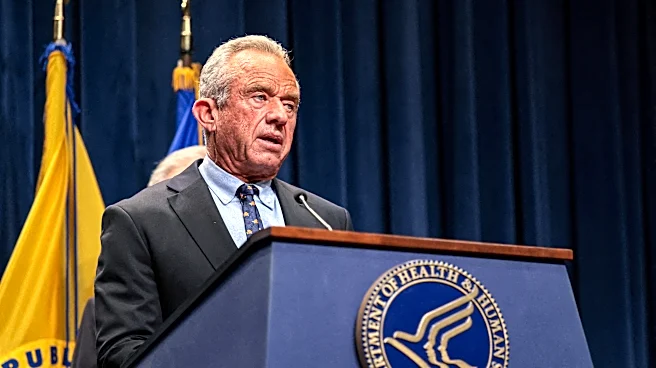





As the United States experiences its worst measles outbreak in 35 years, a handful of Democrats are leaning on their backgrounds in medicine and public health to pitch themselves as potential checks on Health and Human Services Secretary Robert F. Kennedy Jr. if Democrats win control of Congress in November.
Richard Pan, a doctor and former state senator running for a California congressional seat, said he’d be well equipped to question Kennedy and other health officials in hearings after he successfully passed two state-level bills Kennedy opposed that tightened exemptions to childhood vaccine rules.
Annie Andrews, a pediatrician running against Sen. Darline Graham, R-South Carolina, said that Kennedy’s confirmation spurred her to run, and she
would push for him to be impeached and removed if she wins.
“I talk to veterans and active-duty service members who wake up every day and think about Pete Hegseth and how absurd it is that he is the Secretary of the Department of Defense,” Andrews told USA TODAY. “The passion that they feel about that is the passion that I feel about RFK Jr. being the Secretary of Health and Human Services.”
They and other candidates are also stressing the importance of vaccines as the Trump administration has renewed its focus on recommendations for childhood immunizations and sought to maintain close relationships with the Make America Healthy Again movement that backed Kennedy's 2024 presidential run.
During a Sept. 17 speech at a conference hosted by Children's Health Defense, the anti-vaccine organization he founded and formerly led, Kennedy told the audience they have “a friend at the White House.” He referenced recent measles deaths in the context of rare incidents of people being harmed by vaccines.
“In our country we care about rare illnesses and deaths. We care about every child who dies from measles. They get headlines,” he said. “I’d ask you to care about children who are dying or suffering or being injured by vaccine injuries.” The Department of Health and Human Services didn't immediately respond to a request for comment.
In January, the Centers for Disease Control issued narrower advice for which vaccines should be routine. Those changes were paused by a federal judge in March in a case that is ongoing as the administration appeals.
In August, the president signed an executive order presenting his own set of vaccine recommendations that reduced the number of routine vaccines and called for separating the measles, mumps, and rubella shot into three separate vaccines once they are available, which medical groups oppose.
The August order marked a change of course for the administration, which had pulled back from its focus on vaccines amid warnings that it posed a political risk. In August 2025, President Donald Trump’s pollster Tony Fabrizio released a memo stating that there is “broad unity across party lines” in support of vaccines, including “sky-high” support among the swing voters who will decide close elections.
While there’s broad support for vaccines, vaccination rates have dropped and polling suggests trust in vaccines has waned. A Reuters/Ipsos poll released Sept. 16 found that 76% of Americans believe the MMR vaccine is safe for children, down from 84% who said the same in their May 2020 survey.
Medical experts and organizations such as the American Medical Association have stressed that the MMR vaccine, which has been available in its current form since 1971, is safe, effective and the best defense against measles.
Childhood vaccines on the ballot
Voters aren’t casting their ballots solely based on a candidate’s stance on vaccines, but the issue has become a signal of a politician’s broader approach to politics, said Matthew Motta, an associate professor at Boston University’s School of Public Health who studies the rise of anti-science attitudes and their health impacts.
“Vaccines are becoming a symbolic issue, a way of saying ‘I will stand up to the – for lack of a better word – chaos that this administration is implementing on things that you thought were untouchable, sacred consensus issues,” he said.
In Iowa, Rob Sand, the state auditor and Democratic nominee for governor, released an ad on Sept. 18 saying that his opponent, Zach Lahn, wants to “ban some lifesaving cancer treatments.” Lahn, a farmer and businessman, won the Republican gubernatorial primary and defeated a Trump-backed opponent with the endorsement of MAHA Action, the main political action committee backing Kennedy-aligned Make America Healthy Again candidates.
Lahn said during a January 2026 primary debate that he supports banning vaccines developed using mRNA technology, such as the Pfizer COVID shot. Medical professionals believe mRNA research could eventually lead to treatments for diseases like cancer.
Lahn’s campaign said in a statement that he “will not ban cancer treatments, or ban all MRNA vaccines” but he has “discussed pulling the COVID shot from the market.”
In Florida, Republican Gov. Ron DeSantis and State Surgeon General Joseph Ladapo have said they want to end all vaccine mandates in the state. Ladapo signed an August proposal to end school immunization mandates for four diseases, including those for chicken pox and Hepatitis B, and make it easier for parents to opt out of other vaccines due to “moral and ethical beliefs.” Other vaccine requirements, such as the one for measles inoculation, can only be changed through legislation.
David Jolly, the Democratic nominee for governor, has slammed the effort on the campaign trail and told the Tallahassee Democrat that he would fire Ladapo on his first day in office.
Rep. Byron Donalds, R-Florida, the GOP gubernatorial nominee in his state, said he agreed with DeSantis and Ladapo's push to end the four vaccine mandates. Asked whether he would seek legislation to roll back other vaccine mandates, Donalds told CBS News’ “Face the Nation” that “those are things we want to make sure we study and really engage in before we make those determinations.”
Donalds was also asked whether he would recommend that Floridians vaccinate their kids against measles, given that much of the state has fallen below the 95% rate necessary for herd immunity.
"No, actually, my message to Floridians and, quite frankly, to Americans is the reason why we have seen a measles outbreak in certain parts of the country is because of rampant illegal immigration into the United States from the previous administration," Donalds said.
Experts have attributed increased measles transmission in the United States to declining vaccination rates, particularly in close-knit communities with low immunization records where outbreaks have been concentrated.
Running as a check on Kennedy
Erik Polyak, the executive director of 314 Action, which recruits candidates with science backgrounds, said their picks – including Michigan Senate Democratic nominee Abdul El-Sayed, a medical doctor and public health administrator, and Ohio Democratic gubernatorial nominee Amy Acton, a doctor and former head of the state health department – plan to subpoena records, hold hearings and investigate HHS if elected.
“We’re only going to see these measles outbreaks and childhood vaccines in the news more and more because of Trump and RFK’s continued actions in office,” he said. “They’re constantly talking about this and taking action on it, and our candidates are going to hold them accountable.”
Pan, the California congressional candidate, first came into contact with Kennedy in 2015, when the former state senator introduced legislation to end California’s personal belief exemption to childhood vaccines in the midst of a measles outbreak that originated at Disneyland. Kennedy was part of the opposition to the legislation
In 2019, they squared off again when Pan introduced a bill to close loopholes in the state’s medical exemption laws. Kennedy rallied opponents, some of whom carried signs with Pan’s face. The state senator faced death threats and was assaulted on the street. A female protester threw a menstrual cup filled with blood at the Senate floor.
“When it comes to what’s happening with RFK Jr. and the Department of Health and Human Services under this administration, having someone who’s familiar, like myself, who’s actually confronted and beat RFK Jr. is part of being able to hold him accountable,” Pan told USA TODAY.
Candidates have also tied vaccine issues to broader messages on health care affordability. Amish Shah, an emergency room doctor running in an Arizona swing district, has argued that the best way to reduce vaccine skepticism is to make sure that patients have time to discuss their concerns with their doctors. The challenge, he said, is that the health care system doesn't give doctors enough time with patients, and too many Americans don't have health insurance. He's called for allowing people to buy into Medicare regardless of age.
“I think that our profession trains people really, really well to understand the science, and when those doctors get a chance to speak to patients directly and address their concerns thoroughly, you then start to build trust,” he said.
This article originally appeared on USA TODAY: Vaccines become a 2026 midterm election issue amid measles outbreak