








It's time to stop monkeying around. At least that's what the City of Knoxville, Tennessee's chief operating officer thinks.
Chief Operating Officer Grant Rosenberg is asking city council members in Knoxville to approve an ordinance that limits monkeys to the same number as cats and dogs allowed in private homes: four. The ordinance proposal says "keeping more than four animals in a household creates a nuisance in terms of noise and sanitary conditions for members of the household and neighboring citizens."
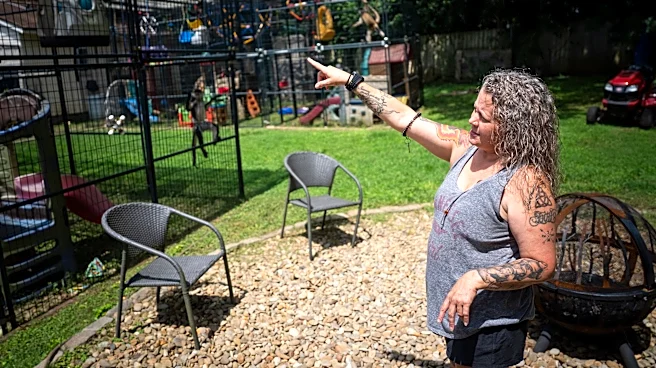
Jamie Fuller knows it's targeting her North Knoxville monkey rescue. She has a U.S. Department of Agriculture license and legally keeps 30 monkeys in her backyard and home.
Saving monkeys is her full-time job.
"This isn't just like, they're pets.
This is a passion. If it wasn't, trust me, I wouldn't be doing it from 8 a.m. to midnight every day," Fuller said.
Fuller has capuchin monkeys, spider monkeys and squirrel monkeys, the majority of which are rescues or rehomes. She said she was not aware of the proposed ordinance change but was told she needed to appear at the city council meeting on Tuesday for "operating a kennel business in a private residence."
She disagrees with that description.
"There's a group that does not like me, does not like who I'm friends with, does not like how I do things and they have called every agency," Fuller said. "They have called USDA, which I am USDA licensed, and turned in false allegations. They have called the health department, they have called TWRA (Tennessee Wildlife Resources Agency), which they don't govern any of the animals I have."
She assumes neighbors have called to complain to animal control, the health department, city codes and city zoning experts, all of which have come to her home. She has never been cited. She even proactively worked with the Knoxville Fire Department to come up with a rescue plan for herself and the animals.
If the ordinance change passes, Fuller said she is prepared to move. On Tuesday, Aug. 18, the city council gave initial approval to the rule change and is moving forward for a final vote.
"We'll have to figure something out, but they ain't going nowhere. They're not leaving me. I would never get rid of them," Fuller said. "There is no way after I have put this much time, attention, money, patience and love into the passion that I do, that I would, uh-uh, I'd just have to move."
The goal of the ordinance, Deputy Chief Operating Officer Chad Weth said, is to keep other animals in line with longstanding rules on cats and dogs.
"The purpose of this limitation is to protect neighborhood quality of life by minimizing issues related to excessive noise, odors, health and sanitation conditions, and potential safety concerns for both residents and neighboring properties," Weth said in an email sent to the Knoxville News Sentinel.
Knoxville's monkey rescue
Fuller bought her first monkey 14 years ago. Since then, most owners have found her as they needed someone to care for their pets when they couldn't. She said she spends $2,000 a month on fresh fruits and vegetables, $1,000 on meats and $1,000 on monkey biscuits. Enclosures for the monkeys, which Fuller says have been approved by veterinarians, have cost between $20,000 and $30,000 and enrichment toys cost her between $10,000 to $15,000.
"They definitely eat better way than I do, I'll tell you that right now," Fuller said. "And I've said that – I'll go hungry before they will. I will go down to nothing but sandwiches and soup before I ever stop feeding them."
Since bringing her first monkey home, Fuller said she has never had a monkey bite her or anyone else, and never has had one escape. Since the majority are rehomes, they cannot go to a sanctuary or zoo because they would have trouble being introduced to monkey troops. She said desperate pet owners come to her from all over the country.
As for noise complaints, Fuller said she doesn't let the monkeys outside before 9 a.m. and later than 11 p.m. to avoid noise complaints. She said she recognizes she has neighbors and lives in a residential area, but she says the noise is limited.

It is legal to own certain monkeys as pets in Tennessee, but the Tennessee Code prohibits primates including baboons, chimpanzees, drills, gelada baboons, gibbons, gorillas, mandrills and siamangs, which are considered wildlife. Those species are considered inherently dangerous to people and are only allowed to be kept by zoos, circuses and commercial propagators.
However, Michael Granatosky, a University of Tennessee biology professor, thinks it's not great to keep monkeys as pets in homes, both for the animals and the people who keep them.
Primates are "highly social," "incredibly smart" and "problem solvers," Granatosky said, and home settings can't replicate the wild or care they receive in zoos.
"Exotic pet primates, primates as exotic pets, they don't get that appropriate socialization, they don't get that sort of rule learning stage and there's no way we as sort of a human really understand how to teach a primate how to be a healthy, smart primate," Granatosky said.

Facilities accredited by the Association of Zoos and Aquariums that have trained staff and appropriate enclosures can still struggle with ensuring primates have everything they need, Granatosky said. Zoos use mesh or double-layered fences to decrease the risk of monkeys escaping. They also do research on where people can stand and where animals can reach so there is a lessened chance of an animals scratching or biting a person.
Granatosky said that "a scratch from a primate is fairly dangerous from a zoonotic perspective."
Zoonotic diseases are caused by germs spread between animals and people, because primates and people are closely related, risk of zoonotic diseases are more serious. Other risks include self-mutilation.
"The primate's going to start showing stress-based behaviors." Granatosky said. "So, that can be self-mutilation, which you see a lot in captive situations, where they'll pick their own hair or grab their own muscles in very aggressive ways, or it can be aggression towards other individuals, or it can be aggression toward people."
Despite all the dangers associated with keeping primates as pets, Granatosky said he understands why people do so.
"I understand. They're so much like us, we can identify so much of ourselves in them and to sort of see them it's like amazing." Granatosky said. "That's a reason I studied anthropology. They're beautiful animals to look at and see, but it's this feeling of ownership that's just dangerous for the keeper, it's dangerous for the primate itself."
The council will vote on the ordinance for a final time Sept. 1.
This story originally appeared in Knoxville News Sentinel.
This article originally appeared on Knoxville News Sentinel: Woman with 30 monkeys fights ordinance that would ban her sanctuary