


The Hyundai Ioniq 5 is the South Korean automaker's best-selling electric car. The company discounted all versions of it for 2026 by at least $7,600, which conveniently is almost a dollar-for-dollar match of the $7,500 tax credit for EVs that was eliminated by the federal government in September 2025.
I drove the 2026 Hyundai Ioniq 5 Limited or a week to see if it deserves the Kelley Blue Book Best Buy among electric vehicles, CarGurus Best EV Experience and U.S. News and World Report Best Commuter Car accolades that it received.
The 2026 Hyundai Ioniq 5 Limited all-wheel drive model that I tested is the highest trim of the electric SUV, and it starts under $49,000, which was down from a starting price of $58,200 in 2025. Entry-level models start at a more
modest $35,000, which was also down from a starting price of $42,600 in 2025.
The vehicle is available in nine trims, with both rear-wheel drive and all-wheel drive options.
I've recently tested other crossover electric SUVs, including the fully electric Chevrolet Blazer, Toyota bZ and Lexus RZ. I have also reviewed three-row SUVs like the Kia EV9 and hybrids such as the Kia Telluride and Toyota Grand Highlander.
Here's what I learned after a week behind the wheel of Hyundai's popular two-row crossover electric SUV.
What makes the 2026 Hyundai Ioniq 5 stand out?
The Hyundai Ioniq 5 stands out for its modern features, smooth handling and appealing exterior. The vehicle is available in nine exterior color options, including the Ultimate Red that consistently drew attention during my week behind the wheel.
During testing, the Hyundai Ioniq 5's interior and cargo area felt spacious for daily driving needs. I also enjoyed the Ioniq 5's large 12.3-inch infotainment screen and wireless Android Auto, Apple CarPlay and Bluetooth connectivity. I drove the Hyundai Ioniq 5 over 100 miles in my week of testing, putting it through its paces on flat interstate highways, suburban streets and roads with winding hills and tight corners. It handled each terrain with ease.
How does the 2026 Hyundai Ioniq 5 drive?
The vehicle had quick acceleration, even on very steep hills, and handled well around tight curves on two-lane roads. It felt powerful enough that it could have been confused with being a traditional gas-powered car, save for the super quiet engine that is now a hallmark of electric vehicles.
The Ioniq 5 gets an EPA-estimated 318 miles of range, according to Hyundai. All-wheel drive versions of the vehicle get the equivalent of 129 mpg in city driving and 100 mpg on highways. The model I tested had a max range of 352 miles when it arrived with 95% battery charge.
The Ioniq 5 came with a Tesla Supercharger-compatible North American Charging System port built-in. I had to use an adapter that was included with the vehicle to connect it to a nearby Electrify America public charger that used the non-Tesla CSS, or Combined Charging System, which is also known as DC Fast.
Once I figured that part out, charging was a breeze. I was able to track the battery's progress from an app on my phone while I was picked up a few items from a nearby grocery store. Hyundai says the vehicle can charge from 10% to 80% in 30 minutes on a 400-volt Tesla Supercharger and 20 minutes using an adapter on a non-Tesla DC fast charger with at least 800 volts, which most public chargers have. Hyundai said at home, the Ioniq 5 can be charged from 10% to 100% in about 7 hours, 20 minutes, making overnight charging the best option in that situation.
The Hyundai Ioniq 5 is powered by a permanent magnet synchronous dual electric motor. Hyundai said the vehicle packs 320 horsepower and 446 lb-ft of torque.
Will the 2026 Hyundai Ioniq 5 fit your lifestyle?
The Hyundai Ioniq 5 that I tested is over 183 inches long, more than 74 inches wide without considering the mirrors, and 63 inches tall. The model I tested was equipped with a panoramic fixed glass sunroof that Hyundai calls a “Vision Roof.”
The Limited model I tested came with built-in navigation and several Google services. It has the Hyundai Bluelink+ and Digital Key 2 Premium system that allows owners to start their cars and adjust temperatures remotely from their phones.
The Ioniq 5 also has a heads-up display that projects driver personalization, warning messages and vehicle messages onto the lower part of the windshield to help keep drivers' eyes focused on the road. The Ioniq 5 is also equipped with safety features such as auto emergency braking, blind spot monitoring, parking sensors and lane keep assist, among other available technologies.
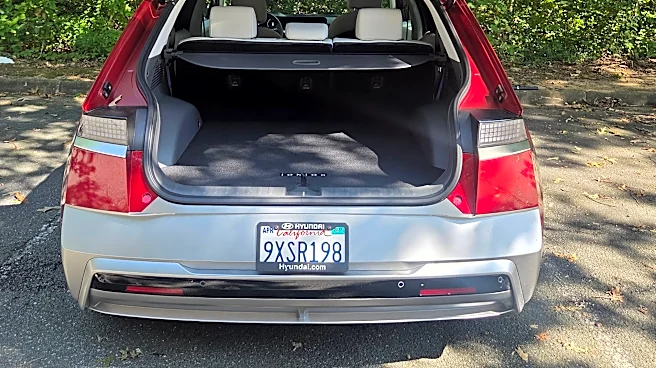
The Ioniq 5 Limited all-wheel drive model I tested offered about 26 cubic feet of cargo space behind the second-row seats, which I found sufficient for luggage and grocery hauls. With the rear seats folded, cargo space expands to more than 58 cubic feet, enough room to tote small pieces of furniture.
There's also available storage under the hood, though the Hyundai Ioniq 5 doesn't have a full "frunk."
The Hyundai Ioniq 5 can comfortably fit up to 5 passengers, but with no row third row there is no option for additional seating. The model I tested offered nearly 40 inches of headroom for front row passengers and close to 39 inches on the second row.

Is the 2026 Hyundai Ioniq 5 worth it?
Starting at $35,000, the 2026 Hyundai Ioniq 5 costs a lot less than the average price of an electric car, which was $54,813 in August, according toCox Automotive's Kelley Blue Book. It's also in line with the average price of a mid-size gas-powered compact crossover SUV, which was $37,722 in August, according to Cox.
The 2026 Hyundai Ioniq 5 is available in nine trims, ranging from the entry-level SE rear-wheel drive Standard starting at $35,000 to the top trim Limited all-wheel-drive retailing for $48,975. The model I tested had add-ons that increased the sticker price to a little more than $52,000.
The Ioniq 5 Limited trim model I tested came with 20‑inch alloy wheels and front row seats that can be heated or ventilated. The Ioniq 5's rear seats can also be heated. It had an eight-speaker Bose premium audio system.

I enjoyed the Hyundai Ioniq 5 Limited I tested. The car was fun to drive, and it drew positive comments from onlookers who told me they thought it looked good. I also appreciated the Ioniq 5's efficiency as I drove past gas stations that were charging over $4 per gallon.
If I were shopping for an electric car today, I'd likely choose the less expensive Ioniq 5 SE all-wheel-drive trim, which starts at $41,000. The SE trim is the first trim available with all-wheel drive, and the starting prices saves almost $7,000 over the more expensive Limited trim.
The Hyundai Ioniq 5 competes in the fully electric crossover SUV segment with models such as the Tesla Model Y, Kia EV6, Nissan Ariya, Ford Mustang Mach‑E, Toyota bZ and Chevrolet Blazer EV.

Who should buy the 2026 Hyundai Ioniq 5?
The 2026 Hyundai Ioniq 5 is a compelling option for buyers seeking a powerful electric compact SUV with sturdy handling and distinctive styling.
With most new cars costing over $50,000, the Hyundai Ioniq 5 could be a steal with a starting price of only $35,000. It's great vehicle for anyone looking to make the transition to an electric car for the first time without breaking the bank.
Keith Laing is an automotive reporter on the National Trending Desk at USA TODAY. Contact Keith at klaing@usatodayco.com.
This article originally appeared on USA TODAY: I drove one of the most popular non-Tesla EVs. Hyundai's Ioniq 5 wows