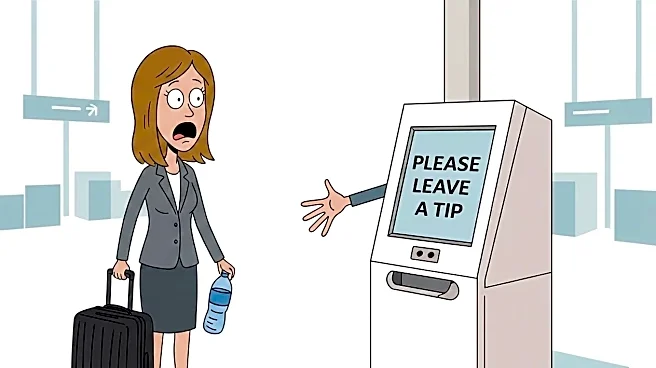



Cara Laban did a double-take when she bought a bottle of water at a tiny kiosk by the airport gate recently. Before she'd finished her transaction, the terminal asked if she wanted to tip 25% or 30%.
"I'm a tipper," she said, "but I do not love tipping on a $7 bottle of water that I had to get myself from the fridge."
A lot of travelers have been there. You're staring at a demanding screen with a line forming behind you, wondering if you're cheap for hitting "no tip."
Check out Elliott Confidential, the newsletter the travel industry doesn't want you to read. Each issue is filled with breaking news, deep insights and exclusive strategies for becoming a better traveler. But don't tell anyone!
More than 2 in 5 Americans think the U.S. should ban tips,
and 81% think tipping has "gotten out of control."
"Aggressive tipping prompts are becoming a growing source of frustration in travel and hospitality," said WalletHub analyst Chip Lupo. "The concern consumers are expressing reflects a broader shift in how tipping is being used and perceived."
Businesses use a variety of strategies to squeeze more money from you. They include clever screen design with percentages prefilled – often before anyone has done anything for you. It's one of the more troubling travel trends I've covered.
And it's gotten worse, from what I hear travelers say. You'll see these screens at hotel check-ins, airport kiosks, in ride-hailing cars, at lounge bars and self-service machines where nobody ever helped you.
It's even spreading outside the country. Just last week, I took my sons out for pizza in Newtown, a suburb of Sydney. Before I finished placing the order on my phone, the restaurant's app asked if I wanted to leave a 20% tip or a 30% tip. (Australia doesn't have a tipping culture comparable to America's, and tipping is entirely discretionary.)
The screen wants you to tip more
Not so long ago, tipping was a human experience. A server did something for you and you reciprocated out of a sense of gratitude. The pressure – if there was any – came from a person.
"What's changed is not the behavior," said Anneliese Place, a former nightclub owner who has watched tipping culture shift from both sides of the transaction. "It's the delivery. The pressure was human. A look, a moment, a sense of expectation. Now it's built into the system. The screen is doing the nudging before any service is delivered."

The screen pressures you to pay more now. Faiz Ahmed, an expert on payment infrastructure, said most kiosks set the default tip flow to whatever maximizes the business's revenue.
"The terminal makers know exactly what conversion lift each layout produces," Ahmed said. "That's why the buttons keep getting larger, the percentages keep climbing, and the 'no tip' option keeps moving to a less prominent position."
And the workers? Often they see only a fraction of it, or nothing at all.
Should you tip before you get service?
Andrew Cullison, executive director of the Cincinnati Ethics Center and a philosophy professor at the University of Cincinnati, raises moral objections to pre-loaded tip prompts.
He said tipping was designed to reward service after a service has been rendered. It creates an incentive for a worker to do well. But pre-loaded prompts destroy both functions.
"When I was recently at a deli and was asked to tip before anyone had touched the bread, I hadn't seen whether they got the order right," Cullison said. "Tipping in advance works against both the reward and the incentive that justified the practice in the first place."
He also objects to the coercion. It's the social pressure of a public screen with a line behind you. Also, if you decline a tip before anyone makes your sandwich, the person who hasn't yet made it may know you declined.
"You may reasonably worry that declining will affect the service you receive," Cullison said. "That is a form of coercion that traditional tipping never imposed on the customer."
When travelers get burned by enough bad prompts, they start declining across the board – including in situations where a tip may be warranted. Wait staff at sit-down restaurants, people paid a subminimum cash wage who depend on gratuities, end up paying for the sins of a kiosk vendor.
"These prompts are designed to make declining feel antisocial," Cullison said. "Recognizing that is itself useful."
At least one country recognizes the problems. This summer, India's Ministry of Road Transport and Highways ordered ride-hailing apps to delete tip prompts that appear before or during a trip.
Under the country's Motor Vehicle Aggregator Guidelines, an app can offer a tip button only after the ride ends. Under Indian regulations, the driver also gets the full amount, with no cut for the platform. The ministry reportedly was reacting to apps that offered an "advance tip" or hinted that a tip might get you a car faster.
How to say no to a tip screen without guilt
I've been on the receiving end of these prompts more times than I can count. Experts offered a few ways to push back.
- Slow down. Justin Carter, an assistant professor of management at the University of North Alabama, recommends treating every tip prompt like any purchase decision. "Slow down, read the screen, and choose the amount that matches the service actually provided," Carter said. "The villains in that situation are poor design and lack of transparency, not the customer."
- Ask one question before you tap. Gregory Lee, the chief operating officer for an apartment rental site in Boston, offers an easy litmus test: "Did a specific human just do something tangible for me?" If the honest answer is no, you can decline without feeling cheap.
- Watch for pre-service timing. James Kastelein, who runs a service business in Richmond, Virginia, said a legitimate gratuity prompt comes after the service. If the kiosk is asking for 30% before anyone has lifted a finger, it's using social pressure to collect revenue.
- Tip workers directly when you're unsure. Laban carries small bills specifically for this. If you're not sure the platform payment reaches the person who helped you, cash still works. It's the surest way to get the money into the right hands.
Does guilt tipping hurt workers who earn tips?
Guilt tips erode trust in a way that's hard to rebuild. When every checkout becomes a small trust test, the fatigue builds up. Eventually, people might start declining everything, including at restaurants where servers count on tips.
Laban, the woman confronted with the $7 water bottle, has an insider perspective. She's the founder of an online travel preparation tool and is herself a former restaurant server.
"If I had great service or enjoyed my tour experience, and I am being prompted to tip on a platform or a computer, I will ask the service worker or the tour guide if they get the tip directly," she said. "If they get all of it, I'll tip. If not, I will tip them cash."
She draws the line at a gratuity for a bottle of water.
"I did not feel like a monster for not tipping," she added.
Christopher Elliott is an author, consumer advocate and journalist. He founded Elliott Advocacy, a nonprofit organization that helps solve consumer problems. He publishes Elliott Confidential, a travel newsletter, and the Elliott Report, a news site about customer service. If you need help with a consumer problem, you can reach him here or email him at chris@elliott.org.
This article originally appeared on USA TODAY: Tipping is getting out of control. When is it OK to just say no?