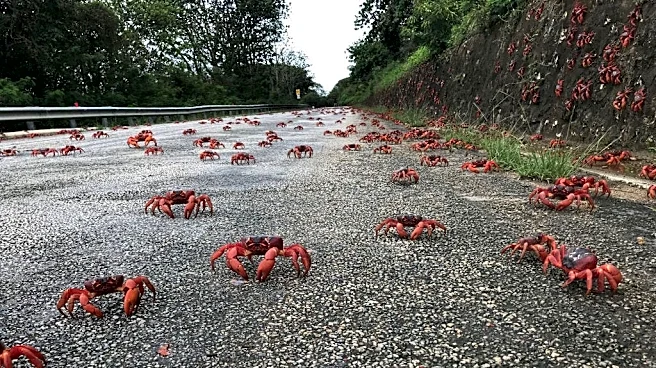







Millions of bright red crabs are swarming across Australia's Christmas Island as the crustaceans begin their annual migration toward the ocean to breed.
The mass migration produces a distinctive scraping and chittering sound as the crabs move together, creating an almost rainfall-like noise. The annual event is one of the island's most remarkable natural spectacles, attracting attention from nature enthusiasts around the world.
Footage shared by Parks Australia captures the remarkable scene as the crabs blanket parts of the island, making their way across roads and other obstacles on their journey toward the coast.
Watch: Millions of red crabs swarm Christmas Island
What is the Christmas Island red crab migration?
Every year, millions of red crabs emerge from their forest habitats and travel toward the coast to mate and spawn, according to Christmas
Island National Park.
The migration typically begins with the first rainfall of the wet season, usually in October or November, although it can happen as late as December or January. This year's migration was underway by Nov. 14, with millions of crabs making their way across the island's roads and specially constructed bridges, according to Euronews. The journey can take about nine days, with male crabs leading the way and females joining along the route.
Christmas Island, an Australian territory in the Indian Ocean more than 200 miles off the Indonesian island of Java, is home to the species.
The timing of the migration is determined by rainfall, the moon's phase and the tidal cycle. Red crabs spawn before dawn during a receding high tide in the moon's last quarter, according to the national park.
How does rainfall affect the red crab migration?

The crabs wait for the first rains before beginning their journey, making rainfall essential to the annual migration. If the rain arrives close to the ideal spawning date, the crabs may hurry toward the coast. If it comes too late, some will remain in their burrows and wait until the following month.
A lack of rain can delay or even prevent the migration, according to a 2013 Princeton University study published in the journal Global Change Biology.
During the particularly dry 1997 season, the crabs did not migrate or mate, Princeton researchers said. The conditions were linked to a strong El Niño, a climate pattern associated with dry conditions in the Indian Ocean.
What happens after the crabs reach the ocean?
Once they reach the coast, male crabs typically arrive first and dig burrows. Females join them to mate in or near the burrows.
Female crabs can produce up to 100,000 eggs each, which they carry in a brood pouch. After about two weeks, they head to the shoreline and release their eggs into the ocean. The eggs hatch almost immediately after entering the water.
Most of the larvae do not survive, becoming food for fish, manta rays and whale sharks. However, once or twice a decade, unusually large numbers survive and return to shore, helping maintain Christmas Island's red crab population, according to the national park.
Reporter Anthony Thompson can be reached at ajthompson@usatodayco.com or on X @athompsonUSAT
This article originally appeared on USA TODAY: Millions of red crabs take over island in annual migration