





There’s something haunting Tucker Carlson, and it’s not just the rise of the woke left, or the decline in American masculinity, or even the erosion of patriotic values.
It’s demons. Lots and lots of demons.
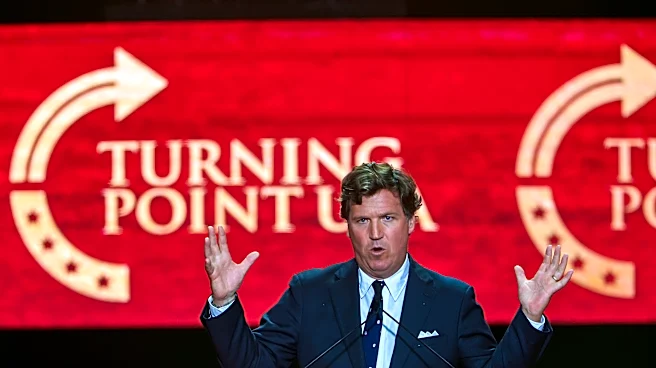
For the past three years, demons, the demonic and the supernatural have increasingly dominated the former Fox News host’s The Tucker Carlson Show on YouTube, according to a recent analysis provided exclusively to USA TODAY by Media Matters for America, a left-leaning nonprofit that monitors far-right media.
“There's a reason that people worship demons, not just because they're inherently perverse, but because it works short-term,” Carlson said during an episode in July.
Carlson, or one of his guests, mentioned demons and the supernatural a total
of 644 times in 75 episodes between the show’s launch in December 2023 and the end of July. Collectively, viewers watched those shows more than 109 million times.

And the mentions have been rising. Between 2024 and 2025 they increased 313% and in the first seven months of 2026, Carlson or his guests mentioned demons or the supernatural 357 times – a 55% increase over the total for all of 2025, the study found.
Carlson did not respond to requests for an interview with USA TODAY, so it’s unclear what is driving this increased fascination with the demonic.
But Carlson’s embrace of supernatural terminology to describe his opponents mirrors a broader recent shift among conservative politicians and public figures towards describing Democrats, the political left and other opponents as evil, Satanic or demonic, said Brad Onishi, a former evangelical minister, author, scholar of religion and founder of the podcast Straight White American Jesus.
And this is just one facet of a broader movement, where ideas that were not long ago considered extreme have now solidly entered the mainstream of American politics, Onishi said.
“Alex Jones was popular 10 years ago, but he was really considered somebody that you would not invite on any mainstream venue – he was beyond the pale – if you wanted to watch him, that was fine, but you were a conspiracy theorist, you were an extremist,” he said. “Now, Tucker Carlson says this, and he may be on the right-hand tilt of the American conservative spectrum, but this is not out of bounds.”
In March, Vice-President JD Vance told an interviewer he believed that UFOs aren’t aliens but are demons. Pressed by podcaster Joe Rogan about his statement, Vance said “I’m not one of these people who is a hyper-rationalist – I think there are things happening in the world that we’re not always seeing.” Former Congresswoman Marjorie Taylor Greene similarly told HBO host Bill Maher she believes UFOs could be “fallen angels.”
Victor Marx, the current GOP nominee for governor in Colorado, claims to have cast demons out of hundreds of peopleand to have met Satan in real life. After the assassination of conservative pundit Charlie Kirk last year, President Donald Trump said violent left-wing ideologues in America “Have the devil’s ideology.”
“What we've seen, over the last 10 years especially, is a mainstreaming of the idea of spiritual warfare,” Onishi said. “Demonology really comes out of the larger motif of spiritual warfare, and that motif says, ‘Look, all around us: in invisible, unseen ways, there is a battle going on – a battle between good and evil, between God and Satan.”

Tucker and Demons
In late 2024, Carlson, who was being interviewed for a documentary titled “Christianities?” told a startling story:
“I got attacked while I was asleep with my wife and four dogs, I was mauled, physically mauled,” he said. “By a demon, or by something unseen that left claw marks on my sides.”
Asked more about this alleged incident by conservative talk show host Megyn Kelley in 2025, Carlson doubled down on his claims:
“I thought the whole thing was bizarre – culturally, I’m not from a world where people are attacked by demons,” Carlson said. “I’m not embarrassed at all, and I don’t care if I’m mocked.”
On his weekly YouTube show, Carlson has hosted exorcists, priests and conspiracy theorists and has increasingly talked openly about demons and the demonic.
A typical episode aired May 18. Titled “Ex-Freemason: Possessed Politicians, Demonic Rituals for Power, Secret Societies, and the Occult,” it featured an interview with Sean Stone, an actor and conspiracy theory peddler who used to host a show on the Russian-funded network RT.
“There are spiritual forces that are working through people in this world,” Stone said in one early exchange. “And just because someone is a so-called Christian it doesn’t mean they’re serving God, and just because someone is a Muslim, it doesn’t mean they’re serving the devil.”
“There’s no question about that,” responded Carlson.
Carlson does not appear to have directly targeted specific individuals or organizations with his claims of demonism. Rather, he has taken aim at ideologies, beliefs and even technologies he describes as agents of Satan.
Carlson has described nuclear weapons, artificial intelligence and even rock and roll as demonic. In a May interview with an Eastern Orthodox priest he said:
“How does it make you feel personally as you see the world moving in a way that’s more explicitly evil and the leadership of the world becoming just sort of openly demonic?”
Angelo Carusone, president of Media Matters for America, which conducted the study, said Carlson’s increased use of supernatural language appears to be an appeal to a broader movement within American politics: Christian Nationalism.
Christian Nationalism is the belief that America is, or should be, a Christian nation, without a separation of church and state, Carusone said. Other high-profile political leaders, including Minister of War Pete Hegseth and Speaker of the House Mike Johnson, have espoused Christian Nationalist ideas, he said.
Carlson, with his relatively newfound focus on the supernatural, may be attempting to tap into that movement, Carusone said. But he may also be doing what content providers on the internet have to do to survive: playing to his audience.
“You can start to lose a sense of where you begin and end and where the desire to get that engagement begins,” he said. “I do think that's a part of what has taken over here.”
Onishi agreed.
While he acknowledged Carlson has long identified as a Christian and a spiritual person, Onishi said the host’s recent obsession with demons and the demonic also plays well with his audience.
“It really shores up his Christian bona-fides,” Onishi said. “He's saying to those folks who have traditionally been Christians from underserved, less affluent, lower middle class sectors, ‘Yeah, I understand your theology, I understand your battle. I understand what it means to be a Christian. I'm really in the trenches, I'm not just a rich guy on TV who used to wear a bow tie and has a famous family.”
Carlson’s talk of demons and the supernatural has also raised eyebrows among fellow conservatives. Former presidential candidate and U.S. Ambassador to Israel Mike Huckabee discussed Carlson’s claim of a demon attack in a podcast interview earlier this month.
“I’m thinking that demon must have got into him,” Huckabee told host Miranda Devine of the Pod Force One podcast during a discussion on Carlson. “I do think there is something that is mentally off.”
Majority of Americans believe in demons
While for many Americans, talk of demons and the supernatural may be a topic of conversation best saved for Halloween or a night around the campfire, these are not fringe beliefs. Annual studies by the American Bible Society have found that a majority of the population believes in supernatural forces.
This year’s study found that 51% of respondents said they believe in demons, while 55% believe in Satan. That mirrors the findings of a YouGov poll of more than 17,000 adults in 2020, 50% of whom said they believe that demons definitely or probably exist.
None of this surprises Ryan Burge, a professor at the John C. Danforth Center on Religion and Politics at Washington University in St. Louis.
Belief in the supernatural is incredibly pervasive in the United States, said Burge. And those beliefs remain despite no scientific or empirical evidence to support them, he said.
“I think there's always the American inclination to really not trust the experts, like – there's a limit to what science can do,” Burge said. “I think that the vast majority of Americans have things that have happened in their lives, or they perceive something happening in their life, that they can't explain and they don't believe that science can explain either.”
Talk about the supernatural has also long permeated American politics, Burge said. When Thomas Jefferson was elected in 1801, many Americans were convinced the nation’s third president was “literally the antichrist,” he said.
“There's actually stories of little old ladies in New England burying their Bibles when Jefferson was president because they were convinced that he was going to confiscate their Bibles,” Burge said.
Today, supernatural language, and framing political differences as a battle between good and evil is a tactic being employed by both sides of the aisle, but particularly by the Republican Party, Onishi said.
What’s remarkable about the latest incarnation of this tactic, he said, is that mainstream politicians are now parroting the same extremist and inflammatory rhetoric that just a few years ago was being pushed by conspiracy theorists and “shock jocks,” like Alex Jones, a frequent guest on Carlson’s shows.
“There's no Tucker Carlson talking about demons without Alex Jones talking about demons,” Onishi said. “Alex Jones in 2016 was talking about Hillary Clinton smelling like sulfur and it was laughable, it was the kind of thing that unless you were part of that ultra right-right fringe, you were like, ‘Who is this crazy dude?’ And now here's Tucker Carlson with how many millions of viewers every night? saying that he was attacked in his sleep by a demon.”
The growth of Pentecostalism
There’s another very good reason why Carlson and others in the political world are increasingly talking about the supernatural and demons, Burge said. For the last century, while church attendance has generally waned across the United States, one branch of Christianity has seen robust growth: Pentecostalism.
Churches that concentrate on exploring the boundaries between human experience and the supernatural – including speaking in tongues, demonic possession and miraculous healings – have been booming in recent years, Burge said.
“Those churches are huge and growing and everywhere,” he said. “So, tapping in the audience is strategically smart.”
And there could equally also be another, more prosaic reason for Carlson’s interest in demons and the supernatural, Burge said.
“Dude just has to fill the air two hours a day, five days a week, 40-some odd weeks a year,” he said. “You're going to bring on some people that are weird like that every once in a while because you think it's interesting.”
Will Carless covers extremism and emerging issues for USA TODAY.
This article originally appeared on USA TODAY: How often does Tucker Carlson mention demons? Someone counted