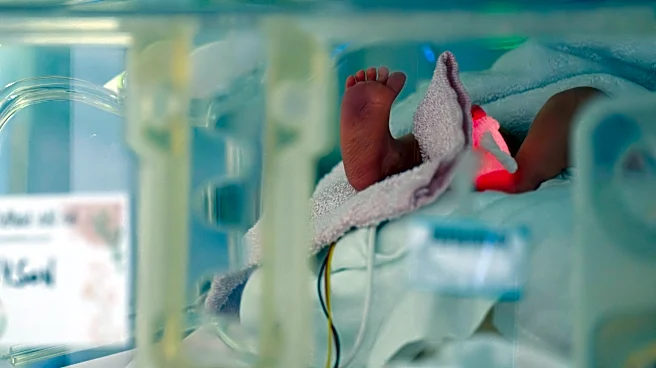







A baby at the center of a high-profile surrogacy dispute is in critical condition after undergoing complex heart surgery, according to court documents.
The newborn, known as Gabriel to surrogate McKenna West and Rumi to his biological parents, was diagnosed before birth with hypoplastic left heart syndrome, a serious congenital heart defect.
West, an Alaska nurse who was serving as a surrogate for California couple Nausheen Gilkar and Omar Ahmed, traveled to Texas during her pregnancy after she said the couple wanted her to terminate the pregnancy following the diagnosis.
The baby was born in Dallas on Aug. 12 and has remained under medical care in Texas.
Baby's condition declines after surgery
Gilkar and Ahmed said the newborn recently underwent a Norwood procedure, a complex open-heart
operation commonly performed as part of treatment for hypoplastic left heart syndrome, according to court documents obtained by TMZ.
The parents said in the filing that “serious medical developments” had arisen and that the child was in critical condition and being closely monitored at a hospital. They also alleged the baby was experiencing potential complications from the Norwood procedure and that his condition declined significantly, requiring doctors to reintubate him.
The court documents do not provide additional details about the specific complications or the baby's current prognosis.
The parents' statements about the baby's condition have not been independently confirmed by USA TODAY Network.
What is hypoplastic left heart syndrome?
Hypoplastic left heart syndrome, or HLHS, is a rare congenital heart defect in which the left side of the heart does not develop normally, according to the Centers for Disease and Control. It occurs in about 925 babes in the U.S. each year, or 1 in 3,846.
Babies with HLHS typically require a series of surgeries to redirect blood flow and allow the right side of the heart to perform the work normally handled by the left side. The Norwood procedure is generally the first of those surgeries and is performed shortly after birth.
Why is the baby at the center of a custody fight?
The baby's medical condition has been intertwined with a legal dispute between West and his biological parents.
West traveled from Alaska to Texas during the pregnancy after she refused to terminate the pregnancy and sought legal protection and access to medical care for the baby, according to her attorneys.
Texas Attorney General Ken Paxton intervened in the case before the baby's birth, and a Dallas County judge issued an emergency order requiring hospitals to provide medically necessary care and preventing the baby from being removed from Texas while the case proceeded.
After the baby's birth, Gilkar and Ahmed obtained a temporary restraining order that awarded them custody, according to the Texas Tribune.
The biological parents are now asking a court to delay a scheduled hearing on that order because of the baby's medical condition, according to the latest court filing.
Can intended parents legally require a surrogate to have an abortion?
Surrogacy agreements can include provisions addressing what happens if prenatal testing reveals a serious fetal abnormality, but those provisions do not necessarily give intended parents the power to force a surrogate to terminate a pregnancy.
In West's case, the biological parents say the surrogacy agreement included an abortion clause and that they and West initially agreed to terminate the pregnancy after the baby was diagnosed with hypoplastic left heart syndrome. West later changed her mind and refused to have the abortion, according to court filings. West disputes the parents' characterization of the agreement and is challenging the enforceability of the abortion provision.
Texas law also requires an abortion to be performed with the pregnant woman's voluntary and informed consent. The statute does not provide an exception allowing another person — including an intended parent in a surrogacy arrangement — to consent to an abortion on the surrogate's behalf.
That does not necessarily mean refusing an abortion has no legal consequences under a surrogacy contract. Legal experts told The Texas Tribune that an abortion clause could potentially create financial or contractual consequences if a surrogate does not follow the agreement.
Those could include disputes over compensation or pregnancy-related expenses, or litigation over whether the contract was breached. But experts also said courts have rarely been asked to enforce financial penalties when a surrogate refuses an intended parent's request for an abortion.
Are abortions legal in Texas?
Under Chapter 170A of the Texas Health & Safety Code, nearly all abortions were prohibited in the state after 2022.
There are exceptions made for when the life or health of the patient is at risk, according to the Texas State Law Library; however, the state does not grant exceptions to the law in cases of rape or incest.
Penalties do not apply to a patient who receives an abortion, according to Section 170A.003, but rather those who perform the procedure could face:
- A criminal offense — a second-degree felony, or a first-degree felony if the abortion results in the death of the fetus.
- Have their license or permit revoked if they are a physician or health care professional.
- A civil penalty of at least $100,000.
Brandi D. Addison covers weather across the nation as the Weather Connect reporter for the USA TODAY Network and contributes to Texas Connect coverage across the state. She can be reached at baddison@usatodayco.com. Follow her on Facebook here.
This article originally appeared on USA TODAY: Baby in Texas surrogacy fight is critically ill, biological parents say