
No team looks unbeatable. Plenty look like College Football Playoff contenders. And several enter this weekend knowing their postseason hopes could effectively be wiped out before September ends.
Meanwhile,
the sport's defending national champion finally faces a meaningful test. Indiana opens Big Ten play against Northwestern on Friday (8 p.m. ET, Fox).
Forget what we know. Let's focus on what we don't.
Here are the five biggest questions facing college football entering Week 4.
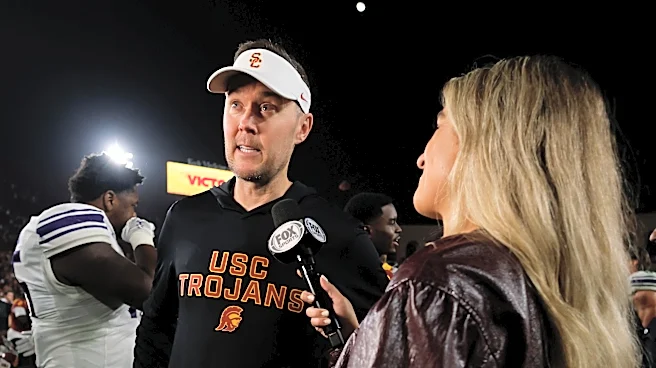
Is this the biggest game of Lincoln Riley’s USC coaching career?
Undefeated USC, ranked No. 12 in the latest US LBM Coaches Poll, hosts No. 16 Oregon in the Big Ten's first marquee showdown of the season.
One loss wouldn't eliminate the Trojans from playoff contention. That's the rational view.
But a loss would trigger another wave of questions about Lincoln Riley, now in his fifth season at USC without a College Football Playoff appearance. The Trojans seemed destined for one in 2022, sitting at 11-1 behind Caleb Williams before Utah dismantled them in the Pac-12 championship game. Since then, Riley is just 24-17 over his next 41 games.
USC is 4-0 this season, and its 39-0 shutout of Fresno State was more impressive than it appeared. Bulldogs coach Matt Entz believes his team is good enough to contend for a Pac-12 title.
Still, this feels like the biggest game of Riley's coaching career.
Yes, he led Oklahoma to multiple CFP appearances and nearly reached the national title game in his head coaching debut before blowing a 31-14 lead to eventual champion Georgia in the Rose Bowl.
But that was Year 1. This is Year 10.
Riley remains one of the highest-paid coaches in the sport. General manager Chad Bowden helped assemble the consensus No. 1 recruiting class in 2026. Industry insiders have told USA TODAY Sports that USC's roster operates at the upper end of the sport's spending scale, in the neighborhood of $40 million.
Oregon has looked vulnerable at times, but the Ducks have far less to prove. Dan Lanning has already delivered two consecutive CFP appearances, including a No. 1 overall seed. Riley has yet to get USC there.
And if the Trojans can't win this game at home, it's hard to believe they're done losing this season.
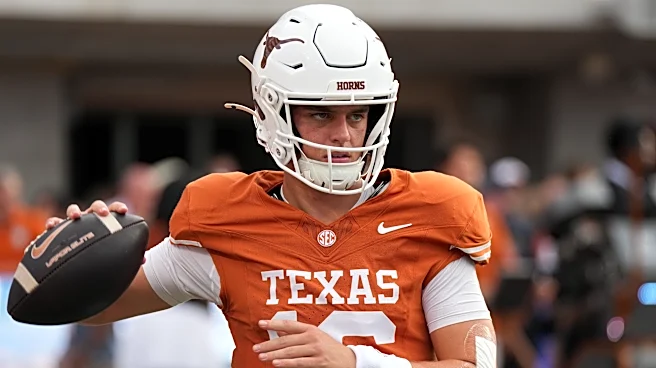
Which is true: Texas is for real, or will Arch Manning still scuffle on the road?
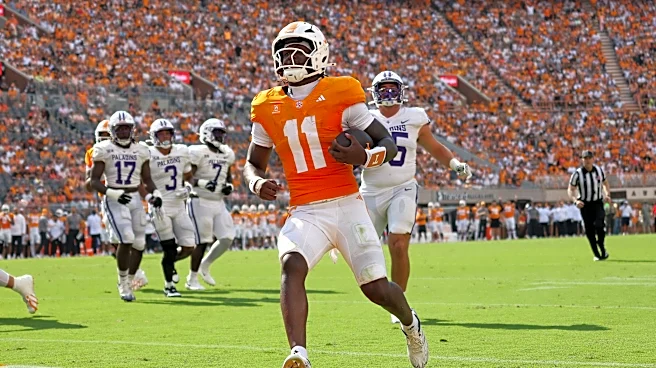
Tennessee is unbeaten, owns a road win at Georgia Tech and has climbed to No. 13 in the polls. More importantly, the Vols believe they have Josh Heupel's most talented quarterback yet in Faizon Brandon.
That's saying something.
But Brandon is still an 18-year-old freshman preparing to face a Texas defense that has allowed just three touchdowns through its first four games. The Longhorns also shut out then-No. 1 Ohio State in the second half of a comeback victory.
Across the field will be Texas quarterback Arch Manning. Though he's in his fourth college season, his road woes are well-documented. As USA TODAY Sports' Paul Myerberg noted, Manning has completed just 57.8% of his passes away from home, with seven touchdown passes and five interceptions.
Brandon has plenty working in his favor: a veteran offensive line, a dependable rushing attack and a sold-out Neyland Stadium crowd behind him.
Manning doesn't have those advantages.
What he does have is pressure.
The former No. 1 recruit carries playoff expectations, Heisman expectations and the burden of proving Texas can win the biggest games away from Austin. Brandon is playing with house money. Manning is playing with everything on the line.
Will Georgia effectively end Oklahoma’s season before the calendar hits October?
Yes. An emphatic yes.
Oklahoma's defense is good enough to keep things competitive early when the Sooners head Between the Hedges to face No. 2 Georgia.
The offense is another story.
Calling Oklahoma's offense disjointed might be too kind. Quarterback John Mateer has thrown eight interceptions over his past five games, including the end of last season. The unit has also failed to reach 300 yards in back-to-back games against Michigan and New Mexico, managing just 24 total points across those eight quarters.
That's a troubling formula heading into Athens.
Georgia's defense has smothered overmatched opponents through three games and enters the weekend ranked seventh nationally in total defense, allowing just 211 yards per game.
Even if the Sooners somehow spring an upset, their path remains brutal. Oklahoma still has a neutral-site showdown with No. 1 Texas, home games against Kentucky, Ole Miss and Texas A&M, and road trips to Florida and Mississippi State.
This team simply isn't done losing.
In fact, the next loss is likely coming Saturday against Georgia.
Is the loser of the Texas A&M-LSU game out of the playoffs?
Short answer: Yes.
Longer answer: Absolutely.
The schedules are simply too demanding for both teams. A two-loss SEC team is almost certainly getting into the College Football Playoff this season, especially as the conference fights to reclaim its status as the sport's top league from the Big Ten. It wouldn't be surprising if multiple two-loss SEC teams make the field.
But there are still only 12 spots available. The ACC, Big Ten and Big 12 champions are guaranteed bids, along with the highest-ranked Group of Six champion. No. 3 Notre Dame likely doesn't have the schedule strength to survive two losses, but the Irish also have a favorable path to avoid taking a second defeat.
Which raises an important question:
What will the loser of this game have shown to make anyone believe it can navigate the final nine weeks of the season without another setback?
Texas A&M still must face Missouri, South Carolina, Oklahoma and Alabama on the road while hosting Tennessee and Texas.
LSU's schedule is no kinder. The Tigers enter a defining stretch in November that includes back-to-back home games against Alabama and Texas before Lane Kiffin's second trip to Neyland Stadium as opposing head coach.
The winner of this game preserves at least a one-loss cushion.
The loser leaves with far less margin for error and far more questions.
If passed, will Protect College Sports Act curb roster-spending in college athletics, especially college football?
Sometimes one question naturally leads to another:
If the Protect College Sports Act passes a Senate floor vote and then clears the House, will the adults in the room finally start spending like adults who follow the rules they've spent years demanding?
SEC commissioner Greg Sankey, Big Ten commissioner Tony Petitti and numerous power brokers across college athletics, including Nick Saban and Deion Sanders, have all called for guardrails. Those guardrails were supposed to arrive, at least in part, with the House settlement in June 2025.
Instead, the sport turned the search for loopholes into an arms race.
Schools immediately began pushing the boundaries of the new system. Nebraska and others explored how many NIL deals could be routed through multimedia-rights partners. Programs looked for every possible avenue to create additional compensation opportunities and get them approved through the College Sports Commission.
The result was exactly what many feared: a race to the gray area rather than a commitment to the spirit of the rules.
Will expanding the revenue-sharing pool under the Protect College Sports Act change that behavior?
Maybe not.
But Sen. Eric Schmitt, a Missouri Republican and one of the bill's co-sponsors, told USA TODAY Sports this week he believes it at least gives college athletics a chance to curb the incentives that have fueled the current spending frenzy.
“I think you’ve got effectively $50 million,” Schmitt said, noting the expanding rev-share pool would be almost $50 million with the potential to dole out an extra $5 million to women’s and Olympic, non-revenue sports atop the roster-spend elsewhere on campus. “I talked to Pete Bevacqua of Notre Dame [and asked], ‘If you got rid of the collectives, what would the real (salary) cap look like?’ Because we all know $21.5, that’s not true. We’ve got some college teams, they have $40 million dollar football rosters.
“So, if you legitimize everything and made it legit, what would the real number be? He said it was about $45 to $50 million. That’s really where we’re at (if the PCSA passes).”
This article originally appeared on USA TODAY: From Lincoln Riley to Arch Manning: College football’s 5 biggest questions this week