



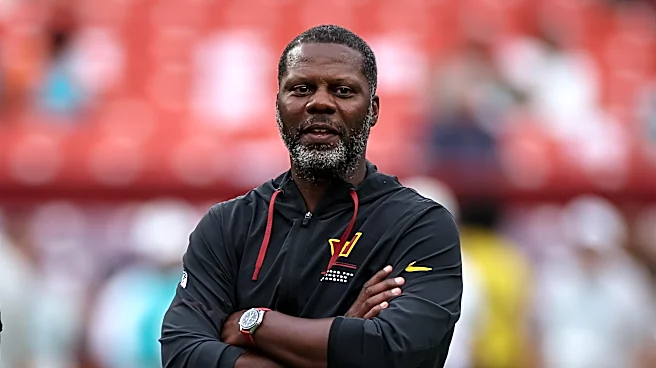
WASHINGTON, DC — When you think about the years Darrell Green roamed the grass of a cozy stadium not too far from here, you might remember his reputation, too.
"I was what you would consider kind of small for the game, so it’s odd that I made it to the NFL," says the Hall of Fame defensive back who played for Washington and who was listed at 5-foot-9, 184 pounds as a player
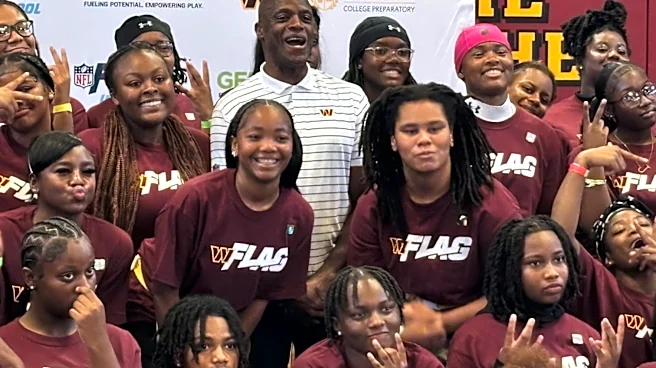
, "but I had a secret weapon."He was speaking last week to a group of high school girls in the gymnasium of IDEA Public Charter School in Northeast D.C. He asked them to guess his age, and a flurry of numbers were shouted back at him, ranging from the 40s to the 60s.
Green is now 66, and still slender. He stepped forward and backward purposefully to deliver his point.
"In any
city I went to, any stadium, on any playing field, I was the fastest player," he says, hinting at the title of "NFL’s fastest man" he earned during a 20-year career with one franchise. "Not only do you need to be fast, you need to have footwork, technique, different things. Flag football gives you the chance to develop all those skills: A lot of running, quick feet, catching the ball, spinning, all kinds of things that you need to be good."

The girls, representing IDEA Public Charter School and KIPP DC College Preparatory, quietly listened. But about 10 minutes later, their shouts rattled against the walls of the tight space. They ran pass routes against one another. One of them made a catch close to the back wall.
“Oh my God!” Green said, now speaking with USA TODAY Sports, urging us to move our interview further off to the side so he wouldn’t get hit.
“You're listening to the sound … you hear that in basketball,” Green says. “You can hear that in any type of indoor activity. But the energy we are hearing and seeing, (it’s) the energy behind just a one-on-one drill that girls never got to be a part of.”
It’s the sound of girls flag football continuing to make massive inroads, and to grow and thrive, in schools across the country. Can you hear it?
'Anybody can play this game': Flag football attracts kids from many different backgrounds and skill levels
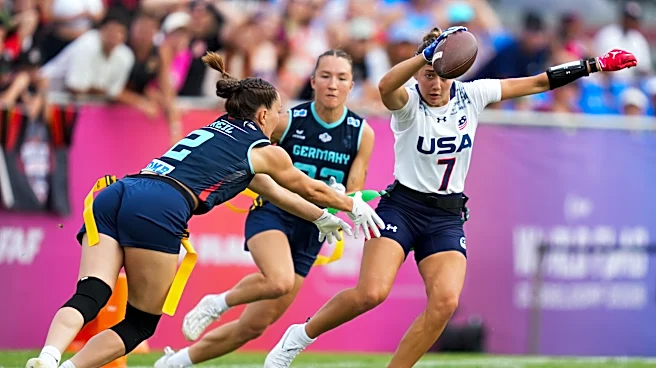
Flag football is the fastest-growing youth team sport in America. According to the Sports & Fitness Industry Association (SFIA), via the NFL, there are more than 4.1 million youth flag players in the U.S. The NFL has seen an 85% growth rate in participation by girls over the last three years.
Girls flag football is the fastest-growing high school sport in the country, with 24 states and the District of Columbia sanctioning it at the varsity level and most others interested in moving in that direction. According to the National Federation of State High School Associations, approximately 102,360 girls played high school flag football during the 2025-26 school year, an increase of 87,000 in four years.
The numbers are heavily boosted by the NFL FLAG-In-School program, which, according to the league, has helped more than 17 million students participate through free kits distributed to 40,000-plus school communities over about 10 years.
“Typically when we come in schools, it's third through fifth graders, and it's an opportunity to introduce them to the game,” says Dan Levy, the director of youth football programs for the Washington Commanders, who hosted last week’s event alongside the NFL and Gatorade, which donated $1 million to provide 1,000 flag football kits to schools nationwide, including those in Washington, D.C.
“We leave them with information about where they can find local leagues in their area so they don't have to travel too far,” Levy says. “That gives them a little bit of an intro to, ‘This is cool. I want to keep playing. I'm feeling some confidence because anybody can play this game.’ ”
GENYOUth, a national nonprofit co-founded by the NFL, administers and executes the NFL FLAG-In-School program. The goal, says Lauren Izzo, vice president of programs at GENYOUth, is to introduce flag to elementary, middle and high schools.
The program, through funding from the NFL Foundation and partners like U.S. Bank and Gatorade, is free to schools and kids. All 32 teams have been involved in the effort, helping to train teachers and coaches, start programs and in other ways.
Often, Izzo says, P.E. teachers are high school coaches themselves. They can help implement the sport further, such as starting their own school team.
“We're creating moments throughout the school day, and specifically in the P.E. classroom,” Izzo says. “Our plan is that kids will really start to enjoy and love and develop a love of the sport and then from there, if they want to continue to play outside, whether it's in leagues or intramurals.”
Bound together, these activities have become a movement, in some cases happening unexpectedly.
Tierra Reeves, head coach at highly successful KIPP DC College Preparatory, says an athletic director said to her a few years ago: “Hey, we're getting into flag football. You're going to be our coach.”
Reeves, who has played in adult leagues, works in the headquarters of KIPP DC, a community of public schools in Washington.
“No, I'm not,” Reeves says she responded to the director. “I don't want to deal with the kids. I'm good.”
Reeves has since had three undefeated seasons and three championships in her public charter conference. She says she recruits, but when she’s out in the city, she’s inundated with girls who want to play for her.
“Those are my babies, 24/7,” Reeves told USA TODAY Sports. “I tell my son all the time, ‘You got 30 sisters. You gotta deal with them. You gotta share me.’
“None of these girls had any experience. I had cheerleaders. My quarterback was a softball pitcher. Drama kid. Like not an inch of a soul of anything flag football right across these kids' face.
“I was surprised. It was beautiful to see that I could take a cheerleader and make them into a flag football player. The quietest person on the team turned into a flag football player.”
'It became a sisterhood': Flag football is a sport girls have grabbed and run with to the collegiate level. Are boys next?
Reeves, a former basketball player, started playing flag football in 2012. She watched a onetime boyfriend compete in tournaments and realized it was something she wanted to do, too.
“My mom passed from sickle cell, and I found myself in a dark space where therefore I had to find an outlet,” she says, “and that outlet was women's flag football, where therefore these women that knew me from nowhere wrapped their arms around me, and it became a sisterhood, which I also invest in my girls.”
Izzo, the VP of programs at GENYOUth, felt the pull when she worked at her father’s supermarket in the Bronx, New York. She was a preschool teacher but her dad needed help. While with him, she worked closely with the Cookshop program that supported the New York City Foodbank’s nutrition activities.
She realized she wanted to go into nonprofit work, and GENYOUth and, specifically, flag football, created an opportunity.
“One of the questions that we always ask on our year-end surveys (is) specifically about, ‘Are you seeing girls’ increased participation?’” Izzo says. “Very consistently over the last 10 years or so they're seeing more interest, more participation among girls, and I'll also add that the high school curriculum was developed specifically with girls in mind. It’s for boys and girls, but it was put through the lens of, how can we make this more exciting and accessible for girls to play, knowing that girls' flag is on the rise.”
According to the NFL, 250-plus U.S. colleges and universities currently offer women's flag football programming. A number of post-secondary institutions (NCAA, NAIA schools and junior colleges) offer varsity flag football for women, while the NCAA voted at its spring meeting to recommend Divisions I, II and III add national championships as early as spring 2028.
The University of Nebraska will become the first Power Four conference school to add women’s flag football as an intercollegiate varsity sport in the spring of 2028.
Levy, of the Commanders, said the team has hosted a showcase for 120 girls from D.C. and neighboring states in front of about 25 colleges. He says a number of girls were recruited on the spot.
“We'll run another one in December and we're hopeful to have 200 girls and as many colleges as can fit in our building,” he says.
The team is working with 178 girls flag football programs throughout Washington, Virginia and Maryland to start high school programs.
“We're really trying to touch every different piece of the flag football and high school tackle and youth tackle universe so that they can all have that touchpoint so they can feel inspired to do anything they want to do,” Levy says. “Our goal is to get girls flag sanctioned in all the different jurisdictions that we're in, to provide pathways for anyone to play, whatever sport it is.
“The high school level, while they're all playing tackle on the boys side now, I wouldn't be surprised if in the future there are a lot of opportunities for boys to play flag football as well. Because you see it when you turn on ESPN to the NFL Flag championships. You see those boys play at the highest level and we'll see a lot of pathway from boys flag to high school to college football.”
'Maintain your you': Flag football, and sports, are just a part of us, but they help show people who we are
Flag will be an Olympic sport for men and women in 2028. Green, the Washington football legend, participated in the Team USA flag football trials in March, hoping to earn a spot on the squad that will compete at the world championships in Germany.
It wasn’t a gimmick. He tried out at 66 after qualifying to be at trials through testing results, according to Callie Brownson, the senior director of high performance and national teams for USA Football.
Green ultimately wasn’t selected, but he proved his point, and tied it to a message he wanted to relay about this burgeoning sport.
“I never played flag football in my life until I tried out for the Olympics, so I think for you guys, you’re coming in at the right time in the right game and a fun game. I honestly had a lot of fun, and I was playing against guys way younger than me," he told the high school girls in Washington.

Speaking with USA TODAY Sports, he solidified his point as the NFL seeks to reach every school in the country with this sport.
Green told the girls that sports gives us the opportunity to bring out the full picture of ourselves.
“Maintain your you,” says Green, now a father and grandfather, “ 'I'm a daughter, I'm a student, I am a grandchild, I am a friend, I care about my community. I look out for my siblings. And I play flag football. … ’
“That's what my mom and dad taught us, a way to live our lives, to treat people as people. And this was prior to me becoming ‘famous.’ I had this already: Treat people like you want to be treated. Oh, and by the way, I balled out on the football field. And then I go home. We cut the yard, we go to dinner, whatever. I think this sport, it just has a wholesomeness about it. And that’s what parents need to look at.
"A grandfather, and a father, a mother and a grandmother can feel good about their kids and feel like their kid can participate."
Reeves, the varsity girls flag football coach at KIPP DC College Preparatory, says the parents of the girls on her team call her "Coach Mom." But she leaves flag football at the door when she gets home to her son, Santana, who’s 16.
She says she makes it to all his high school basketball games, too. She calls herself a “dual mom,” assigned to a sport, and a mission that anyone who enters athletics can benefit from what it brings to their lives, especially in underserved communities.
“I leave flag football at the door to keep a peaceful house,” she says. “But my boyfriend is very supportive. My son is very supportive. They know that everything I do is for these girls that KIPP DC serves. These girls need somebody like this. …
“This is the time (for) flag football. I'm 43. I still play. And to see the direction that it is going in is a very sweet moment because that means that everything that we've done as women at our tender age of 43-plus, that means we've done something, someone has seen it and therefore they’re pushing it forward.”
Steve Borelli, aka Coach Steve, has been an editor and writer with USA TODAY since 1999. He played baseball in high school, rowed in college and spent 10 years coaching his two sons’ baseball and basketball teams. He and his wife, Colleen, are now sports parents to a college and high school baseball player. For his past columns, click here.
This article originally appeared on USA TODAY: NFL legend Darrell Green explains why he joined a girls sports movement