






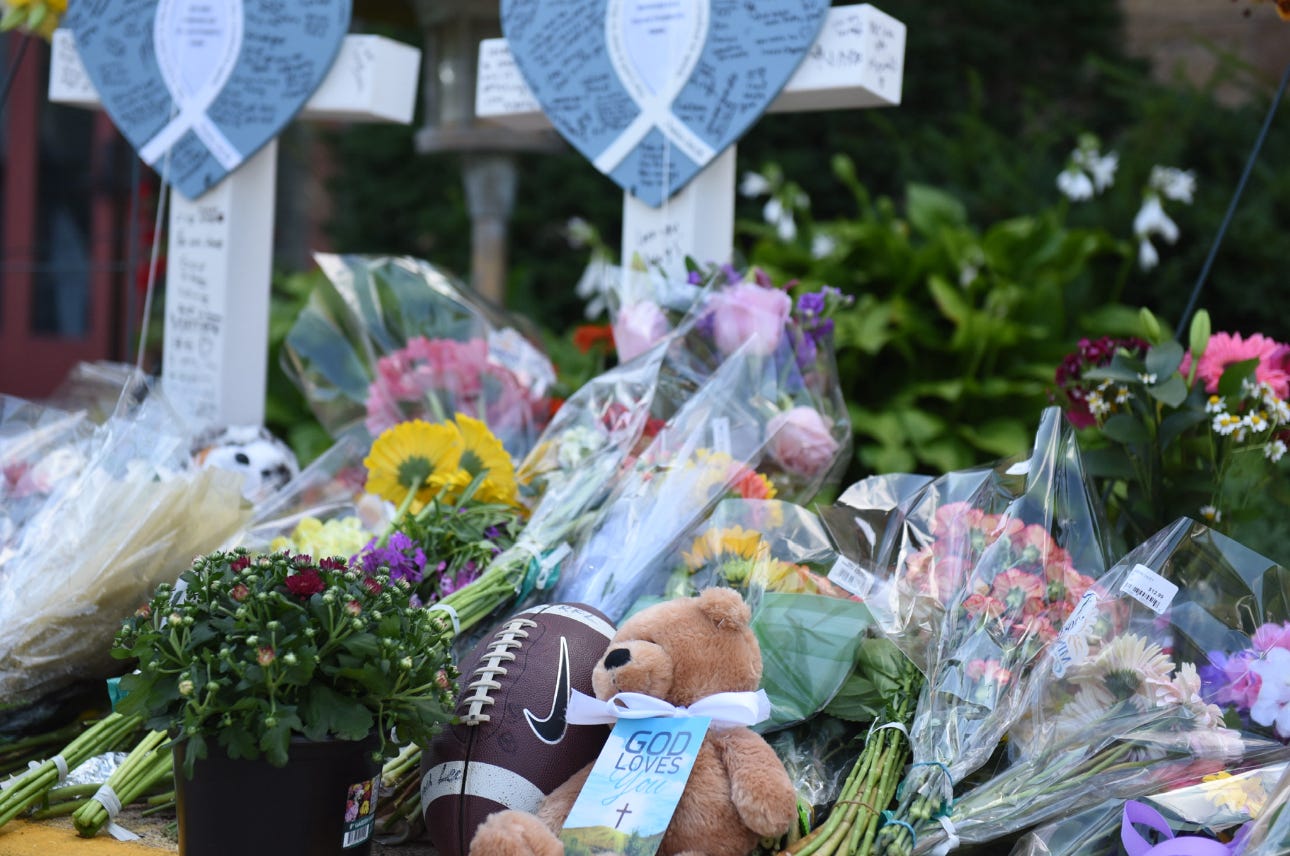
WASHINGTON – Dylan Hockley was six when five bullets fired from an AR-15-style rifle tore through, and destroyed, his small body.
If Dylan’s killer had brought a handgun instead of a semiautomatic rifle to Sandy Hook Elementary School, his mother told USA TODAY, he would not have been able to kill 20 first-graders and six adults in less than five minutes.
“It’s not your typical firearm,” Nicole Hockley said of the Bushmaster XM15-E2S used in the 2012 mass shooting. “It is designed to create catastrophic damage in a very short amount of time. And it does that incredibly well.”
She will be listening closely from the rows of public benches at the Supreme Court on Dec. 2 when the justices debate whether the Second Amendment allows state and local governments
to ban AR-15s, as Connecticut has done in an effort to prevent another mass shooting.
Hockley, who co-founded Sandy Hook Promise to reduce gun violence and promote school safety, said it would be devastating if the court takes away that “important prevention tool.”
While debates over gun regulation are often highly charged, the dispute over assault-style weapons kindles particularly strong emotions on both sides.
AR-15-style rifles are connected in the public mind with mass shootings and are a top target of groups trying to reduce gun violence. But they’re also very popular with law-abiding gun owners – a reason the gun rights groups and individuals challenging bans in Connecticut and Chicago's Cook County, Illinois, argue that they are protected by the Constitution.
“If a state can ban the most common rifle in America, then the Second Amendment’s guarantee means very little in practice,” said Adam Kraut, executive director of the Second Amendment Foundation, one of the groups challenging the bans.

A major Second Amendment case
The issue is one of the biggest the 6-3 conservative court will decide this term.
It may also be the most important Second Amendment case since the court’s landmark – and controversial − 2008 decision establishing an individual right to a firearm for self-defense. The 5-4 opinion in District of Columbia v. Heller included the caveat that the right is not unlimited, but did not detail the specific weapons protected by the Constitution while striking down restrictions on handguns.
Instead, the majority said the Second Amendment protected weapons “in common use at the time,” a limitation supported by “the historical tradition of prohibiting the carrying of dangerous and unusual weapons.”
“Now the court is going to have to address what Heller meant,” said F. Lee Francis, whose scholarship at Widener Law Commonwealth focuses on firearms law. "This case really says whether or not that language was doing any work at all."
Eric Ruben, an expert on the Second Amendment at Southern Methodist University, said judges have been befuddled by whether policymakers can ban firearms based on their danger or on how uncommon they are.
“The question becomes then, well, how do those two different things relate to one another?” Ruben said. “Is it that any weapon that is in common use cannot be banned? Or is it just that they can be banned so long as they’re unusually dangerous?”
In the case of AR-15s, appeals courts have upheld the bans in Connecticut and Cook County but struck down New Jersey’s prohibition.

AR-15s surged after federal ban expired
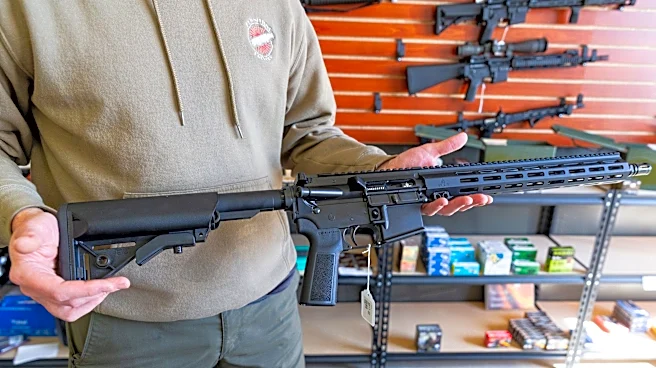
AR-15s are the civilian version of the military’s M-16, a weapon developed for soldiers in the Vietnam War.
The Supreme Court’s Heller opinion mentioned M-16 rifles as a type of weapon “most useful in military service” that may be banned.
In 1994, Congress prohibited the manufacture of specific semiautomatic firearms for civilian use. The ban was not renewed after it expired in 2004, and AR-15s began to surge in popularity. While there are no official figures for how many AR-15s are owned by Americans, gun rights groups say retailer surveys indicate there are tens of millions in circulation.
Kraut, the executive director of the Second Amendment Foundation, said the firearm first caught his attention as the federal ban was sunsetting while he was about to graduate from high school.
“I can remember sitting in class knowing this and kind of looking around, going, `Those look kind of neat. I’m interested in buying one,’” he told USA TODAY.
NRA calls AR-15s 'America's Rifle'
In 2016, the National Rifle Association dubbed the AR-15 “America’s Rifle” in a blog post explaining its popularity.
The weapon is “customizable, adaptable, reliable and accurate,” the NRA said.
The ability to modify and personalize an AR-15 – including its stock, optics and barrel – has prompted some to call it the “iPhone of guns,” the “LEGO of guns,” and “a Barbie doll for men.”

Kraut said when he purchased his first AR-15 after turning 21, his focus was having a fun time at the shooting range with his friends. But as he got older and more versed in guns, he said, the AR-15 became his weapon of choice to protect his home, “mainly because of just ease of use of a rifle versus a pistol.”
Supporters and opponents of AR-15 bans disagree on whether the semiautomatic rifles are commonly used for self-defense as opposed to sport – and also on whether they’re an appropriate weapon for that purpose.
But some of the same reasons why they’re generally popular – being easy to use because they have less recoil and are lighter and easier to fire than other rifles – are also reasons why they’re more dangerous, according to supporters of the bans.
'Uniquely destructive'
That ease of use combined with the velocity of the bullets and the fact that they can be fired at an extremely rapid rate make AR-15s “uniquely destructive,” a group of survivors of assault weapon shootings told the Supreme Court in a filing.
In another brief supporting the bans, an advocacy group formed after the 2025 mass shooting at a Catholic church in Minneapolis said the shooter explained in a journal why an AR-15 was needed.
“I am concerned a pistol caliber won’t be enough to penetrate multiple bodies,” the shooter wrote.
AR-15s or similar rifles were the gunmen’s chosen weapon in 12 of the 17 deadliest mass killings in the United States since 2012, Connecticut’s attorneys said in their written argument defending the state’s ban.
“Criminal organizations, terrorists, and lone gunmen seeking to kill as many people as quickly as possible have all selected AR-15 platform rifles because they allow a single, relatively unskilled shooter to execute a mass casualty event,” the state wrote.
Handguns also used in mass shootings
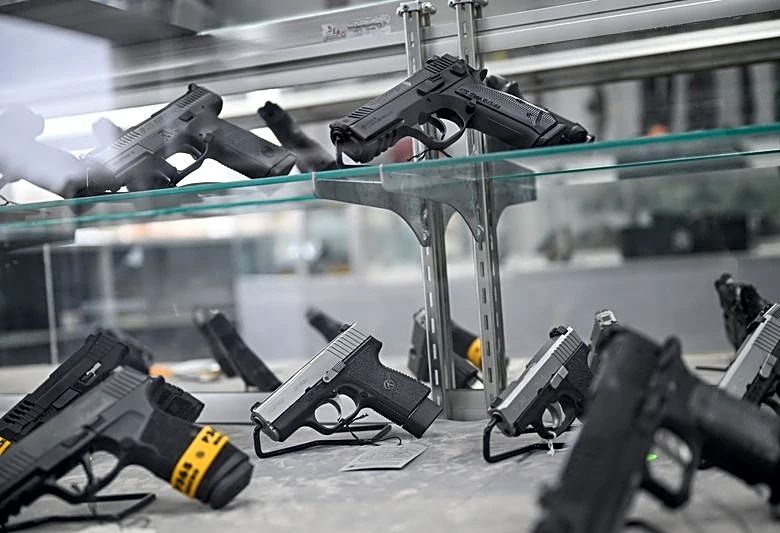
Opponents of the bans point out that handguns are used more often than any other kind of gun in violent crimes.
They also note that the deadliest school shooting in American history – the 2007 attack at Virginia Tech University – was committed with semiautomatic pistols.
The Trump administration’s Justice Department, which opposes bans on assault weapons, told the Supreme Court that handguns are more dangerous and are chosen more often by armed criminals because they can be concealed.
Under Heller – which said states can’t restrict “the most preferred firearm in the nation” to protect a home and family – the people get to decide whether a type of weapon is too dangerous for ordinary Americans to have, according to gun rights groups.

Who gets to decide?
Connecticut’s attorneys agree that the choice is up to the people. But they argue that the people of Connecticut made that choice when the legislature decided that AR-15s posed unacceptable dangers to the community.
Nine other states plus Washington, D.C., have also reached that conclusion, as have a number of cities.
Hockley, the co-founder of Sandy Hook Promise, said her group has stayed away from most legal fights over the Second Amendment while focusing on recognizing warning signs, intervening early and reducing easy access to guns as top ways to prevent school shootings.
But the group filed a brief in this case, she said, to emphasize that a weapon’s capability matters.
“The court’s decision is going to affect how states can protect their people and their children,” Hockley said. “I very strongly believe that we have to value children’s safety as strongly as we value the right to have guns.”
This article originally appeared on USA TODAY: Why the Supreme Court's next gun rights case is one of its biggest