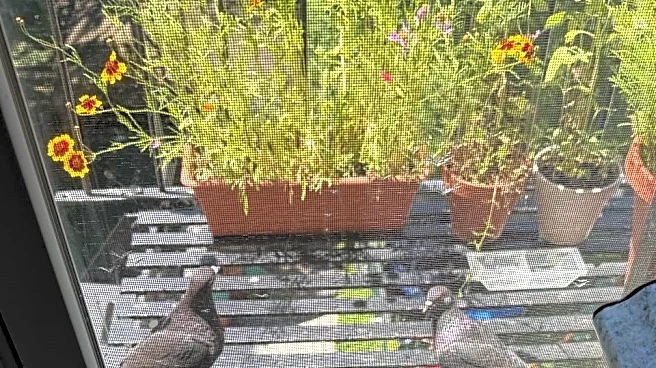








Why send a text when you could send a carrier pigeon?
In April, two mobile apps that allow users to send messages at the rate of carrier pigeons were released to app stores. Though the apps Roost Social and Carrier Pidge have no affiliation with one another, they've grown sizeable audiences as users seek a slower style of communication.
At their core, Roost and Carrier Pidge are the same − think traditional snail mail but digital (and with birds).
When creating an account on one of the apps, users input their location. Users then craft a message and send it to a friend who also has the app. Messages are sent at the speed in which it would take a bird to fly the distance from one friend to another (or close enough to the real speed), in real-time.
The two apps launched at the same time, but the creators of the platforms told USA TODAY they didn't know about one another.
How do the apps work?
Carrier Pidge only offers pigeons, which travel at 110 mph in the app (pigeons actually fly at 50-60 mph, according to Northumberland National Park). Roost offers a breadth of different birds (and other animals) users can choose from, including a mallard that travels at 51 mph, a rock dove that travels at 49.5 mph and a red-eared slider turtle that travels at 1 mph.
In addition to messages, Roost offers mini games users can play to level up their animals and a pen pal feature, which randomly connects users across the globe.
Building their nests
Logan Mendelsohn, 31, of New York, said the idea for Roost came about 11 years ago with a group of college friends.
"We were backpacking Europe and I made a joke about, 'Hey, we should make an app to send carrier pigeons to our friends back home and it would be so funny if it took a super long time to get there,'" Mendelsohn told USA TODAY. "I guess since then, it's always been a joke." At the time, Mendelsohn and his friends didn't have the experience to develop an app, he said, but the group always returned to the idea.
In May 2025, Mendelsohn, who is a senior product manager at Ticketmaster, began tinkering on the idea and posted the idea to TikTok. He was surprised by how many people liked the idea.
"As a person who loves silly apps but also does the occasional birding, I need this app bad," a TikTok user commented on one of Mendelsohn's early videos.
Over the course of a year, Mendelsohn flushed out the concept and began coding. The app released in the Apple App Store on April 30, Mendelsohn said.
For Noah Larrobino, 29, of Brooklyn, the process to create Carrier Pidge was quicker.

"I was just sitting on my couch one night and the idea just came to me," Larrobino, a software engineer, told USA TODAY. "I just couldn't get the idea out of my head and that night, I just starting building the project. I just had a big smile on, just laughing the whole time while developing it."
Larrobino said he had the idea for the app in early April and by April 18, the app was on the Apple App Store. Largely, artificial intelligence aided in this turnaround.
Both apps got help from AI
To start, Larrobino said he used an AI chatbot to hash out his idea before asking the AI to generate a file he could upload to Claude Code to create the app. Released in February 2025, Claude Code is an AI coding assistant that can read code, edit files, run commands and integrate with a user's development tools, according to the Claude website. Larrobino said Claude Code wrote "a lot" of Carrier Pidge.
Mendelsohn also used AI for Roost.
The developer said he wrote the initial code for Roost but since its release, he's used Claude Code to work out kinks.

Initially, Mendelsohn said he used AI-generated artwork within the app, but upon the app's release, he received widespread backlash for it. Since the app has taken off, Mendelsohn said he is looking to replace the artwork to elements made by real people. To facilitate, Mendelsohn started an artist challenge in the Roost app where users can submit artwork for various animals, which is then voted on by other users.
Though the apps are wildly similar, their timely releases are consequential, both creators said. The two have talked since the release of their apps and agree their projects offer different experiences to different users.
In-app purchases to keep afloat
Both apps are free to download but feature in-app purchases. Upon creating an account, Roost users select four animals to start their "rookery." Users can buy more animals for between 99 cents to $9.99.
Mendelsohn said implementing in-app purchases was necessary because the cost of keeping Roost afloat is costly. In July, Mendelsohn spent more than $10,000 on Roost, according to a Google Cloud billing statement shared with USA TODAY. As of Aug. 18, Roost had already cost Mendelsohn more than $7,600.
When launching Carrier Pidge, users are only provided one pigeon per conversation with another user. This pigeon is sent back and forth and in some cases, a pigeon may die while in route (a 0.2% chance, the app states). If a pigeon dies, a user must purchase another for 99 cents.
Why are users flocking to carrier pigeon apps?
As of Aug. 18, Mendelsohn and Larrobino said Roost boasted more than 700,000 users and Carrier Pidge had 76,000 users.
And the popularity isn't surprising, as younger audiences are turning toward simplified technology. Gen Zers are buying "dumb phones," millennials are installing rotary landlines and tech companies like Brick are looking to actually help cut down people's screentime. In June, Eventbrite even deemed the warmer months "The Offline Summer."
When talking to Roost users about why they enjoy the app, Mendelsohn said the common thread is intentional communication. The lack of an endless scrolling feed and noisy notifications are also a perk, he said.
"I think people are getting tired of technology being so integrated into our lives, especially a couple years past COVID," Larrobino said. "People want to get outside, people want to get off of their phones. I think slow messaging kind of helps with that."
How to download Roost and Carrier Pidge
Roost is available for download in the Apple App Store and Google Play Store. Carrier Pidge is only available in the Apple App Store, as of Aug. 18.
Greta Cross is a national trending reporter at USA TODAY. Story idea? Email her at gcross@usatoday.com.
This article originally appeared on USA TODAY: These apps send texts at the rate of a pigeon – and users are flocking