





Ask any critic about their favorite performance of the year, and they’ll likely tell you it’s Jeon Do-yeon.
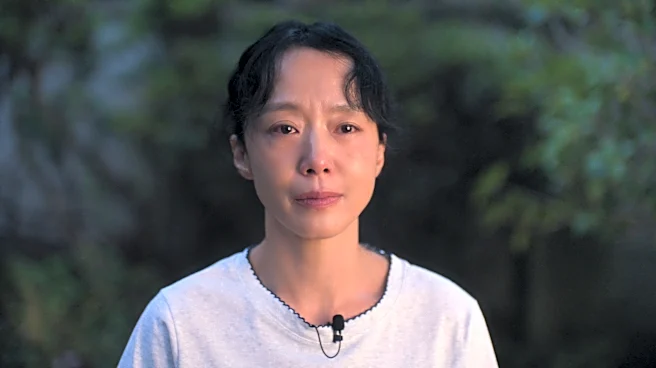
Ever since the Venice Film Festival in September, the South Korean star has been flooring audiences with her breathtaking tour de force in Lee Chang-dong’s “Possible Love” (now streaming on Netflix). The mesmerizing drama – about two married couples from different social classes – is already shaping up to be an Oscar contender across multiple categories, with countless people on social media waving the flag for Jeon in best actress.
“I’m OK if you jinx it,” Jeon, 53, tells USA TODAY with a grin, speaking through a translator over Zoom. “Truly the fact that people are talking about this film gives me so much happiness. I just feel grateful
about that, so I’m very happy with whatever happens.”
'Possible Love' wrestles with the thorny 'ethics' of making documentaries

In “Possible Love,” Jeon brings infectious warmth and wistful melancholy to Mi-ok, the wife of a laid-off factory worker named Ho-seok (Sul Kyung-gu), who has been emotionally gutted by a violent labor strike.
Their quiet existence is soon shaken up by the affluent Sang-woo (Zo In-sung) and his filmmaker wife, Ye-ji (Cho Yeo-jeong), who wants to make a documentary about the plight of the working class and the human toll of corporate cost-cutting.
But the line between good intentions and exploitation begins to blur as Ye-ji embeds herself with Mi-ok, capturing her family’s most vulnerable moments on camera.

The movie is a striking companion piece of sorts to Elizabeth Holmes documentary “You Can See Everything,” which likewise explores the ways that people behave or present themselves differently when they know they’re being filmed.
“That doesn’t mean they are lying or acting,” Lee says. “It means they may begin to create what they think the camera wants – or what they imagine a potential audience might want to see.”
Mi-ok, for instance, attempts to start a union at her factory job, sensing that Ye-ji is looking for something “interesting” to film. Ye-ji, too, continually pushes Ho-seok to sit for an interview in spite of his trauma.
“A camera is inevitably drawn to what is more dramatic and more painful,” Lee says. “I wanted the audience to feel that desire, and the power that comes with holding the camera, and to reflect on the ethics of looking through it. I also wanted viewers to become aware of their own gaze – not only of the characters being watched in the film, but of our own desire to watch them.”
Jeon opted not to interview laid-off workers in preparation for the movie, in fear that she would then get too caught up in wanting to do their stories justice and not actually make the character her own.
“Director Lee has spoken about the ethics of his approach, and quite similarly, I didn’t think I would be able to wholly understand them,” Jeon says. Instead, “I thought it would be more fitting for me to just feel the character as she is. And while the story does start with that particular event, it’s about how they navigate life and carry on. Mi-ok and Ho-seok are just one of the many, many families who have gone through that.”
How Oscar hopeful Jeon De-yeon found the 'contradictions' of Mi-ok

Jeon is best known to American audiences for 2010’s “The Housemaid” and 2007’s “Secret Sunshine,” for which she won best actress at the Cannes Film Festival. The latter marked her first project with Lee, who is in awe of the ways that her performances have only gotten more truthful and surprising over the last two decades.
“Mi-ok is not simply the conventional figure of a suffering wife – she has an irreverent humor and pride, desires and anxieties, and contradictions within herself,” Lee says. “Jeon reveals all these sides without reducing Mi-ok to a single explanation.”
Throughout filming, “she would break through my assumptions about how someone might feel or behave in a particular situation and reveal the unexpectedness of a living person.”

There are layers to the playful Mi-ok, who enjoys drinking and snapping photos of her food, despite lamenting that she has no one to send them to.
Initially, “I thought Mi-ok was a very hopeful and optimistic character, and that what made her powerful was that very bright, positive energy about her,” says Jeon, who lives in Seoul with her husband and teenage daughter.
“However, with time, I’m realizing that level of energy is her own way of dealing with the anxiety she carried with her. That insecurity Mi-ok feels all stems from her so desperately wanting to protect her family, which is something I can relate to.”
In a childhood flashback, we see Mi-ok playing with a hose at her mother’s car wash. Angrily, her mom snaps it out of her hands, not wanting her daughter to grow up to do the same menial job that she has.
That scene is powerfully echoed later in the movie, as Mi-ok watches her young son, Cheol (Jeong Seop), make a rainbow with a hose, as he helps a groundskeeper water plants at Ye-ji’s palatial estate. It’s a brief yet heart-wrenching moment that was actually unscripted.
“On the day we were shooting, Director Lee said to me: ‘I would like for Mi-ok to look at him once,’” Jeon recalls. “But she doesn't say anything or take it away. In her mind, she was probably thinking about the contrast between her own childhood. She had her own free will taken away at that moment with the hose, but Cheol doesn't get that done. Although it's a small scene, it gives you a little glimpse into how Cheol probably lived his life according to his own free will.”
“Possible Love” is a thought-provoking study of identity and inequality, yet it’s also a deeply human romance at the end of the day. Mi-ok spends much of the film envying the relationship between Ye-ji and Sang-woo, only to realize that what she has with Ho-seok is built on something much stronger.
“It's not only love when you go through the good times and the happy times, but it's really about the difficulties in life that you face together,” Jeon says. “It's only then that truly reveals how much you love them and how much you are willing to do for each other.”
This article originally appeared on USA TODAY: Jeon Do-yeon unpacks her Oscar-worthy turn in Netflix's 'Possible Love'