

NAPLES, FL — Ray Lewis didn't know how to slow down.
He was wearing half pads, and his high school football coach had made it clear: There would be no tackling.
Then the play happened. Lewis hit the player anyway.
His coach couldn't believe it. He had just told the players there would be no tackling.
Lewis' response: “Coach, that wasn't even full speed.”
His coach looked at him.
“Don't change it. We'll change around you.”
Ray Lewis blends impact with influence
Decades later, that mentality still defines Lewis. It followed him from Lakeland Kathleen High School to the University of Miami and through 17 NFL seasons in Baltimore.
But the lesson Lewis took from that moment wasn't simply about playing hard. It was about having a coach who understood him.
Now, Lewis is trying to provide that same
kind of influence for a new generation.
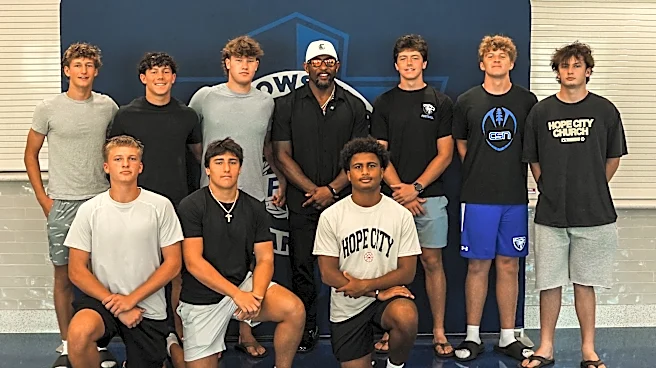
The Pro Football Hall of Famer spent part of Saturday, Aug. 22, at the Community School of Naples, talking with coaches, players and teachers before later addressing a smaller audience on campus during a Fellowship of Christian Athletes event.

“I'd do this the rest of my life for free,” Lewis told USA TODAY Sports. “I want to see a young man that says, ‘I get it.’ A few of these kids came to me later (today) and said, ‘I’m really struggling.’ And they will never tell nobody else that. But you expose who you are. That’s why I always give them my weaknesses. If you know my weaknesses, then you can appreciate my strengths.
“But if you don’t know where I came from, then you’re just gonna look at me as, ‘Oh my gosh, you’re Ray Lewis.’ A lot comes with that. That’s why I come to schools like this; it’s a bonus. It’s what I live my life with. Making the transition of losing my child, every time I take one of these boys' hands, I’m blessing somebody else.”
Lewis shared plenty of stories about his past. His mother was 15 when she had him. He grew up without his biological father and watched his mother struggle to provide for him and his siblings.

The Hall of Famer didn't just listen to those coaches. He absorbed them.
Football wasn't initially an option because his family couldn't afford the $15 required to play. He went to practices anyway, sitting outside the gate and crying because he couldn't join the other players.
Then, in 1985, a coach approached him and asked why he wasn't playing. Lewis told him.
The coach went to his mother. After a three-hour conversation, Lewis got his chance.
That coach became one of the people Lewis still credits with changing his life. So did the coaches who followed.
Every coach Lewis had from high school and college remains in his phone. He still talks to them and sends them annual Father's Day messages. Three of them attended his Hall of Fame ceremony.

He didn't just listen to those coaches. He absorbed them.
He asked questions about drills and technique, often using the car rides home to understand why his coaches directed him to do something a certain way.
Looking back, Lewis believes his childhood circumstances made him more willing to learn from those men.
“I recognized them (at my Hall of Fame) because they gave me the leadership that my father wasn’t around to give me,” Lewis said. “... Every one of my coaches gave me that. All leadership, all fatherhood, all discipline, all responsibility, all integrity, all the character.”
That experience shaped the way Lewis thinks about coaching. It's also part of why he has become so focused on what happens to young people away from the football field.

'You'll check their surgery history. But you won't check their minds.'
Lewis has partnered with Baltimore County Public Schools on a program focused on students' mental and emotional well-being. Launched in March, the pilot mental health screening program is set to enter its first full school year in Baltimore, with hopes of expanding the initiative statewide.
The work has taken on added meaning for Lewis following the loss of his eldest son in 2023, and he often speaks to kids about the importance of not being afraid to be vulnerable.
“You check their 40 (time), you check their hips,” Lewis said. “You'll check their surgery history. But you won't check their minds.”
He talked at CSN about how difficult it is for many young people to open up, particularly in a world where social media can make perception feel more important than reality. When young people know somebody genuinely cares about them, they're often willing to say things they have been holding inside.
Benjamin Reseau was one of them.

The impact of Lewis' journey
Hearing Lewis' story didn't feel like listening to a distant NFL legend recount Reseau's childhood. He saw parts of his own life in it.
Lewis talked about growing up without his father. Reseau lost his father to coronavirus during the pandemic. Lewis talked about his relationship with his mother, who he has described as his best friend. Reseau shares the same sentiment.
“I saw a connection in a lot of his characteristics and a lot of the things he's done over his life,” Reseau said.
That connection made Lewis' message more personal.

Reseau previously struggled to open up about his own experiences, in part because he was afraid of being judged. Coming to CSN, where many students had grown up in circumstances far different from his own, made it difficult at times to explain what he had been through.
Over time though, he learned that keeping things inside wasn't helping. So when Lewis spoke, Reseau listened.
“I just thought today, something just told me to speak up,” Reseau said. “I had to.”
Lewis made sure to talk to Reseau after the discussion, and the two exchanged phone numbers.
"No one I've coached has handled so much adversity with grace," CSN football coach Jonah Dubinski said of Reseau.
For Dubinski, that was part of the challenge Lewis was addressing.
“We have kids on both extremes socioeconomically and culturally, and how do you reach those different kinds of kids with the same message?” Dubinski said. “And Ray’s advice there was fantastic. Get away from results-driven analysis of performance and be process- and structure-oriented.
“That's dead on. You listen to (Nick) Saban, you listen to Ray Lewis, you listen to everyone who's done it at a high level. It's process-oriented.”

Beyond a simple photo op with an NFL legend
That philosophy extends beyond football for Dubinski. CSN's goal is to develop young men and women first, trusting that the results on the field will follow. That's part of why having Lewis in the building carried more weight than simply showing the players a video or playing a motivational speech.
“A lot of what he said today, you can piece together from the hundreds of videos out there,” Dubinski said. “But it impacted me differently. It certainly impacted the kids differently.”
Two parts of Lewis' message particularly stuck with Reseau: hearing Lewis talk about losing his son and hearing him discuss the relationships he has maintained with his coaches.
Reseau said he already tries to maintain those relationships with his own coaches beyond football.
“I always try to make sure I'm connected with everybody on another level, like a relationship type,” Reseau said. “Always try to leave a good footprint for myself, for everybody.”
Lewis left the players with another piece of advice:
“Stop asking for the picture,” he said. “Ask for knowledge.”
Follow Sports Reporter Alex Martin on X at @NP_AlexMartin or via email: amartin@usatodayco.com. For additional high school sports coverage, be sure to follow USA TODAY High School Sports on Instagram and X.
This article originally appeared on USA TODAY: NFL legend Ray Lewis brings more than just a photo op for one Florida school