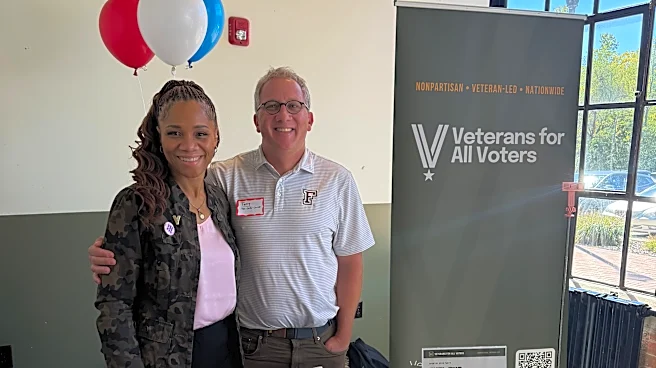


Terry Hoverter spent decades as a nonpartisan observer monitoring elections in Nepal, Sri Lanka, Tanzania, Armenia, Zanzibar and many other countries. He's worked on elections, democracy and human rights in more than 70 nations – and even helped write constitutions and election laws.
Nonpartisan election observers like Hoverter are trusted worldwide to assess whether elections are conducted according to laws and procedures.
Now Hoverter, 52, and other seasoned election observers from around the world are working with the Carter Center Democracy Program. They are training hundreds of Americans to do the same election observation work in Georgia, Michigan, Montana, Nevada and New Mexico ahead of the 2026 elections. The Carter Center, which has conducted
more than 125 election observation missions since 1989, typically focuses on countries emerging from conflict or showing signs of democratic backsliding.
Hoverter said he expects to have 200 election observers in 15 Michigan counties spread across the state.
"I never thought I'd be doing it in my own country, if I can be honest," he told USA TODAY. "I felt like we are at a point in our history that is critical and I thought, if I'm really living what my professional compass has been, it's important to not ignore the fault lines that I'm seeing in this country right now."

The Carter Center – which has decades of experience observing international elections – is preparing to give Americans a nonpartisan report on the accuracy and trustworthiness of the midterm election results. The timing is pivotal. This November, control of both chambers of Congress is at stake, as is what President Donald Trump can accomplish in his final two years in office.
After trying to overturn the results of the 2020 election, Trump is again making unsubstantiated claims about the security of the 2026 midterms. For 18 months, he has harnessed the power of the federal government to seek unprecedented control over how states run elections.
In a Sept. 28 interview with Time magazine, he refused to rule out declaring a national security emergency in the final weeks of the election or invoking the Insurrection Act, which allows the president to deploy the military on U.S. soil to suppress civil disturbances.
For the first time in decades, the administration did not invite foreign-based observers with the Organization for Security and Co-operation in Europe to monitor the election. The United States is a founding member of the organization and in 1990 signed onto an agreement to invite foreign and domestic observers to monitor national elections, according to the organization's Office for Democratic Institutions and Human Rights and Parliamentary Assembly.
“We regret that we will not be able to continue this work during the upcoming mid-term elections,” Maria Telalian, who leads the office, said in a statement. “Election observation is not a judgment on a country or its institutions. It provides voters, election administrators, contestants and the wider public with an independent and objective assessment of the electoral process.”
Trump invited the organization during his first term. Asked why the group was not invited this year, White House spokeswoman Lauren Bis said: "No other nation has done more to advance the cause of human freedom and representative government. American elections will be administered, participated in, and observed by American citizens."
The Carter Center Democracy Program has slowly expanded the domestic election observation efforts it began in 2020. That year, it decided it needed to begin observing U.S. elections after watching voting disruptions caused by the pandemic, the narrative from Trump and others about not trusting election results and the Black Lives Matter social upheaval, according to its director, Avery Davis-Roberts.
“We looked at that situation and sort of asked ourselves, 'If we were seeing this in other countries where we’ve worked, what would the Carter Center do? Would we act?’” Davis-Roberts said.
The Jan. 6, 2021, insurrection at the Capitol and ongoing claims by Trump and the MAGA movement about election security confirmed for the center that it needs to continue focusing on voting at home as well as abroad, she said.

The U.S. Constitution gives states authority over election administration, and thus the rules vary by state and in some places by county. Many states allow poll watchers representing political parties to be present, but few explicitly allow for nonpartisan observers.
What the Carter Center observers will be allowed to monitor varies by state. In Nevada, they can monitor early voting. In Georgia, they can view tabulation and accuracy testing, which ensures the election and voting equipment function accurately.
In other states, they'll observe Election Day operations and watch as ballots are processed that night and in the days after. Some will monitor the tabulation and county canvassing states do to ensure the results were accurate in the weeks after Election Day.

Davis-Roberts said states were selected in part based on where election observers are allowed. But they also considered a balance of political preferences and demographics and whether people vote by mail or in person. In Montana and New Mexico, they want to examine the experience of Native American voters.
For decades, the United States and other major developed countries have monitored elections in emerging democracies. The presence of organizations such as the Carter Center is pervasive enough that voters expect to see them.
While nonpartisan election observation is common internationally, it remains relatively rare in the United States, where voters are more accustomed to partisan poll watchers and advocacy groups.
"We don’t have what we see in most other countries in the world, which is nonpartisan election observation that’s really focused on understanding how the process works and providing transparency on the process itself,” Davis-Roberts said. In the United States, she added, “there was almost a gap where the election administration process needed its own champion. We felt that nonpartisan observation could fill that role.”
Nicole Rowsell considered the rhetoric around the 2020 presidential election and what else was taking place in the country and decided it was time to come home after 20 years overseeing elections and democracy overseas.
"It, for me, raised questions about my own responsibility as an American to try and contribute at home," Rowsell told USA TODAY.
Rowsell, 49, who had observed elections in the Middle East, Africa and Eastern Europe, now leads the Montana Election Observation Initiative. The initiative has partnered with the University of Montana's Mansfield Center and the Carter Center to train nonpartisan observers across the state.
Rowsell is recruiting up to 400 Montanans in 20 counties to observe the process before, during and after Election Day. She's hoping this will help people better understand how their own elections work.
"They're going to go home to their families and their communities and talk about what they did all day – probably how bored they were," she said. "But their ability to understand a very complex process and to share that with people in their community is extremely important."
This article originally appeared on USA TODAY: Citizens step up to monitor U.S. election integrity