



When a collapse of ice, water and rock hurtled 60 miles down a mountain river in Nepal in late August, it shocked the world with its deadly force and devastation.
But scientists who study remote alpine peaks and valleys say the event underscores the dramatic changes happening across the world's mountain ranges. Alpine environments are being transformed as global temperatures rise, disrupting glaciers, ecosystems, water resources and people.
In the Himalayas, Alps, Andes and Rockies, studies show snowpack and glaciers are declining in volume and plantsand wildlife are shifting in response.
"Plant ranges are shifting up the mountain, which means the highest elevation plants may not have anywhere to go because there's no more mountain at the top,"
said Robbie Hart, an ethnobotanist and vice president for plants and people at the Missouri Botanical Garden.
Mountain meadows that for centuries supported grazing for llamas, yaks or cows and plants for food and medicine are changing, Hart said, raising concerns about the preservation of cultures, sacred landscapes and local economies.
Warming is "destabilizing these highly unstable environments called mountains," Alton Byers, faculty research scientist at the Institute of Arctic and Alpine Research at the University of Colorado Boulder, told USA TODAY.
Scientists haven't yet definitively concluded whether climate change is directly responsible for the glacier collapse in the Himalayas. That investigation continues, but many scientists expect it to conclude that climate change played at least an indirect role after a summer that was among the warmest on record.

Mountain ranges worldwide are facing “the same sorts of pressures,” whether they are in Europe, North or South America or Asia, Hart said. In many cases, these mountain landscapes are vital to farmers and others who depend on them for their livelihoods, he said, using them for pastures and collecting plants for food, medicine and cultural reasons.
"What we see is disruption to these unique, very special alpine environments," he said. "These mountaintops are warming."
Summer heat is helping to reshape the Swiss Alps, the Swiss Academy of Sciences said in late September, announcing the country's glaciers lost more than 5% of their volume over the past year and nearly 20% over five years.
"We've seen the disappearance of several small glaciers, and extreme losses at other ones," Matthias Huss, a glaciologist with ETH Zurich and head of the Swiss Glacier Monitoring Network, told USA TODAY. Heat and drought across Europe this summer showed "how critical the situation has become," Huss said.
Glacier loss in the United States
In western North America and Alaska, rates of glacier mass loss are among the highest on Earth, the U.S. Geological Survey has reported. A study published in Nature’s “Scientific Reports” in March reported that nine North American glaciers where baseline measurements have been taken since 1957 have shrunk an average of 33% and collectively lost a cumulative total of 1.5 billion tons of fresh water.
The West Gulkana glacier in Alaska's Delta Mountains lost the most volume, decreasing by roughly 87%. Only a third of the nine glaciers are forecast to remain in 2100, according to the study, which the authors wrote painted "a grim picture for the future generations observing glaciers in North America."
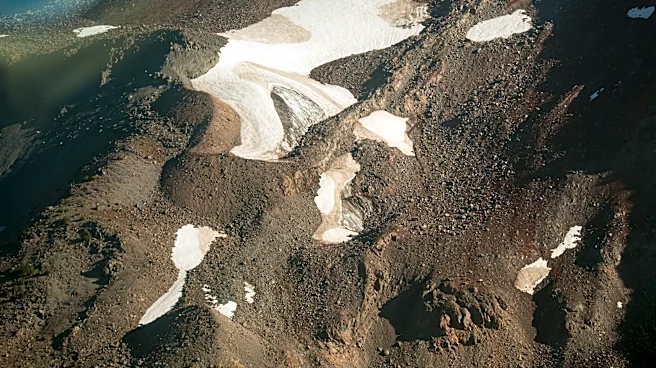
In Oregon, glaciers in the Three Sisters mountains in the Cascades provide water during the driest times of the year, reported the Statesman Journal, a USA TODAY Network publication. Yet glacier cover has been reduced by more than 50% in the Three Sisters, according to the Oregon Glaciers Institute. Glaciers vanished from Oregon's southern Cascades and Wallowa Mountains, and half of the state's named glaciers are expected to be gone before 2050.
Retreating glaciers threaten water resources, change landscapes
“Glaciers are just one small piece of [the] puzzle,” but their changes are easy for the public to understand, Huss said. As the glaciers get smaller, they lose the potential to contribute water in future drought periods, he said. Many regions of the world rely on snowpack and glaciers for water resources.
A study in the Andes, published in April 2025, reported melting glaciers and reduced water availability had led to widespread cascading impacts.
Hart is one of many scientists who collaborate in an international network tracking biodiversity across six continents, with a database of nearly 9,000 species of plants, including wildflowers, lichen and mosses. The Global Observation Research Initiative in Alpine Environments, or GLORIA, began in 2001 and includes 130 sites around the world, with 25 in the United States and five of those in the Rocky Mountains.
The international scientific collaborators in GLORIA "have this shared love of mountain environments," he said. “It gives me hope.”
Glacial retreat is fundamentally changing landscapes, exposing new ground in some cases, or making glacial lakes larger, Huss said, adding that it's "impressive how quickly the vegetation can resettle in moonscape-like environments."

Amid the plants moving higher on the mountains, Hart said it’s becoming more likely that other cold-adapted alpine plants will be lost.
International scientists with GLORIA published in Science in September 2026, concluding extinction rates in the resident plants on high mountaintops are rising with the magnitude of warming. Areas of plants above the tree line, the scientists said, face an accelerating loss of their most characteristic species.
Hart pointed to Glacier National Park in the U.S., where previous studies found several species growing at the southern limits of their geographic ranges are declining.

But it's not just plants that are being lost, as Hart was reminded on a research expedition near the region where the Nepal flood began. Returning to a plot in the Himalayas he had previously surveyed, the plot had “slipped off the side of the mountain."
“We were not able to resurvey it because it was not physically there anymore,” he said. “We thought of this as a permanent plot, but it actually was impermanent.”
Contributing: Zach Urness, Statesman Journal, USA TODAY Network
Dinah Voyles Pulver, a national correspondent for USA TODAY, covers climate change, violent weather and the environment, among other news. Reach her at dpulver@usatoday.com.
This article originally appeared on USA TODAY: Look up: Dramatic changes are happening on mountaintops