



Donald Trump was always heading out the door on Jan. 20, 2029. The midterm elections set the terms. He will leave office in defeat, leaving a party and a movement far worse off than he found them.
With no elections left to win, Trump has turned to building his legacy. He spent his first public appearance after the midterms showing off his White House ballroom under construction. In the days since, he has promoted his desired triumphal arch, blasted a judge for halting his golf course project and bragged about the White House’s restored columns and stonework. In his final act, we might see what Trump truly cares about, untainted by political ambition.
The question now is whether he can get it built before the courts and a Democratic Congress stop
him.
Trump's mind is on his White House ballroom

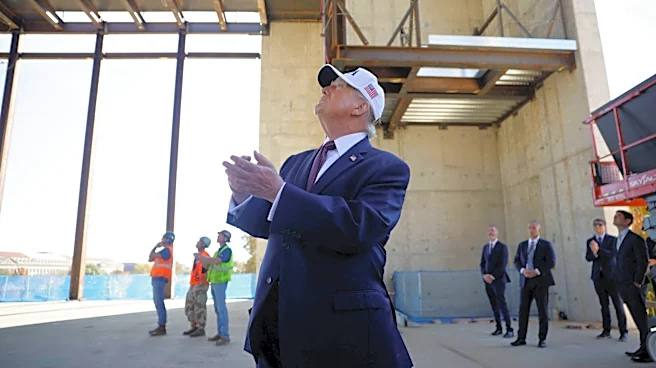
Plenty of people found Trump's behavior the day after the election funny, or just strange. While Republicans around the country conducted an initial autopsy on why they'd been demolished, or jockeyed for position ahead of the 2028 presidential race, Trump abruptly summoned reporters to the construction site of his ballroom so they could watch him sign its final steel beam.
“Our country is more successful right now than at any time in its history,” Trump said, then he broke off and pointed to the ceiling. “Watch the beam go up.”
Reporters stood by, eager to ask about the midterm elections from the night before.
Trump did his fair share of explaining away the losses. On election night, he posted on Truth Social that if he’d been on the ballot, “we would have won IN A LANDSLIDE!”
Still, Trump seemed a lot less interested in relitigating the results than in looking ahead to the rest of his presidency. He told The New York Times on election night that he'd look forward to working with Democrats, and that "we'll probably work something out."
That's something he has shown essentially no willingness to do so far. He also offered a reminder of how he sees the next two years: He has "total veto power, so they have to come to us."
Presidents often change their behavior after losing a second-term midterm.
“My job over the next couple of years is to do some practical, concrete things – as much as possible with Congress; where it’s not possible with Congress, on my own,” President Barack Obama said after Democrats’ heavy losses in 2014.
Obama turned his attention to his legacy after those losses, mostly through policy. But much of that policy depended on executive action. His signature immigration plan was blocked by a deadlocked Supreme Court in 2016.
President George W. Bush, by contrast, owned his party’s “thumping” in 2006. He said he shared “a large part of the responsibility” and promised to find common ground with the new Democratic majority, after years of mostly going it alone.
A physical legacy to make up for a weak policy one

Trump is less ideological than Bush or Obama, and certainly more self-centered. Beyond tariffs and immigration, he has never had much in the way of policy goals, and he cares a lot more about how he’s perceived than the century’s other two-term presidents.
Much of Trump’s agenda has come through executive orders and can be wiped away by the next president. His signature legislative achievement is the One Big Beautiful Bill Act, mostly an extension of his tax cuts. His other is three Supreme Court justices, two of whom he now attacks. Even his tariff agenda, aimed at restructuring the U.S. economy and done entirely through executive action, was largely struck down by that court.
What Trump has been obsessed with throughout his second term is building a physical legacy: the ballroom, a triumphal arch and a redone golf course. The ballroom is a lasting mark he can point to as something he tangibly changed. Much of this has also been done without congressional approval, but a future president is far less likely to spend money tearing down a building out of spite than to undo a policy with the stroke of a pen.
"I'm doing it because the White House is the ultimate symbol of America," Trump said at the ballroom construction site. "And it's got to be pristine. It's got to be perfect."
The president wants to be remembered for adding something of value to America's most iconic building.
Trump will likely continue to focus on creating and restoring physical landmarks as the chief part of his legacy. Perhaps it’s not such a bad strategy.
As it stands, his governing legacy is one of turmoil and easy-to-overturn executive actions. Physical constructs, like his ballroom, at least leave something lasting that Americans can remember him by – if he can finish them before the courts and a Democratic Congress stop him.
Dace Potas, a law student, is an opinion columnist for USA TODAY. Follow him on X: @DacePotas
This article originally appeared on USA TODAY: Trump's legacy plan: Build it before they block it | Opinion