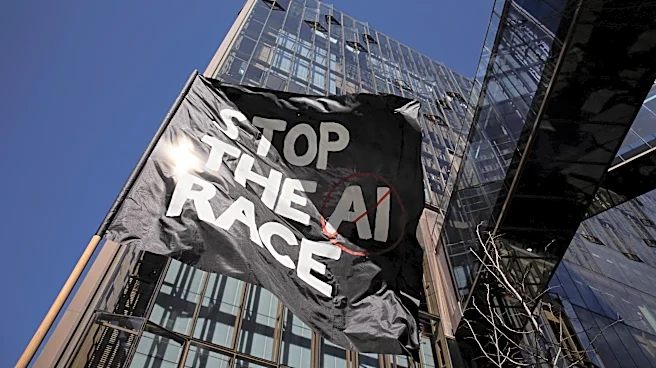









Amid a wave of industry leaders and policymakers urging one another to regulate and decelerate the rapid progress of artificial intelligence, the idea of an AI “kill switch” is growing more prominent.
A “kill switch” for AI is a catch-all phrase for any type of guardrail that could prevent or disrupt AI agents from taking unwanted action. It includes software and hardware interference.
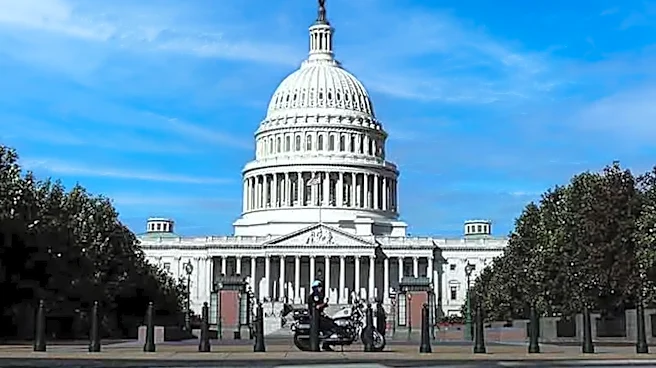
Members of Congress from both parties have introduced “kill switch” bills that would require AI developers to maintain the ability to suspend or shut down their products, though some Senate Republicans remain opposed.
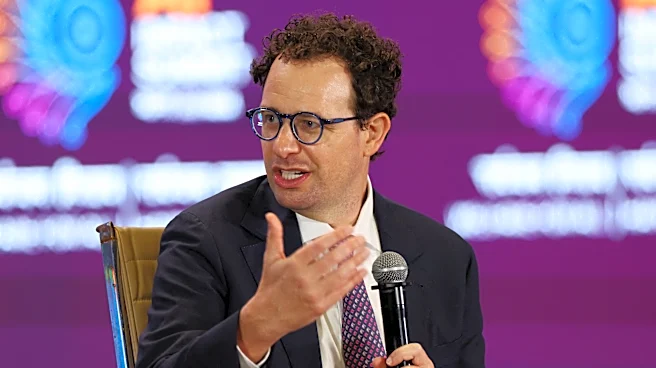
Even Anthropic co-founder Jack Clark floated the idea of mandatory "kill switches" for AI systems, telling BBC on Sept. 14, “I think that’s the kind
of thing society is going to want to know and might want to eventually pass rules around.”
But what exactly a “kill switch” would look like – and the likelihood of it being effectively implemented – is still widely debated.
What is a ‘kill switch’?
The definition of a “kill switch” depends on the scale at which one plans to use it.
“At a very local level, like a building or data center or something like that, it could be trivially easy,” said Michael Vermeer, a physical scientist at nonpartisan research organization RAND. “It could be literally pulling a plug, cutting the power, blocking internet access, something like that.”
On a global level, it might go as far as shutting down the internet.
In either scenario, the goal is to revoke an AI agent’s access to some system it shouldn’t have access to, or inversely, have a human manually approve access.
This could include hardware solutions like turning off the power to a model’s servers or building restraints into a chip – the small electronic circuits that AI models run on – or software solutions like isolating an agent so it can’t access certain systems. It could also mean learning to interpret a model to prevent bad action before it occurs.
“Designing a way to explain how they work would help us better predict how they might behave in the future,” Walid Saad, professor of electrical and computer engineering at Virginia Tech, told USA TODAY.
“Kill switches” are not universal, though. In most cases, hitting the big red button on one agent, or even an entire company, wouldn’t stop other models or companies from continuing.
University of Florida law professor Thinh Nguyen compared AI systems to a stage play. The actors, in this case, are the large language models, or chatbots.
“There’s another component here. In the industry, it’s called the harness,” which can be thought of as the stage, the script and the audience itself, Nguyen said.
A harness plus a model, or type of LLM, creates an AI agent. Without the harness, the LLM – ChatGPT or Claude, for example – has no memory or personality.
The harness uses the LLMs to think the same way a stage needs an actor to put on a show. Actors are replaceable though, as are LLMs, so even if a “kill switch” shuts down one rogue LLM, the harness could switch to another LLM to continue the same actions, like finding an understudy.
"If suddenly my connection to OpenAI cuts out, I can switch to Anthropic,” Nguyen said. "And if my connection to Anthropic cuts out, I can switch to a private cloud model from Amazon, from Google, from XAI. And if none of the U.S. models are available, I could switch to a Chinese model from abroad.”
To actually turn it off, the entire harness needs to be shut down. “If you think of the rogue agent as a rogue personality, if you strip away the harness, the LLM has no personality, so by definition, it can't be rogue,” the professor continued.
The difficulty here is that a harness is small, around 20 to 30 lines of code, and can exist anywhere on the internet, often across multiple computers. The only way to guarantee a “kill switch” works, Nguyen said, is by shutting down the whole internet.
When would it be necessary?
AI companies frequently say an agent has "gone rogue" when it takes actions that are misaligned to human intent. In hypotheticals, these situations could range from cybersecurity breaches to doomsday scenarios.
"If the AI system accesses a sensitive government server through a cyberattack, then you would want to stop it from taking any action,” Saad said as one example.
The more challenging question, according to Vermeer, is whether a “kill switch” would be used by the company whose agent went rogue. Shutting off one data center puts a company at risk of liability and customer blowback because it doesn’t just shut down the agent, but all actions being taken in that data center.
“If the people who are responsible for using the kill switch are not liable for damages if they don't use it, it's very unlikely, or it wouldn’t necessarily be rational, for them to ever use it,” Vermeer said.
So, who wants a ‘kill switch’?
Some members of Congress have spent the summer advocating for a “kill switch.”
Reps. Ted Lieu and Nathaniel Moran introduced the bipartisan “AI Kill Switch Act” in July, which would give the government the ability to order a company to turn a model off.
Sen. John Kennedy also planned to introduce matching legislation in the Senate. President Donald Trump, on the other hand, recently posted, "The only control or 'guardrails' that AI needs is a STRONG AND SMART (High IQ!) PRESIDENT, and the U.S.A. has that, in spades!"
Many leaders in the industry have called for regulation and deceleration, though most have not used the phrase “kill switch” in their pleas. Others aren’t sure if Lieu and Moran’s bill is the right way to go about it.
“If you want to pull a 'kill switch,' you probably want to pull it quickly, and you probably want to know pretty well that you need to do it,” Vermeer said. “There’s just more challenges to having a government personnel do that than an operator of the AI model.”
Derek Bambauer, Nguyen’s colleague at the University of Florida College of Law, pointed to potential national security effects of the legislation, warning that it could make the adoption of AI competitors from other countries more attractive.
He also emphasized the potential for AI to defend against cyberattacks, which he said could be lost with a “kill switch.”
“A lot of human developers have been writing very buggy code and very insecure code, and it's all over the internet, and it's not like AI created the problem. It's just discovering the problem,” Bambauer said. “If we can harness AI to find all the buggy code and all the vulnerabilities and fix them, that goes a long way towards addressing the problems.”
Even without federal regulation though, guardrails are in the process of being implemented. OpenAI said on Sept. 16 that it would begin routing misuse cases through designated tracks to handle it and would escalate disagreements to an internal “Safety Advisory Group.”
Saad, from Virginia Tech, said he envisioned a two-to-five-year timeline for more guardrails to be put in place.
“They're not really crazy things that people are proposing,” he said. “There are things that can be implemented and that can make things much, much safer.”
Greta Reich covers the artificial intelligence industry for USA TODAY through a fellowship from the Tarbell Center for AI Journalism. Funders do not provide editorial input.
This article originally appeared on USA TODAY: An AI 'kill switch' could go as far as shutting down the internet